01. Edit your maryland unclaimed property claim form online
Type text, add images, blackout confidential details, add comments, highlights and more.

Type text, add images, blackout confidential details, add comments, highlights and more.

Draw your signature, type it, upload its image, or use your mobile device as a signature pad.

Send it via email, link, or fax. You can also download it, export it or print it out.
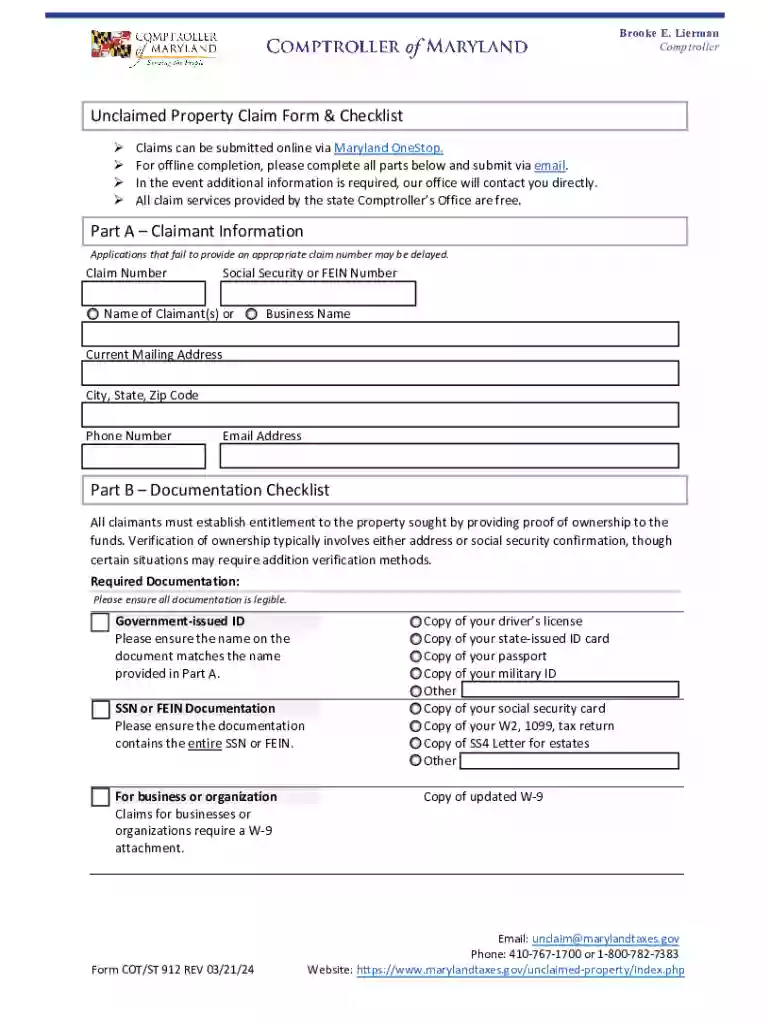
The COT-ST912 form is a crucial document designed for individuals and businesses seeking to claim unclaimed property in the United States. This form, issued by the Maryland Comptroller's Office, serves as a formal request to reclaim property that has been lost or left unaddressed over a period. The unclaimed property could range from forgotten bank accounts and uncashed checks to stocks, bonds, or even the contents of safety deposit boxes. The form ensures that rightful owners can provide necessary information and documentation to prove their ownership and reclaim their assets.
To obtain the COT-ST912 form, individuals can visit the Maryland Comptroller's Office official website. The form is typically available for download in PDF format, making it easily accessible for both printing and digital filling. Alternatively, individuals may request a physical copy by contacting the Comptroller's Office via mail or phone. These options ensure that all potential claimants have access to the form irrespective of their preferred method of communication.
Personal Information: Begin by entering personal details such as full name, address, and contact information.
Property Details: Provide detailed descriptions of the unclaimed property, including account numbers or identifiers, and the associated institution, such as a bank or utility company.
Proof of Ownership: Attach required documents proving ownership, like previous account statements or past correspondence with the institution.
Signature and Date: Sign and date the form to verify the information’s authenticity.
Submission: Review all filled information for accuracy before submitting the form, either through mail, email, or during an in-person visit to the Comptroller's Office.
Using the COT-ST912 form is essential for anyone who wishes to reclaim unclaimed property under their name. This form provides a structured method to formally declare and prove ownership rights, ensuring that rightful owners can retrieve their assets efficiently. It reduces the likelihood of fraud and protects the interests of property owners through a legitimate process.
Besides individuals, businesses often need to use the COT-ST912 form to recover corporate assets. Common users include small businesses, large corporations, estate executors, financial institutions, and legal representatives acting on behalf of property owners.
Claimants must provide essential documents when submitting the COT-ST912 form. These typically include:
The legal use of the COT-ST912 form is bound by state regulations aimed at the rightful return of unclaimed property. The form complies with state-specific laws and requirements, ensuring legally enforceable claims. It’s important for claimants to understand these legal frameworks, which include deadlines for claim submissions and the statute of limitations on claims.
The COT-ST912 form is typically used in scenarios such as moving to a new state and leaving behind a forgotten bank account, inheriting an estate with undisclosed assets, or businesses recovering overpaid vendor funds. Each instance provides a unique backdrop for the application of this form, highlighting its versatility in addressing varied unclaimed property situations.
We've got more versions of the maryland unclaimed property claim form form. Select the right maryland unclaimed property claim form version from the list and start editing it straight away!
At DocHub, your data security is our priority. We follow HIPAA, SOC2, GDPR, and other standards, so you can work on your documents with confidence.