01. Edit your maryland w 4 withholding form online
Type text, add images, blackout confidential details, add comments, highlights and more.

Type text, add images, blackout confidential details, add comments, highlights and more.

Draw your signature, type it, upload its image, or use your mobile device as a signature pad.

Send maryland w 4 form via email, link, or fax. You can also download it, export it or print it out.
The I-9 Confirmation Tax Residency Status Form is a critical document used to verify an individual's employment eligibility in the United States. It ensures that employees are authorized to work and that they comply with U.S. tax residency requirements. This form plays a significant role in confirming the legal status of workers and aligning their tax obligations under federal guidelines. For employers, collecting and maintaining a completed I-9 Form is essential to demonstrate compliance with immigration and tax laws.
Employers and employees alike must engage with the I-9 Form actively. Employers should provide the form to newly hired employees, who must complete it by the first day of employment. Employers then review the documentation provided by the employee within three business days to verify identity and work authorization. Accurate completion and verification prevent future legal complications and ensure seamless workforce management.
Filling out the I-9 Form involves a straightforward yet crucial process. Here is a step-by-step breakdown:
Employee Information and Attestation: Employees complete Section 1, entering personal details such as name, address, date of birth, and Social Security number, followed by a signature.
Employment Authorization Documentation Review: Employers must inspect original documents provided by the employee. Examples include a U.S. passport, permanent resident card, or employment authorization document.
Employer Certification: The employer fills out Section 2, certifying the validity of documents reviewed and their congruity with employment records.
Reverification of Employment Authorization: For employees with temporary work authorization, make a note of expiration dates for periodic review and re-verification.
Completing the I-9 Form necessitates specific documents to verify identity and employment eligibility. There are three lists of acceptable documents, and employees must present:
The I-9 Form serves as a legal instrument to prevent unauthorized employment within the U.S. By accurately verifying work eligibility, employers comply with the Immigration Reform and Control Act (IRCA). Maintaining up-to-date and accurately filled forms can shield businesses from potential audits and legal penalties.
Non-compliance with I-9 requirements can lead to severe consequences for businesses. Potential penalties include fines, sanctions, and other legal repercussions.
The I-9 Form can be completed using either digital or paper formats. Many companies prefer digital formats for ease of storage and compliance tracking.
The I-9 Form is issued by the U.S. Citizenship and Immigration Services (USCIS), a component of the Department of Homeland Security. This agency is responsible for enforcing immigration laws and providing guidelines regarding employment eligibility verification. Employers and employees must adhere to the standards set by USCIS for legal compliance.
Ensure to follow USCIS updates regularly to remain informed about any changes in the form or its usage requirements.
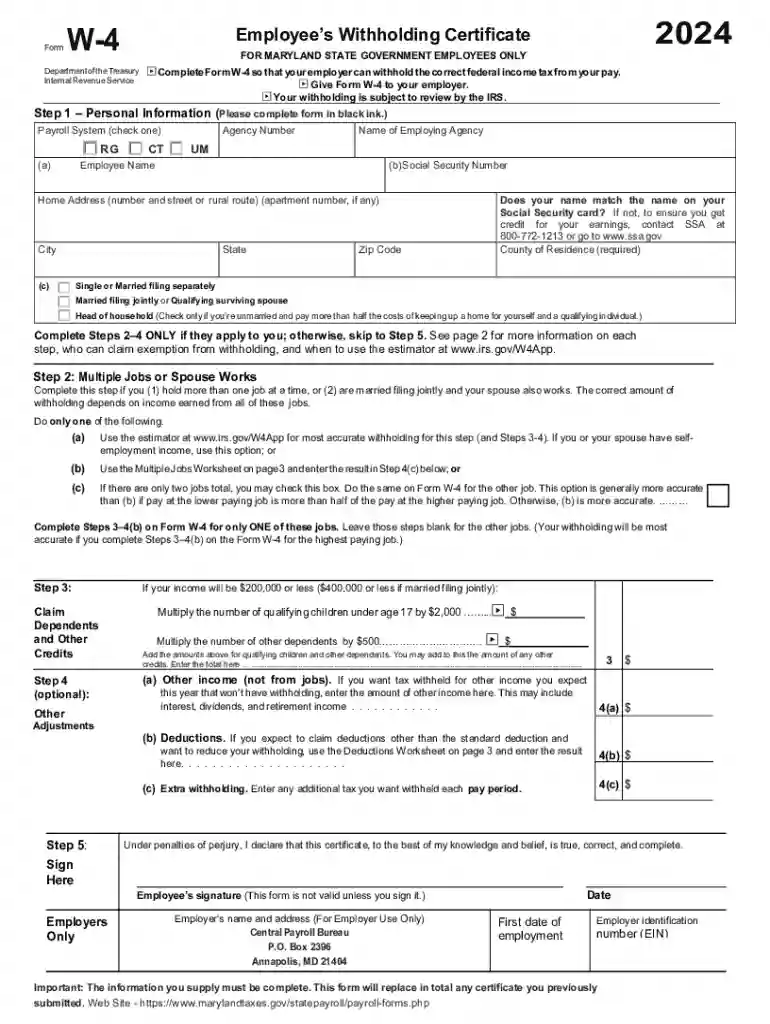
We've got more versions of the maryland w 4 withholding form form. Select the right maryland w 4 withholding form version from the list and start editing it straight away!
At DocHub, your data security is our priority. We follow HIPAA, SOC2, GDPR, and other standards, so you can work on your documents with confidence.