Definition and Purpose of the 2010 Universal Credit Application Form
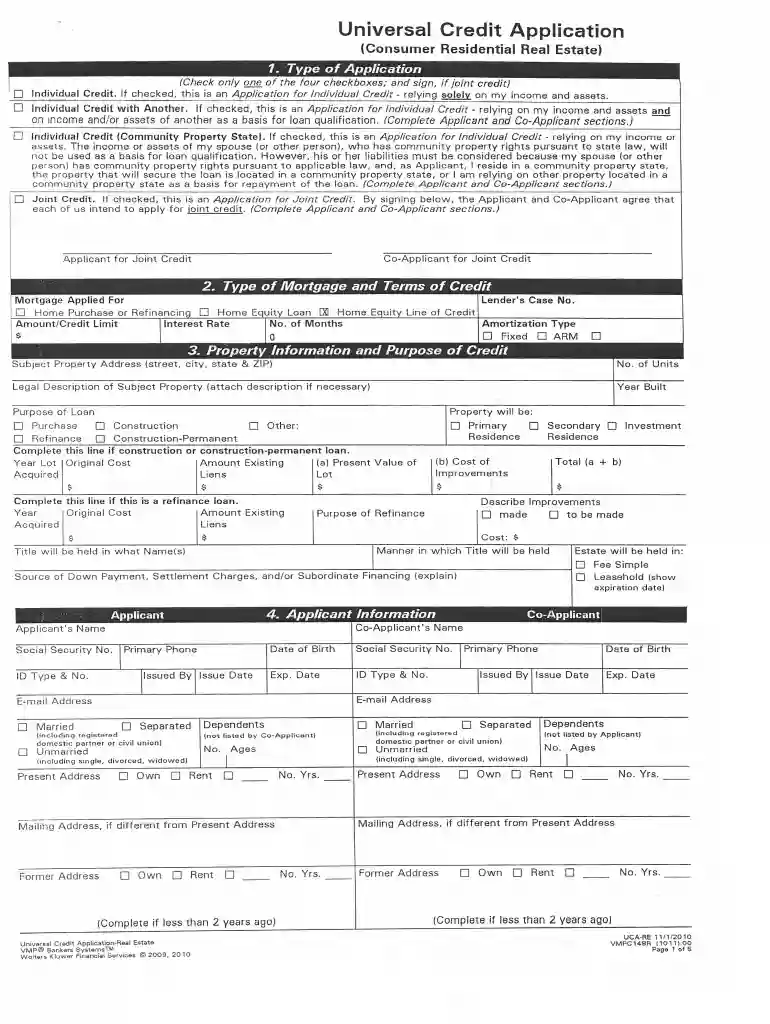
The 2010 Universal Credit Application Form is a comprehensive document used primarily for residential real estate credit applications in the United States. It serves as a standardized tool for collecting detailed information about the applicant(s) seeking to obtain credit, whether for a home purchase, refinancing, or home equity loan. The form covers a wide array of data points, including personal identification, financial history, and loan details, facilitating the credit assessment process by lenders.
- Types of Applications: The form accommodates different types of credit applications, such as individual, joint, and those involving community property.
- Comprehensive Information: It requires inputs on applicant details, employment, assets and liabilities, and declarations affecting creditworthiness.
- Legal Notices: Applicants are informed of federal and state notices concerning their rights and responsibilities.
How to Use the 2010 Universal Credit Application Form
Using the 2010 Universal Credit Application Form involves a meticulous process to ensure that all necessary data is meticulously captured. It is structured to guide applicants through the provision of essential information required for a credit application.
- Acquire the Form: Obtain the form from a lender or a downloadable version from a financial institution’s website.
- Gather Information: Collect necessary documents and details concerning income, employment, and financial obligations.
- Fill Personal Information: Complete the sections related to the applicant's name, address, Social Security number, and contact details.
- Include Co-applicant Details: If applicable, provide co-applicant information and ensure all shared obligations are acknowledged.
- Review and Submit: After completing the form, review all entries for accuracy before submission.
Steps to Complete the 2010 Universal Credit Application Form
Completing the 2010 Universal Credit Application Form requires attention to detail. Each section serves a specific purpose, helping lenders assess creditworthiness.
- Applicant Information: Start with the personal details section, offering information such as legal name, marital status, and dependents.
- Employment Details: Provide current and past employment information, including employer name, tenure, and income.
- Assets and Liabilities: Enumerate all assets, including savings accounts and real estate, alongside liabilities like credit card debt.
- Declarations: Disclose any pertinent financial declarations, such as bankruptcy or legal judgments.
- Agreement Section: Read and sign the agreement section, thereby confirming all information is truthful and complete.
Key Elements of the 2010 Universal Credit Application Form
Several critical components form the backbone of the 2010 Universal Credit Application Form, ensuring it serves its intended purpose effectively.
Essential Sections
- Applicant and Co-applicant Profiles: Gathering comprehensive personal data for accurate identity and credit evaluation.
- Income Details: Capturing stable sources of income is vital for evaluating repayment capacity.
- Liabilities and Obligations: Understanding existing debts to calculate the applicant's financial leverage.
- Property Information: Details on the property in question, if applicable, including its address and intended use.
Additional Features
- Signature Blocks: Spaces provided to secure agreement to the form's terms and conditions.
- Federal and State Notices: Alerts and compliance statements as required by law.
Legal Use of the 2010 Universal Credit Application Form
Ensuring the 2010 Universal Credit Application Form's legal validity is crucial for both lenders and applicants. It protects both parties by clearly defining responsibilities and commitments.
- Compliance with Laws: The form aligns with federal standards, such as the Fair Credit Reporting Act, ensuring legal integrity.
- Data Privacy: Compliance with privacy regulations is maintained, safeguarding personal and financial data.
- Dispute Resolution: Provides guidelines for addressing inaccuracies or disputes over the credit application process.
State-Specific Rules for the 2010 Universal Credit Application Form
While the form adheres to federal guidelines, state-specific variations can affect certain aspects of its use.
- Community Property States: Requirements may differ, elucidating joint financial responsibilities.
- State Notices: Particular states may mandate additional disclosures or agreements within the form.
- Property Tax Regulations: Varies across states, potentially impacting lending criteria and form requirements.
Eligibility Criteria for the 2010 Universal Credit Application Form
Determining eligibility involves evaluating whether applicants meet the necessary conditions to apply for credit using this form.

- Creditworthiness: Lenders typically require a minimum credit score for approval.
- Income Stability: Demonstrable steady income is usually a prerequisite.
- Financial History: A clean financial history without recent defaults enhances eligibility.
Required Documents for the 2010 Universal Credit Application Form
Documentation is vital in substantiating the information provided in the form and enhancing the application’s credibility.
- Identification: Copies of government-issued IDs to verify identity.
- Proof of Income: Pay stubs, tax returns, or bank statements.
- Asset Verification: Title to real estate, vehicle registration, savings account statements.
- Liability Documentation: Credit card statements and signature loans.
Through thorough completion and submission of the 2010 Universal Credit Application Form, applicants can efficiently navigate the credit application process, providing all necessary information for lender evaluation.