




01. Edit your form online
Type text, add images, blackout confidential details, add comments, highlights and more.

Type text, add images, blackout confidential details, add comments, highlights and more.

Draw your signature, type it, upload its image, or use your mobile device as a signature pad.

Send it via email, link, or fax. You can also download it, export it or print it out.
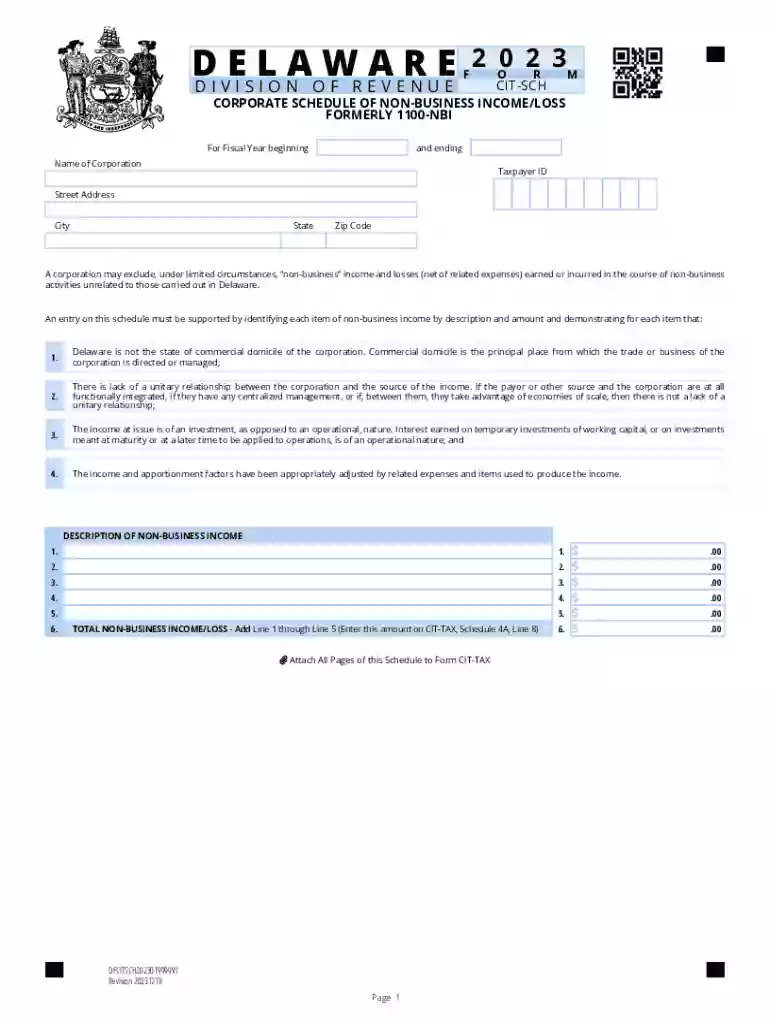
The CIT-SCH Corporate Schedule of Non-Business Income Loss is a critical document used by corporations to report and manage non-business income and losses. This form allows companies to separate their non-business financial activities from their primary business operations, which is essential for correct tax reporting. Understanding the specific terminology associated with this form can help corporations effectively classify their income and losses. Non-business income can include earnings from investments, dividends, royalties, or any income not directly connected to the core business operations. Accurately completing this form is crucial as it ensures that corporations only report and pay taxes on their business-related income in jurisdictions like Delaware.
Corporations use the CIT-SCH Corporate Schedule of Non-Business Income Loss to delineate between business and non-business finances accurately. This differentiation is vital for tax purposes, as each category may be subjected to different tax treatments. Companies can benefit from knowing how to efficiently document income and losses on this form to ensure compliance and optimize tax liabilities. Additionally, attaching relevant documentation supporting the status of income as non-business is necessary, such as explanation letters or contracts showing income source details.
Identify Non-Business Income: Start by distinguishing non-business income from regular business income.
Document Support: Collect all required documentation that justifies classifying the income as non-business.
Complete the Form: Fill out the CIT-SCH form accurately with all identified income and related documentation.
Review Details: Double-check all entries for accuracy to prevent discrepancies.
Submit with Tax Filing: Attach this completed schedule to the corporate tax return for final submission.
A comprehensive understanding of specific terms can aid in accurately completing the CIT-SCH form:
Filling out the CIT-SCH form requires careful attention to detail and adherence to specific steps:
Gather All Relevant Documentation: Before attempting to fill out the form, ensure that all supporting documents are on hand.
Categorize Income: Identify and categorize each source of non-business income and corresponding losses.
Complete Income/Expense Sections: Enter the total income and loss amounts in the respective sections on the form.
Attach Documentation: Affix all necessary proof and additional details that validate the categorization of income as non-business.
Review for Compliance: Verify that the completed form meets all regulatory requirements before submission.
Compliance with the CIT-SCH reporting depends heavily on the availability and accuracy of specific documents:
This form is predominantly used by corporations with diversified income streams, especially those that operate in multiple states where separating business and non-business profits is legally mandated. It is particularly relevant for:


The legal implications of using the CIT-SCH form extend to ensuring the just distribution of tax obligations. Accurately declaring non-business income allows corporations to remain within legal bounds, avoiding penalties associated with inappropriate income reporting. Moreover, adherence to the CIT-SCH’s legal framework aids in complying with state-specific tax laws, primarily when corporations engage in activities across different jurisdictions.
Key components that require focus when completing this form include:
We've got more versions of the CIT-SCH Corporate Schedule of Non-Business Income Loss form. Select the right CIT-SCH Corporate Schedule of Non-Business Income Loss version from the list and start editing it straight away!
| Versions | Form popularity | Fillable & printable |
|---|---|---|
| 2023 | 4.3 Satisfied (49 Votes) |
At DocHub, your data security is our priority. We follow HIPAA, SOC2, GDPR, and other standards, so you can work on your documents with confidence.



CIT-SCH Corporate Schedule of Non-Business Income/Loss. NOL Corporate Schedule Net Operating Loss Worksheet. Calendar Year 2025 and Fiscal Year Ending 2026
In computing the Florida corporate income tax, a deduction for the NOL carryover will be allowed to the extent of the amount allowed for federal purposes,Read more


