







Definition & Meaning
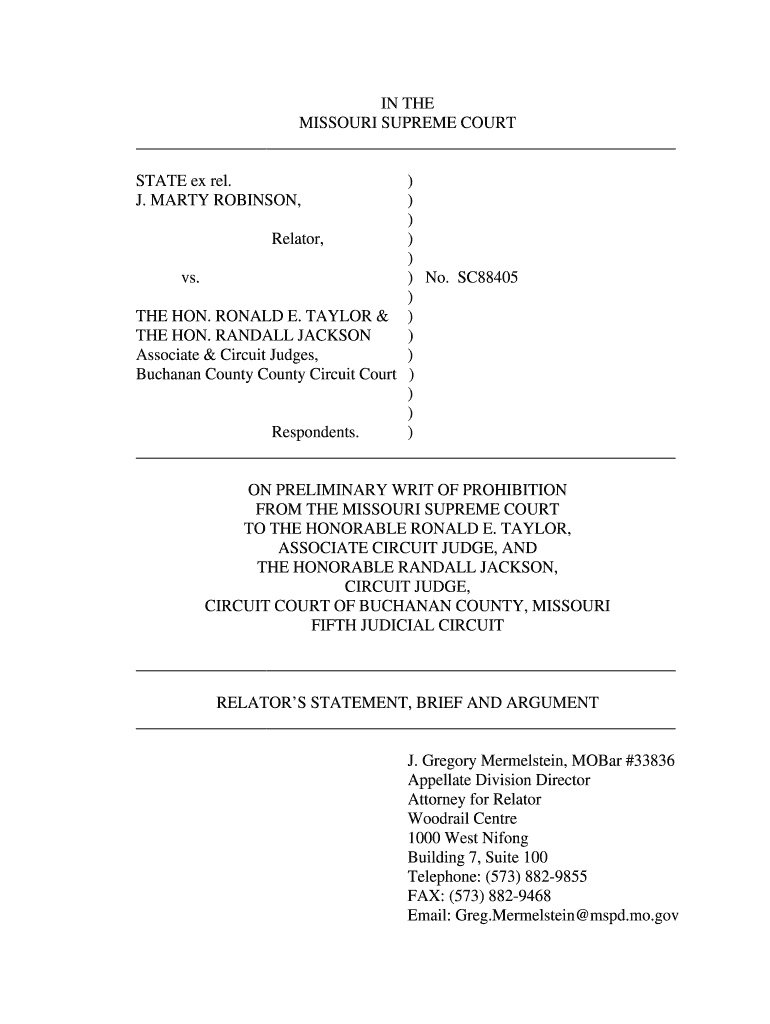
The "IN THE MISSOURI SUPREME COURT STATE ex rel ) J MARTY R" refers to a legal brief filed within the Missouri Supreme Court. This document is submitted by J. Marty Robinson, the Director of the Missouri Public Defender System. A writ of prohibition is being sought against Judges Ronald E. Taylor and Randall Jackson. The central contention is regarding the appointment of a public defender for Heather Rich, who previously retained private legal counsel, thus questioning eligibility for public defender representation under Missouri law.
Key Elements of the Form
The legal brief involves crucial components such as the request for a writ of prohibition, the eligibility criteria for public defender representation, and financial implications for taxpayers. It highlights the statutory constraints under Section 600.086.1 RSMo, questioning judicial authority and the obligations of private legal counsel under specific circumstances. These elements collectively form the basis of the arguments and provide a framework for interpreting legal responsibilities.
Eligibility Criteria
Eligibility for public defender services is a significant point of debate in the form. As defined under Section 600.086.1 RSMo, criteria typically focus on the financial inability to retain private counsel. For instance, Heather Rich's eligibility is in question because she previously hired Matthew O'Connor. This aspect draws on whether the defendant lacks financial means or if exceptional circumstances warrant public defender intervention, which has implications for case legitimacy and resource allocation.


Steps to Complete the Form
-
Draft the Legal Argument: The initial step involves preparing the legal argument highlighting the basis for seeking a writ of prohibition and the relevant legal statutes.
-
Collate Relevant Documents: Gather all necessary documents and evidence supporting the case, including prior legal representation contracts and financial declarations.
-
Specific Judicial References: Clearly reference applicable statutes like Section 600.086.1 RSMo to substantiate claims within the brief.
-
Submit to Missouri Supreme Court: File the completed form, adhering to the court's procedural requirements to initiate judicial review.
-
Await Court Instructions: Monitor communications from the court, which could include requests for additional information or scheduling of hearings.
Legal Use of the Form
The form serves to challenge judicial authority via a legal mechanism known as a writ of prohibition. It aims to prevent a lower court from overstepping jurisdictional boundaries or improperly applying the law. In this case, it questions the assignment of a public defender based on eligibility, ensuring judicious use of legal resources and adherence to statutory requirements.
Important Terms Related to the Form
-
Writ of Prohibition: A judicial order restraining a lower court or a public agency from exceeding its jurisdiction.
-
Public Defender: A government-appointed attorney assigned to represent individuals unable to afford private legal counsel.
-
Section 600.086.1 RSMo: Missouri statute defining conditions under which public defender services can be rendered.
-
Judicial Authority: The official power of a court to make legal decisions and judgments.
Examples of Using the Form
In practice, a similar form might be used when a public defender challenges the legitimacy of their appointment due to the defendant’s previous engagement with private counsel. For example, if a defendant transitions from private to public representation under dubious financial changes, this form could serve to rectify potential misuse of public resources, ensuring legal and fiscal accountability.
State-Specific Rules
Missouri’s legal provisions under Section 600.086.1 RSMo are particularly pertinent, as they delineate who qualifies for public defender services. These rules encapsulate the intricacies of evaluating financial incapacity, factoring in temporary financial hardships, existing litigation costs, and a defendant’s income and assets. Ensuring adherence to these state-specific criteria is crucial for the validity and success of filing such a form.
Penalties for Non-Compliance
Non-compliance with proper filing procedures or misrepresentation within the form can result in various repercussions. For example, the Missouri Supreme Court may dismiss the case or deny the writ of prohibition, leading to forced compliance with the lower court's orders. Additionally, there might be financial penalties or increased legal scrutiny, emphasizing the gravity of adherence to procedural and factual accuracy in legal proceedings.




