







Definition & Meaning
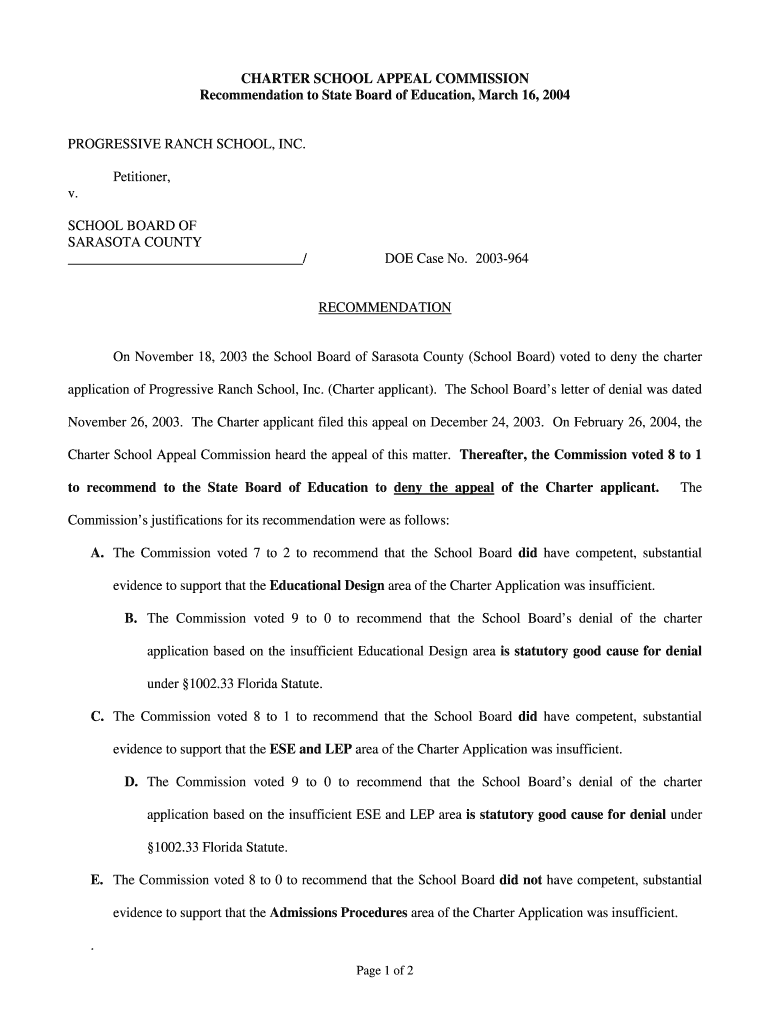
The Charter School Appeal Commission is a body under the Florida Department of Education tasked with reviewing appeals submitted by charter school applicants like Progressive Ranch School, Inc. The Commission evaluates whether the denial of a charter application by a local school board should be upheld or overturned. This process plays a crucial role in ensuring fairness and due process for applicants seeking to establish charter schools in Florida.
How to Use the Charter School Appeal Commission - Florida Department of Education
To utilize the Charter School Appeal Commission, an applicant must file an appeal following the denial of their charter application by a local school board, such as the Sarasota County School Board. The appeal involves submitting supporting documentation and evidence to counter the reasons for denial cited by the local board. The Commission then reviews these materials to make a recommendation to the State Board of Education.
Steps to Complete the Charter School Appeal Process
-
Prepare Documentation: Gather and organize all the necessary documents, including the initial charter application, any correspondence from the local school board, and additional materials addressing the areas of concern.
-
Submit the Appeal: File the appeal with the Florida Department of Education following the procedures and deadlines specified. Ensure all documents are complete and accurately represent the applicant's case.
-
Attend Meetings: Be prepared to attend any hearings or meetings scheduled by the Charter School Appeal Commission, where you may present your case and respond to questions.
-
Wait for Commission's Decision: The Commission will deliberate and provide a recommendation, which is then forwarded to the State Board of Education for the final decision.
Key Elements of the Charter School Appeal
-
Educational Design: Ensure the educational design matches the standards and expectations set by the state, addressing any identified gaps.
-
ESE and LEP Provisions: Demonstrate how the school will meet the needs of Exceptional Student Education and Limited English Proficient students effectively.
-
Performance Outcomes: Define clear, measurable performance outcomes that align with state educational objectives.
-
Reading Programs: Provide evidence of effective and research-backed reading programs responsive to diverse student needs.
Important Terms Related to Charter School Appeals
-
Statutory Good Cause: Refers to the legal basis for denying a charter application under Florida Statute §1002.33, which includes failing to meet specific educational criteria or standards.
-
ESE (Exceptional Student Education): Programs designed to support students with disabilities or special educational needs.
-
LEP (Limited English Proficient): Students who do not have English as their first language and require additional language support services to succeed academically.
State-Specific Rules for Appeals
The process of charter school appeals in Florida is governed by specific statutes and guidelines unique to the state. Applicants must navigate the legal framework outlined in Florida Statute §1002.33, which details the acceptable grounds for charter application denial and the procedure for appealing such decisions. Understanding these regulations is crucial for successfully navigating the appeal process.
Real-World Examples of Appeals
A notable case involved Progressive Ranch School, Inc., which appealed the Sarasota County School Board's denial of their application. Despite their efforts, the Charter School Appeal Commission recommended denial due to insufficient evidence in several critical areas. This case underscores the importance of addressing every aspect of an application thoroughly.
Legal Use of the Charter School Appeal Commission
Engaging with the Charter School Appeal Commission is a legally recognized process for contesting adverse decisions by a local school board. This option provides charter school applicants a structured and impartial venue to seek redress and ensure their proposed educational institutions meet state requirements while addressing concerns raised during the application review.
Application Process & Approval Time
The appeal process's timeline can vary, but applicants should expect to adhere to strict submission deadlines and prepare for potentially lengthy review periods. It is essential to track the appeal's progression through the Commission and be ready to respond promptly to any additional requests for information or clarification.
Penalties for Non-Compliance
Failure to comply with the appeal process's procedural requirements can result in dismissal of the appeal. This includes missing submission deadlines, failing to provide necessary documentation, or not attending scheduled meetings. Such non-compliance can prevent the reconsideration of the application and uphold the initial denial decision.
Form Submission Methods (Online / Mail / In-Person)
Appeals must be submitted through designated channels as outlined by the Florida Department of Education. The submission process typically involves online platforms or mailing physical documents, depending on the specific requirements set forth by the Commission. Understanding these methods is vital for ensuring timely submission and adherence to procedural norms.




