







Definition & Meaning
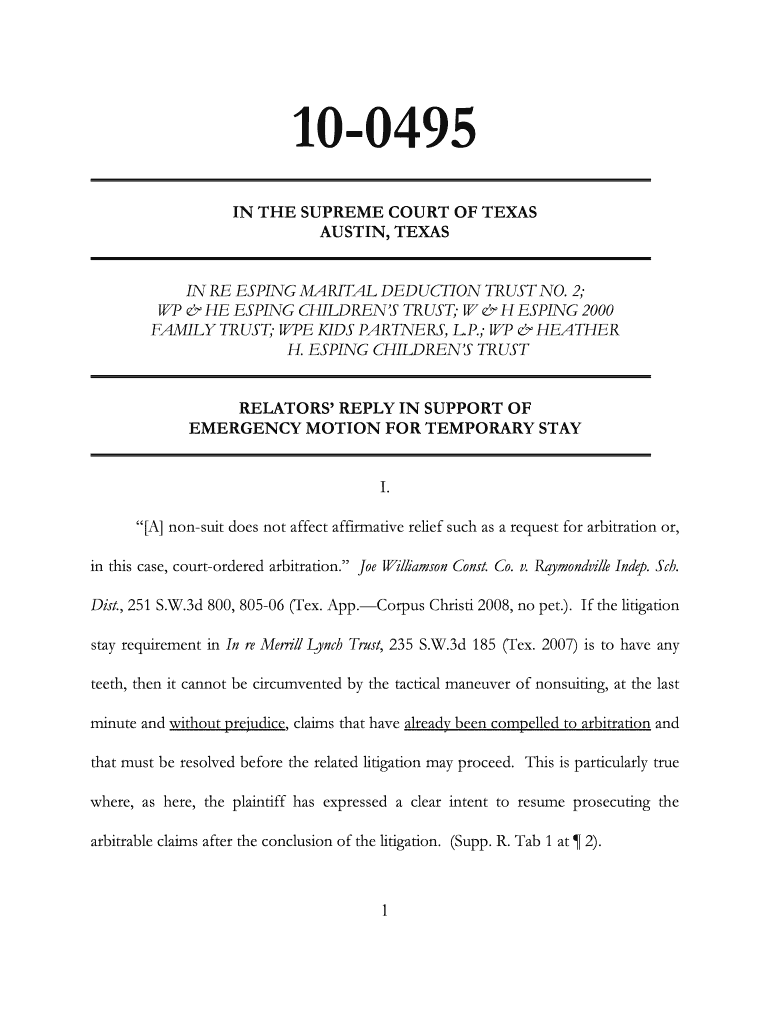
The "10-0495 - Supreme Court of Texas - supreme courts state tx" refers to a specific legal filing submitted to the Supreme Court of Texas. This form is often used in legal proceedings involving emergency motions, temporary stays, or arbitration-related matters in the state of Texas. The case referenced by this form involves disputes over trusts and claims, specifically focusing on the involvement of Bluff Power and the Trust Defendants. It is crucial for addressing legal strategies related to arbitration and other judicial remedies under Texas state law.
Key Elements of the 10-0495 - Supreme Court of Texas
- Parties Involved: The form identifies parties involved in the legal dispute, including Bluff Power and Trust Defendants, who have claims attributed to them in an ongoing arbitration.
- Legal Actions: The document details attempts to nonsuit claims, compelling aspects already sent to arbitration. It highlights legal arguments and procedural directions aimed at maintaining continuity in the arbitration process.
- Judicial Relief Sought: The document represents a request for temporary stays and other orders to enforce or delay certain legal proceedings as evaluated by the court.
- Court Instructions: It includes directives from the Supreme Court of Texas about handling arbitration and legal proceedings between involved parties.
Steps to Complete the Form
-
Gather Relevant Information:
- Include details of the motion, parties involved, and any previous court rulings related to arbitration.
- Highlight key case facts, including current arbitration status and pertinent legal arguments.
-
Prepare the Legal Document:
- Draft the reply or motion adhering to the format required by Texas Supreme Court procedures.
- Integrate specific legal citations or references to prior court rulings that support your arguments.
-
Review and Finalize:
- Ensure accuracy in the relevancy of arbitration information, motion requests, and legal citations.
- Have the document reviewed by legal counsel or an expert to ensure compliance with legal standards.
-
File with the Court:
- Submit the completed form to the Supreme Court of Texas, ensuring it meets any submission deadlines.
- Follow up for confirmation of receipt and review any procedural updates provided by the court.
Legal Use of the 10-0495 Form
- Arbitration Processes: Used to argue against nonsuited claims and emphasize the need for arbitration, as per prior court rulings.
- Stay Requests: Seeking temporary relief or to pause proceedings until the court evaluates and decides on the petitioned orders.
- Resolution of Disputes: Facilitates the continuity of arbitration in disputes involving trusts and legal claims in Texas.
Importance of the Form for Legal Practitioners
- Clarifies Legal Routes: Outlines procedures available when disputes over arbitration or court rulings arise.
- Promotes Legal Strategy: Assists legal teams in leveraging past court decisions to support ongoing arbitration processes.
- Ensures Compliance: Essential for adhering to Texas legal standards and procedural directives from the Supreme Court.
State-Specific Rules in Texas
- Arbitration Guidelines: References Texas legal precedents that influence arbitration proceedings and related court rulings.
- Temporary Stay Mechanisms: Specifies when and how temporary stays can be requested under Texas state law.
- Trust and Claims Handling: Details how trust-related claims are processed and resolved through the Texas judicial system.
Examples of 10-0495 in Use
- Bluff Power Case: Illustrates how the form is employed in real-life scenarios, such as disputes over arbitration and claims.
- Trust Disputes: Examples highlight how various trusts involve legal interpretations and arbitration rules when handled at the state level.
Required Documents
- Initial Arbitration Agreement: Original documents that compelled arbitration and serve as a legal foundation for current filings.
- Court Rulings: Previously issued court directives or orders that the current form addresses or seeks to alter.
- Supporting Evidence: Any documentation or evidential support related to the arbitration process or trust claims that the motion addresses.
Form Submission Methods
- Online Submission: Utilize the Texas courts' electronic filing system for digital document submission.
- Mail or In-Person: Traditional submission options via mail or direct in-person delivery to court clerks.
Form Variants and Related Versions
- Older Versions: Review past variations of the form that might differ in format or content requirements.
- Alternative Legal Documents: Understand alternative documents that may accompany the 10-0495 for comprehensive legal filings.




