







Definition & Meaning
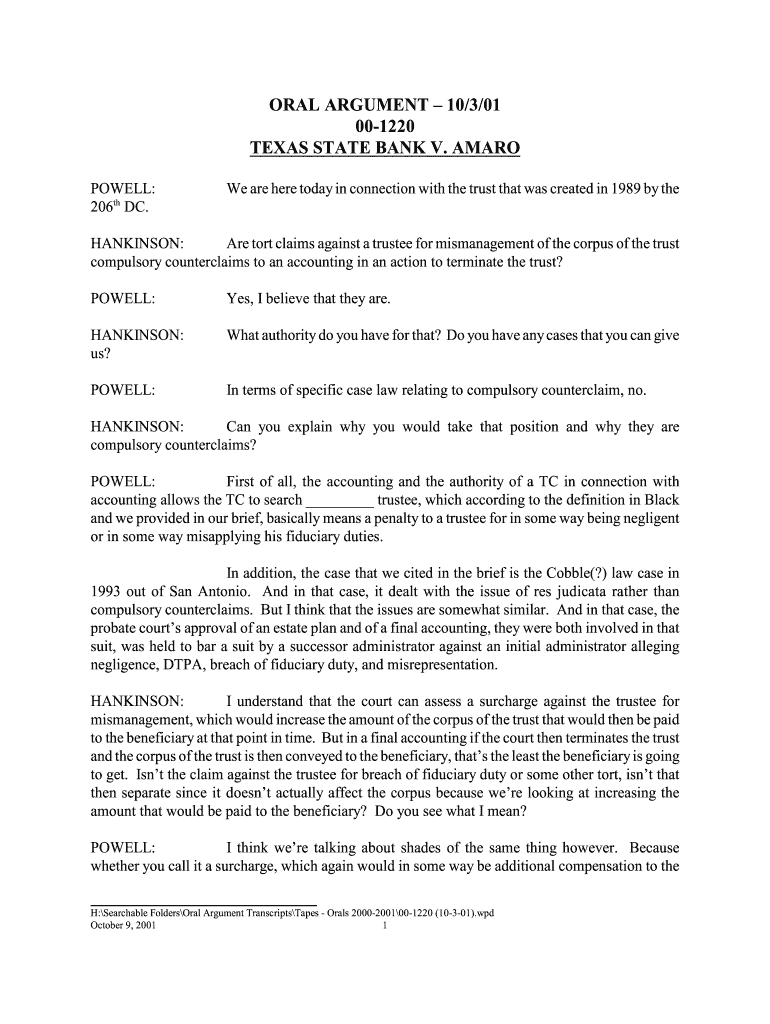
The "Oral Argument 10 3 01 00-1220 Texas State Bank v. Amaro" is a legal transcript detailing the oral proceedings in the case between Texas State Bank and Amaro. This document focuses on the arguments presented during a court session, where justices and attorneys discuss the legalities surrounding tort claims against a trustee due to mismanagement of a trust. Essential topics include whether these tort claims are considered compulsory counterclaims linked to an accounting action aimed at terminating the trust. This transcript serves as a crucial resource for understanding the judicial perspectives and reasoning applied to trust law issues.
Key Elements of the Oral Argument
The primary elements of the "Oral Argument 10 3 01 00-1220 Texas State Bank v. Amaro" include:
- Jurisdiction: The document details discussions about which court holds the authority to adjudicate the claims.
- Notice Requirements: It examines the obligations for notifying parties involved in the trust.
- Nature of Accountings in Trust Law: The oral argument explores the principles governing the accounting and termination processes of trusts.
- Trustee's Obligations: Examination of the fiduciary duties of a trustee regarding mismanagement claims.
These elements are critical for understanding how trust- and tort-related cases are assessed in legal settings.
Legal Use of the Oral Argument
The legal use of this transcript extends to several purposes:
- Reference for Lawyers: Attorneys may use this document to prepare for similar cases or to inform legal strategies.
- Judicial Precedent: Courts could look to this case for precedent when ruling on similar legal matters involving trusts and tort claims.
- Educational Resource: Legal educators might incorporate the case into curricula covering trust law and tort claims analysis.
- Public Record: As an official court document, it serves as a public record that provides transparency into legal proceedings.
How to Obtain the Oral Argument
Resources such as court archives, legal databases, or law libraries typically provide access to the "Oral Argument 10 3 01 00-1220 Texas State Bank v. Amaro." Interested parties can:
- Visit Legal Databases: Platforms like Westlaw, LexisNexis, or PACER can be used to retrieve the document.
- Access University Libraries: Many law schools or universities allow access to court transcripts.
- Request from the Court Clerk: Contacting the clerk of the court where the case was heard can provide access to the official transcript.
Steps to Complete the Oral Argument Form
If preparing related legal documentation, consider these generalized steps:
- Gather Relevant Information: Compile all case details, including parties involved, legal issues, and desired outcomes.
- Draft the Argument: Clearly outline your legal position, referencing case law and statutes.
- Review Legal Requirements: Ensure compliance with court rules regarding format and submission procedures.
- Consult Legal Experts: Seek advice from seasoned attorneys if needed to bolster your argument.
- File the Document: Submit to the court via specified methods, such as electronic filing or mail.
Who Typically Uses the Oral Argument
The primary users of this type of transcript are:
- Attorneys: For case preparation and legal strategy development.
- Judges and Clerks: For reviewing prior legal reasoning and decisions.
- Law Students: As educational material on trust law and torts.
- Law Librarians: To maintain archives of significant legal documents.
These users rely on detailed transcripts to gain insights into legal reasoning and factual interpretations involved in the case.


Important Terms Related to the Oral Argument
Understanding the following terms can enhance comprehension of the transcript:
- Trustee: The entity responsible for managing the trust's assets in accordance with its terms.
- Tort Claim: A legal claim arising from a wrongful act leading to legal liability.
- Compulsory Counterclaim: Claims that arise out of the transaction or occurrence constituting the subject matter of the opposing party's claim.
- Mismanagement: Improper or negligent handling of responsibilities, often leading to legal disputes in trust settings.
These terms help clarify the interactions and legal disputes in the case context.
State-Specific Rules for the Oral Argument
While the transcript provides insights applicable to general trust and tort law, specific state laws, including:
- Texas Trust Code: Governs the establishment, operation, and dissolution of trusts within Texas.
- State Jurisdictional Laws: Determine which courts have the authority to hear certain trust-related disputes.
- Local Procedural Rules: Define how lawsuits and claims should be filed and argued in court.
A deep understanding of these state-specific rules is essential for attorneys dealing with similar cases in Texas or preparing for multi-jurisdictional litigation.




