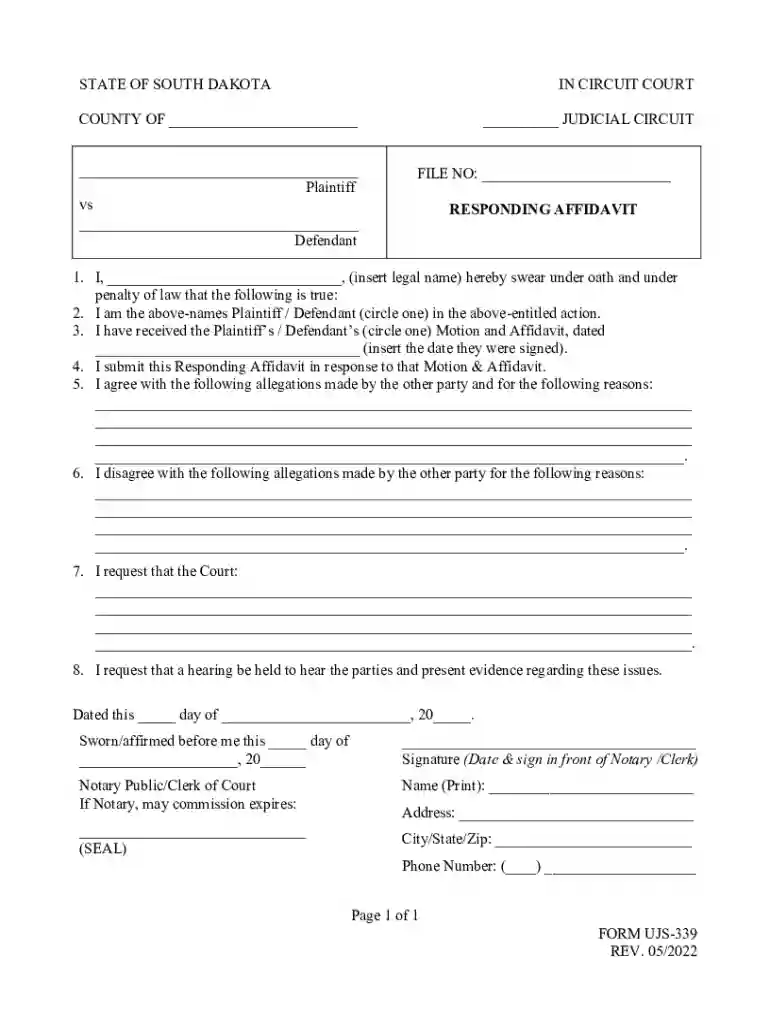
Definition & Meaning
A responding affidavit is a legal document primarily used in court proceedings, where a party provides a formal written response to the claims or allegations made in an opposing party's affidavit. It allows the responder to agree or dispute specific points and requests outlined in the initiating affidavit. An affidavit of mailing, on the other hand, is a sworn statement confirming that a particular document has been sent to all involved parties by mail. Both forms are crucial in maintaining the integrity and transparency of legal communications.
Responding Affidavit
- Purpose: Used to reply to accusations or motions filed by opposing parties.
- Format: Typically structured with sections to agree or disagree with each allegation.
- Notarization: It must be sworn before a Notary Public or Clerk of Court to ensure authenticity.
Affidavit of Mailing
- Function: Provides proof of mailing required documents to relevant parties.
- Content: Includes details such as the sender's name, recipient's name, mailing date, and location from which the document was sent.
- Verification: Often notarized to provide formal validation of the mailing process.
How to Use the Responding Affidavit and Affidavit of Mailing
To use these documents effectively, one must follow specific legal protocols ensuring mutual acknowledgment between parties and the court:
- Read and Understand: Before drafting a response, carefully review the original affidavit to understand the claims made.
- Drafting the Response: Use clear language to address each point raised in the opposing affidavit. Agree or disagree with specific statements, providing supporting evidence where necessary.
- Include Affidavit of Mailing: Prepare this affidavit to document that all necessary parties have been sent copies of the responding affidavit.
Critical Considerations
- Ensure consistency between your affidavit and the affidavit of mailing.
- Always keep copies for personal records and future reference.
- Utilize legal counsel if specific points are unclear or need expert navigation.
Steps to Complete the Responding Affidavit and Affidavit of Mailing
Completing these affidavits involves a structured process that requires attention to detail and adherence to legal standards:
- Gather Necessary Materials: Have copies of the original affidavit, any relevant evidence, and the contact information of involved parties.
- Draft the Responding Affidavit:
- Clearly state your responses point by point.
- Use legal language but avoid jargon that may lead to misunderstandings.
- Notarization:
- Schedule a meeting with a Notary Public or visit the court clerk's office.
- Sign the document in the presence of the notary to obtain official validation.
- Prepare the Affidavit of Mailing:
- Include dates, addresses, and the method of mailing.
- Execute the mailing process and obtain a postal receipt for additional proof.
- Submit:
- Depending on court instructions, submit via mail, in person, or electronically.
- Ensure all steps are documented and copies filed for personal records.
Legal Use of the Responding Affidavit and Affidavit of Mailing
The legal use of these affidavits is instrumental in various civil litigation processes. Their primary role lies in ensuring procedural fairness and clear communication:
- Court Proceedings: Accepted by courts as valid responses and proof of document exchanges.
- Documentation: Serves as permanent records of responses and mailing actions in case of disputes.
- Admissibility: When notarized, these affidavits hold significant evidentiary value in legal disputes.
State-Specific Regulations
- Some states have specific requirements regarding the content, format, and notarization process of affidavits, which must be adhered to for the documents to be valid.
Key Elements of the Responding Affidavit and Affidavit of Mailing
Both types of affidavits share common key elements, essential for fulfilling their intended purpose:
Responding Affidavit Elements
- Identification: Names of parties involved, case number, and court details.
- Response to Allegations: Detailed responses to each claim, with supportive evidence or references.
- Signature: Line for the signature of the respondent and notary public.
Affidavit of Mailing Elements
- Sender and Recipient Information: Full details to ensure no ambiguity.
- Mailing Details: Date, location, and method of mailing.
- Acknowledgment: Notary public or other authorized signature for verification.
Filing Deadlines / Important Dates
Timeliness in filing these affidavits is crucial for maintaining legal compliance and avoiding potential penalties:
- Court-Determined Deadlines: Each court may have different deadlines, often dictated by the proceeding type.
- Grace Periods: Some jurisdictions may allow for late submissions with justifiable cause, but this is not guaranteed.
Avoid Penalties
- Failing to submit on time can lead to procedural dismissals or defaults, potentially impacting the outcome of the case negatively.
Form Submission Methods (Online / Mail / In-Person)
Various methods exist for the submission of affidavits, each with its own procedures:
Online Submission
- Some jurisdictions allow electronic filing through court websites or designated e-filing platforms.
- Considered convenient and often provides instant confirmation of receipt.
Mail Submission
- Traditional and widely accepted method.
- Always use certified mail to obtain a receipt and ensure delivery confirmation.
In-Person Submission
- Offers immediate confirmation and allows for face-to-face clarification if issues arise.
- Often required for documents needing immediate judicial review.
Areas of Use
- Civil Litigation: Predominantly used in response to motions or petitions.
- Family Law: Common in divorce or custody-related proceedings to establish clear communication.
- Business Law: Utilized in corporate disputes or contractual disagreements.