




01. Edit your form online
Type text, add images, blackout confidential details, add comments, highlights and more.

Type text, add images, blackout confidential details, add comments, highlights and more.

Draw your signature, type it, upload its image, or use your mobile device as a signature pad.

Send it via email, link, or fax. You can also download it, export it or print it out.
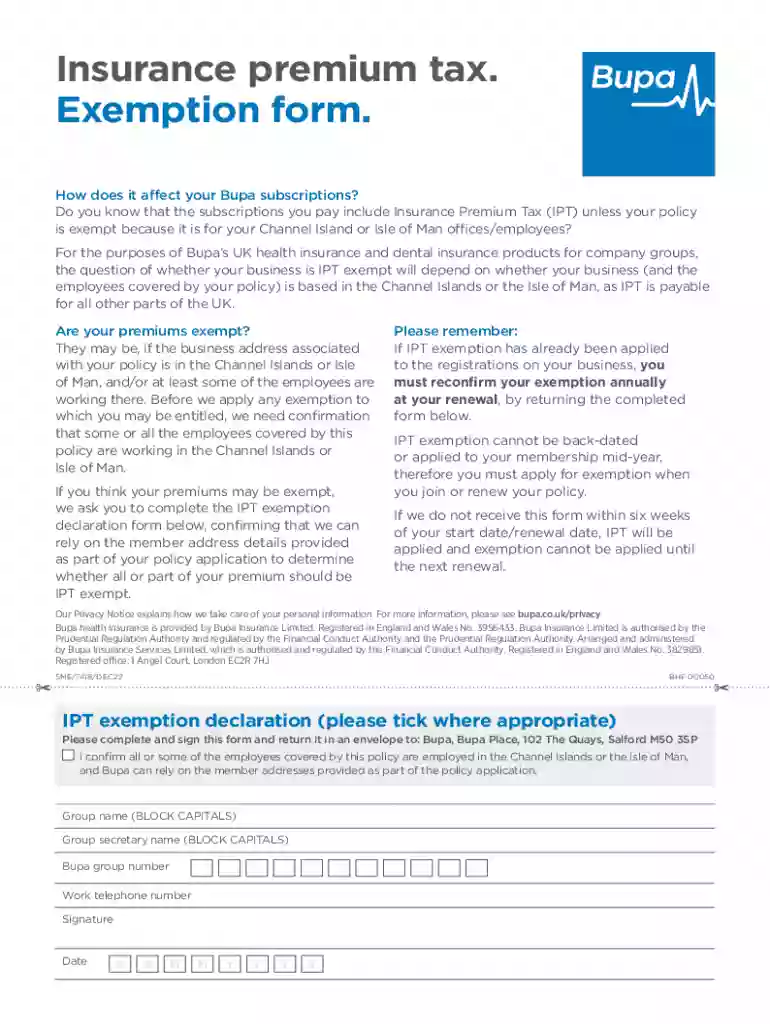
Insurance Premium Tax (IPT) is a tax levied on general insurance premiums, commonly applicable to health, property, and motor insurance. The IPT exemption form for Bupa is used by businesses with employees in the Channel Islands or Isle of Man to facilitate exemption from IPT. This exemption is significant for businesses that qualify, as it allows them to adjust their budgeting and financial forecasts without the additional IPT cost burden on their Bupa insurance policies. The exemption is only confirmed upon successful completion and submission of this form, which requires detailed information about the nature and location of the insurance policy.
To utilize this form effectively, businesses need to follow a specific set of instructions. Initially, you need to verify the eligibility criteria to ensure your business qualifies for the exemption. Next, accurately fill in the required fields with information such as business name, policy details, and employee coverage areas. The completed document should then be submitted as guided by Bupa guidelines.
This form is primarily used by businesses operating within the Channel Islands and the Isle of Man that offer Bupa health insurance coverage to their employees. It's most relevant for organizations that have a significant number of employees in these locations and offer comprehensive health insurance as part of their benefits package. Typically, HR departments or financial managers of such businesses are responsible for completing and submitting these forms to ensure compliance and cost-effectiveness.


The primary eligibility for this exemption involves the geographical location of the business and its operations. Businesses must be based in the Channel Islands or Isle of Man. Additionally, the insurance coverage must be under Bupa policies without existing IPT inclusions, aligning with the form's prerequisites and the regulatory framework governing IPT exemptions.

Form submission can typically be done via online platforms provided by Bupa, which allow for electronic document upload and direct dispatch to the relevant office. Alternatively, paper-based form submission via mail is also an option, where businesses can print, complete, and send the form through postal services directly to Bupa. Although less common, in-person submission to a regional Bupa office might be acceptable for businesses preferring direct interactions.
To showcase practical application, consider a company in the Isle of Man that employs 100 staff and has a comprehensive Bupa health insurance package. By completing the IPT exemption form, the business can avoid additional costs associated with IPT, thus allowing more funds to be allocated toward employee benefits and company resources. Another example is a new tech startup in Jersey that needs to manage expenses tightly. By applying for IPT exemption, it can ensure that its financial resources are optimally utilized for growth and development rather than tax liabilities.
Though the form is applicable predominantly to the Channel Islands and Isle of Man, businesses must adhere to any specific insurance laws or precedents that may differ within these regions compared to broader U.K. or European regulations. Compliance with local insurance regulations is crucial to avoid any legal repercussions or invalid exemption claims.
We've got more versions of the Insurance premium tax (IPT) - Exemption form - Bupa form. Select the right Insurance premium tax (IPT) - Exemption form - Bupa version from the list and start editing it straight away!
At DocHub, your data security is our priority. We follow HIPAA, SOC2, GDPR, and other standards, so you can work on your documents with confidence.
To order a copy ofyour transcript, fill out a request form. OFFICE Hours: Monday- Thursday 8:00 a.m. 6:00 p.m. Friday 8:00 a.m.5:00 p.m.
Application: iL4ila/II* Petition for Appointment of Guardian in Equity. INSURANCE COMPAM OF VIRGINIA declare resolution of the County. Order To Docket Suit,


