
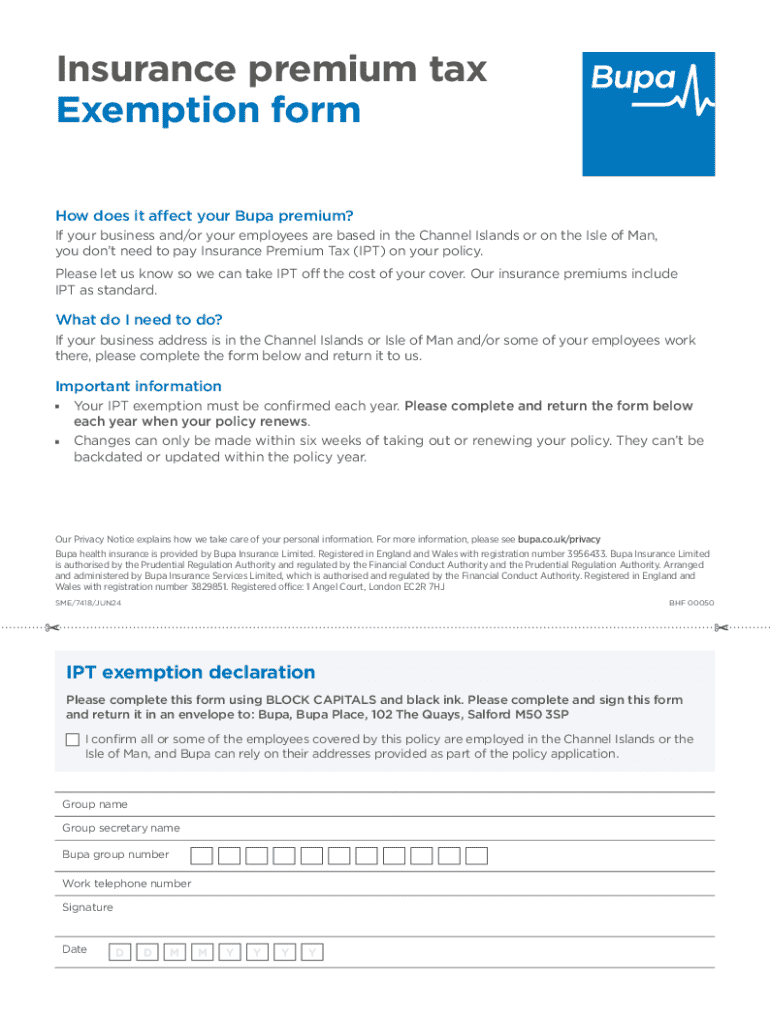







Definition & Meaning
The insurance premium tax (IPT) - exemption form is a document used by businesses to claim an exemption from the insurance premium tax on specific insurance policies. This exemption is particularly relevant for businesses located in certain regions, such as the Channel Islands or the Isle of Man, where they are eligible to forego IPT payment under their healthcare insurance policies with providers like Bupa. By using this form, businesses can effectively reduce their tax liabilities on qualifying insurance premiums.
Core Purpose
The primary function of the form is to certify that certain businesses do not need to pay the standard IPT. The process requires businesses to demonstrate eligibility under specific criteria defined by tax authorities. This exemption is usually renewed annually and must be submitted during policy renewal periods, ensuring that no undue IPT is paid on eligible premiums.
How to Use the Insurance Premium Tax (IPT) - Exemption Form
Completing the Form
When filling out the insurance premium tax exemption form, businesses should ensure the following steps:
- Accurate Business Information: Input your business name, address, and contact details accurately.
- Policy Details: Include comprehensive information about the insurance policy for which you are claiming the exemption. This covers policy numbers, premium amounts, and insurer details.
- Eligibility Confirmation: Confirm your eligibility for IPT exemption under the guidelines provided by the relevant tax authorities.
Submission Guidelines
- Timing: Submit the exemption form concurrently with the annual policy renewal to ensure continuous applicability of the exemption.
- Updates: any changes in business status or insurance policy details must be accurately updated on the form and resubmitted if these changes occur within six weeks of the policy renewal.
Steps to Complete the Insurance Premium Tax (IPT) - Exemption Form
- Gather Necessary Information: Collect all necessary documents, including previous policy statements and business registration details.
- Fill Out the Form: Complete the form with accurate information regarding your insurance policy and business details.
- Attach Supporting Documents: Include any required documentation that substantiates your exemption eligibility, such as previous exemption approvals or business registration certificates.
- Review the Form: Double-check all entries to correct any potential errors that could delay processing.
- Submission: Send the completed form to the designated authority, ensuring it is submitted before the filing deadline.
Tip: Be Thorough
Ensure that every section of the form is filled out correctly to avoid rejection or delays in processing.
Why Should You Use the Insurance Premium Tax (IPT) - Exemption Form?
Benefits of Exemption
- Tax Savings: By claiming an exemption, eligible businesses can save substantial costs on insurance premiums that would otherwise be taxed.
- Compliance Assurance: Using the form ensures that your business complies with relevant tax regulations by properly documenting your exemption status.
- Financial Planning: Knowing the taxable and non-taxable components of insurance premiums can aid in better financial planning and budgeting.
Long-term Benefits
Consistent use of the exemption form can result in significant long-term savings and allows businesses to allocate resources more effectively towards growth initiatives.
Key Elements of the Insurance Premium Tax (IPT) - Exemption Form
Critical Information Required
- Business Identification: Name, address, and registration number.
- Policy Identification: Detailed policy number and issuer information.
- Exemption Declaration: Official declaration of the exemption, asserting the reasons and validity under current regulations.
Specific Fields
- Signature Section: Authentication from an authorized business representative confirming the accuracy of the information provided.
- Date of Submission: Documenting the submission date for record-keeping purposes.
Examples of Using the Insurance Premium Tax (IPT) - Exemption Form
Business Scenarios
- Health Insurance Providers: Claiming IPT exemption for policies offered to employees, reducing operational costs.
- Channel Islands-based Enterprises: Taking advantage of regional eligibility for IPT exemptions.
- Multinational Corporations: Optimizing cross-border tax liabilities by accurately exempting certain insurance policies from local IPT.
Eligibility Criteria


Who can Claim the Exemption?
- Location-Based Eligibility: Businesses headquartered in regions like the Channel Islands or the Isle of Man.
- Policy-Specific Eligibility: Insurance policies related to health and wellbeing rather than property or casualty.
Detailed Requirements
- Must meet specific regulatory conditions as outlined by local tax laws.
- Must be able to provide corroborative documentation supporting the stated eligibility requirements.
Legal Use of the Insurance Premium Tax (IPT) - Exemption Form
Compliance and Legalities
- Regulatory Adherence: Ensure the form's use is in strict compliance with the respective tax jurisdiction's rules.
- Authentification: The form should be signed and certified by an official company representative to uphold its legal validity.
Filing Deadlines / Important Dates
Timely Submissions
- Renewal Alignment: Submit the exemption form in line with your annual insurance policy renewal to maintain uninterrupted exemption status.
- Changes and Modifications: Must be filed within six weeks of any adjustment in policy terms or business status to ensure compliance.
Key Timeline Points
- Always mark renewal dates in your business calendar to prepare exemption documentation in advance, preventing lapses in compliance and financial planning.




