




01. Edit your form online
Type text, add images, blackout confidential details, add comments, highlights and more.

Type text, add images, blackout confidential details, add comments, highlights and more.

Draw your signature, type it, upload its image, or use your mobile device as a signature pad.

Send it via email, link, or fax. You can also download it, export it or print it out.
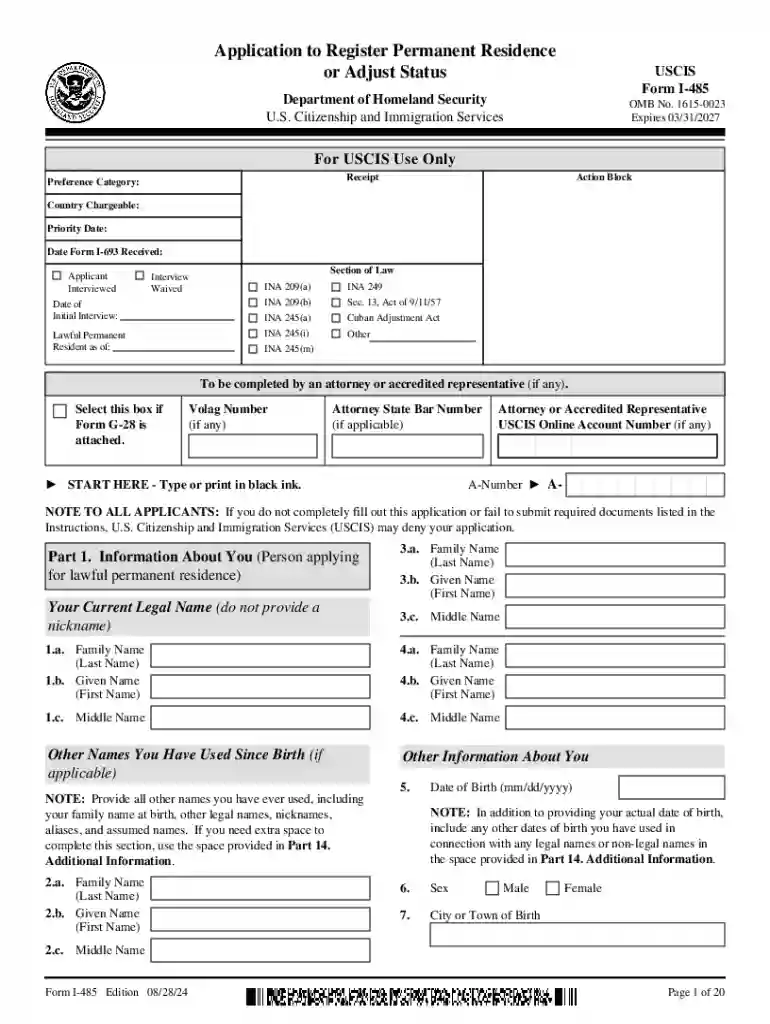
The Form I-485, Application to Register Permanent Residence or Adjust Status, is a critical document utilized by non-citizens seeking to become lawful permanent residents (green card holders) in the United States. Its primary function is to collect detailed personal, biographical, and eligibility information from applicants to evaluate their eligibility for status adjustment. This form is part of the U.S. Citizenship and Immigration Services (USCIS) process, often following approval of an immigrant petition. Individuals can apply under various categories, such as through family, employment, refugee/asylee status, or other specific visa programs.
To successfully apply for adjustment of status using Form I-485, applicants must meet several eligibility requirements:


Applicants should familiarize themselves with key terms included on Form I-485 to understand the questions:
Completing Form I-485 involves multiple steps to ensure accuracy:
Filing this form requires a systematic approach:
Applicants must include a variety of documents when submitting Form I-485:
While the Form I-485 requirements are federally governed, some states may have unique considerations related to:
Filling out Form I-485 involves legal obligations and understanding potential penalties:
This comprehensive overview of Form I-485 encapsulates its definition, purpose, and the critical steps involved in filing it. Whether individuals are applying based on family ties or employment, this guidance serves to streamline the process of achieving lawful permanent residence in the U.S.
We've got more versions of the Form I-485 Application to Register Permanent Residence or form. Select the right Form I-485 Application to Register Permanent Residence or version from the list and start editing it straight away!
| Versions | Form popularity | Fillable & printable |
|---|---|---|
| 2025 | 4.3 Satisfied (42 Votes) | |
| 2024 | 4.5 Satisfied (58 Votes) | |
| 2024 | 4.1 Satisfied (39 Votes) | |
| 2023 | 4.3 Satisfied (55 Votes) | |
| 2022 | 4.3 Satisfied (27 Votes) | |
| 2021 | 4.8 Satisfied (70 Votes) | |
| 2021 | 4.4 Satisfied (91 Votes) | |
| 2020 | 4.2 Satisfied (117 Votes) | |
| 2019 | 4.4 Satisfied (177 Votes) | |
| 2017 | 4.3 Satisfied (78 Votes) | |
| 2017 | 4.3 Satisfied (217 Votes) | |
| 2015 | 4.3 Satisfied (64 Votes) | |
| 2013 | 4.4 Satisfied (72 Votes) | |
| 2011 | 4.4 Satisfied (583 Votes) | |
| 2011 | 4 Satisfied (41 Votes) |
At DocHub, your data security is our priority. We follow HIPAA, SOC2, GDPR, and other standards, so you can work on your documents with confidence.
Jun 16, 2026 Use this form to replace your Permanent Resident Card (also known as your Green Card). I-485, Application to Register Permanent Residence or
Jan 20, 2025 Person admitted to the United States as a fianc(e) or child of a fianc(e) of a U.S. citizen (K-1/K-2 Nonimmigrant). Widow or widower of a U.S.Read more


