Mined Land Reclamation - Idaho Department of Lands 2026

Get Form
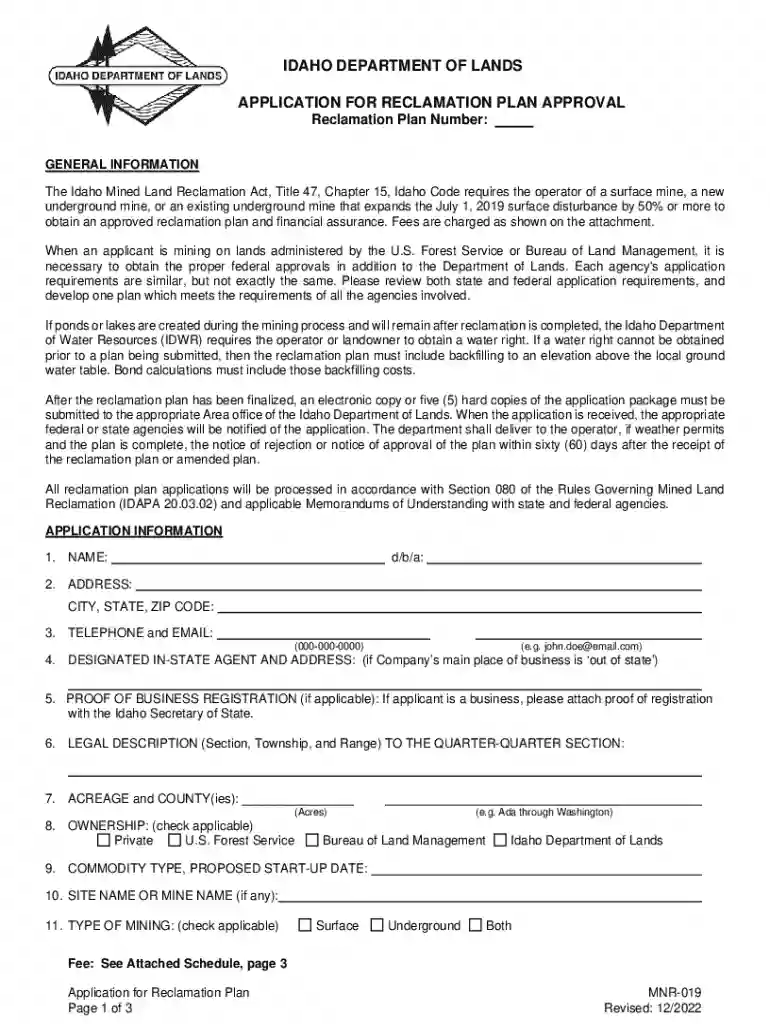
Mined Land Reclamation - Idaho Department of Lands Preview on Page 1

Here's how it works

01. Edit your form online
Type text, add images, blackout confidential details, add comments, highlights and more.

02. Sign it in a few clicks
Draw your signature, type it, upload its image, or use your mobile device as a signature pad.

03. Share your form with others
Send it via email, link, or fax. You can also download it, export it or print it out.

Definition and Meaning

The Mined Land Reclamation - Idaho Department of Lands refers to the process and administrative requirements for reclaiming lands that have been subjected to mining activities in Idaho. This ensures that after minerals are extracted, the land is returned to a condition that is environmentally stable, aesthetically pleasing, and capable of supporting future land uses. Reclamation involves a series of steps outlined in a formal plan that operators must develop and have approved by the Idaho Department of Lands.

How to Use the Mined Land Reclamation - Idaho Department of Lands

Mining operators are required to follow specific guidelines and submit comprehensive reclamation plans. This involves understanding the state's requirements, gathering necessary documentation, and periodically updating the department with progress reports. Utilization of this form typically involves a close analysis of site-specific conditions, ensuring compliance with environmental and safety standards, and setting realistic timelines for reclamation milestones.

Steps to Complete the Mined Land Reclamation - Idaho Department of Lands

  1. Acquire Necessary Approvals: Before starting the reclamation process, operators must secure necessary federal and state mining approvals.
  2. Collect Required Documents: Compile required documentation, including maps of the mining site, planned reclamation strategies, and cost estimates.
  3. Develop a Reclamation Plan: Detail how the land will be restored, considering factors like soil stabilization, vegetation, and water management.
  4. Submit the Plan for Approval: Present the reclamation plan along with the required fees for approval by the Idaho Department of Lands.
  5. Implement the Plan: Carry out reclamation activities according to the approved plan, ensuring each phase is well-documented.
  6. Periodic Reporting and Updates: Regularly submit progress reports as stipulated, detailing any deviations or amendments to the plan.

Who Typically Uses the Mined Land Reclamation - Idaho Department of Lands

Primarily, the form is used by mining companies operating in Idaho, encompassing both surface and underground mining operations. Environmental consultants, land rehabilitation specialists, and legal teams often support these efforts to ensure compliance with state regulations. The target users are those involved in planning, executing, and overseeing reclamation activities to meet legal and environmental standards.


decoration image ratings of Dochub

Important Terms Related to Mined Land Reclamation

  • Reclamation Plan: A detailed strategy for restoring mined land to a usable condition.
  • Surface Mining: The extraction of minerals by removing the overlying soil and rock.
  • Underground Mining: The extraction of minerals beneath the earth's surface.
  • Idaho Department of Lands: The state department responsible for managing the reclamation process.
  • Federal Approvals: Necessary permits from federal agencies to conduct reclamation on certain lands.

Legal Use of the Mined Land Reclamation - Idaho Department of Lands

The application underlines all legal responsibilities of mining operators in reclaiming land post-mining operations. Legal use encompasses following state provisions outlined in the Idaho Mined Land Reclamation Act. Violations of reclamation requirements can result in penalties, fines, or legal action, emphasizing the importance of adhering strictly to the approved reclamation plan.

Required Documents

  • Reclamation Plan Documentation: Includes land use maps, biological and geological surveys, and reclamation timelines.
  • Federal and State Permits: Permissions required to validate the mining and subsequent reclamation operations.
  • Cost Estimates: Detailed financial plans forecasting the expenses for completing the reclamation process.

Form Submission Methods

The form can be submitted through various channels:

  • Online Submission: Utilize the Idaho Department of Lands online portal to upload all necessary documents.
  • Mailing Physical Copies: Send paper copies to the department’s office for processing.
  • In-person Submission: Hand-deliver documents to ensure they are received and processed promptly.

Penalties for Non-Compliance

Failure to comply with reclamation obligations can result in severe penalties, including fines proportional to the extent and nature of the infraction. Continued non-compliance may lead to legal proceedings and potential revocation of mining licenses. The department ensures all reclamation activities meet environmental and safety standards, safeguarding public and ecological interests.

be ready to get more

Complete this form in 5 minutes or less

Get form

Got questions?

We have answers to the most popular questions from our customers. If you can't find an answer to your question, please contact us.
Contact us
The Abandoned Mine Land (AML) program was authorized in Title IV of the Surface Mining Control and Reclamation Act of 1977 (SMCRA). States with approved AML programs, or specific Indian tribes, are eligible for Abandoned Mine Land grants that support reclamation efforts.
Some components of reclamation include practices that control erosion and sedimentation, stablize slopes, and avoid and repair impacts to wildlife habitat. The final step is usually topsoil replacement and revegetation with suitable plant species.
Living on a mining claim means taking responsibility for these environmental aspects. While it might be possible to reside on a mining claim, the primary use of the land must be for mining-related activities, and any residential use must not interfere with the actual mining operations.
Although a mine may appear abandoned it does belong to someone and trespassing laws do apply. Anyone rescued from an abandoned mine may face criminal trespass charges.
Regarding living on a mining claim, it is typically not permitted to use the land for purely residential purposes unless the residential occupancy is incidental to the mining operations.

Security and compliance

At DocHub, your data security is our priority. We follow HIPAA, SOC2, GDPR, and other standards, so you can work on your documents with confidence.

Learn more
ccpa2
pci-dss
gdpr-compliance
hipaa
soc-compliance

People also ask

IDLs Abandoned Mine Lands (AML) program promotes public safety by identifying dangerous conditions at mines that are no longer operating and by securing dangerous orphaned mine openings.
Its estimated, for example, that there are 106,000 such mines in Nevada and 8,800 in Idaho. About 100 persist in New Hampshire. While most of the abandoned mines in New Hampshire are not producing docHub contamination, there are a few that have.

Related links