
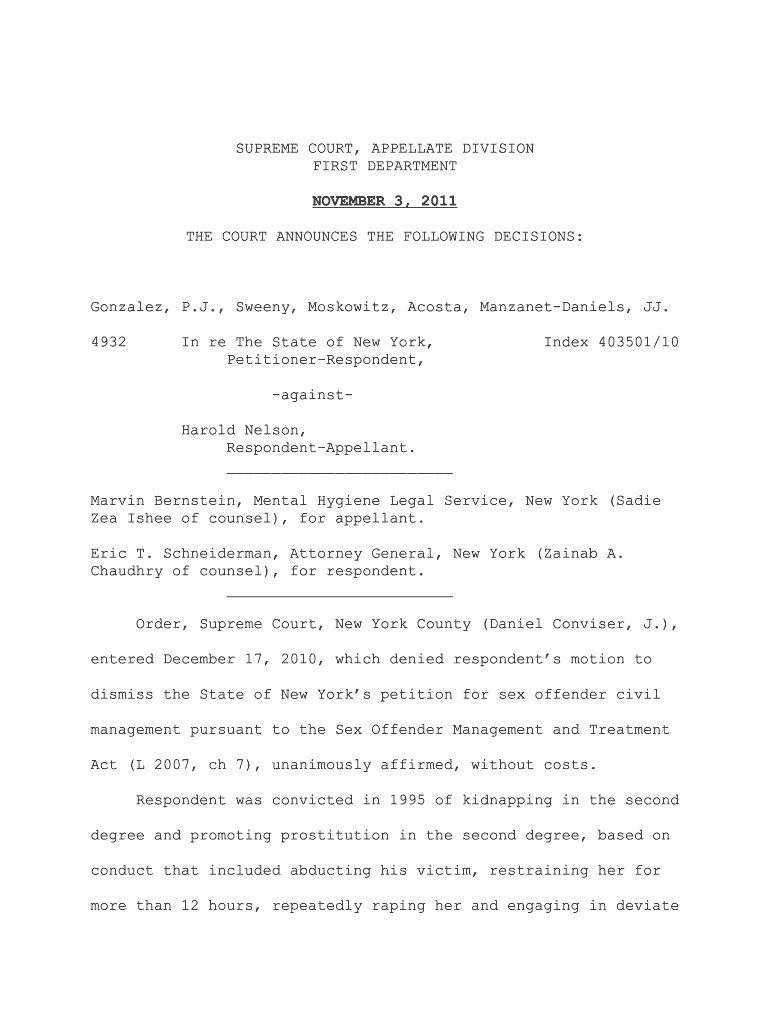







Definition and Meaning
The term "In re The State of New York, - courts state ny" refers to a legal proceeding or matter that involves the State of New York. This phrase is commonly used in court documents to indicate that the case is about a specific issue regarding state governance, legal questions, or state-related disputes. The "In re" acronym stands for "in regards to" or "in the matter of," which sets the context for the legal proceeding or discussion.
Importance of Accurate Understanding
- Understanding the term is crucial for legal professionals and those involved in court procedures as it clearly defines the scope and focus of the cases being dealt with.
- It helps in identifying the legal nature and jurisdiction involved, ensuring that appropriate legal frameworks and precedents are applied.
How to Use "In re The State of New York, - courts state ny"
Legal professionals may encounter this phrase in official documents, such as court orders or legal briefs. It is used:
- To refer to specific legal proceedings concerning statewide issues.
- In legal citations as part of case documentation, ensuring clarity in legal discourse.
Practical Example
- A case filed to challenge state legislation might be documented as "In re The State of New York, - courts state ny," indicating its statewide importance and focus.
Steps to Complete Required Documentation
Completing the necessary documentation for cases involving "In re The State of New York, - courts state ny" involves several meticulous steps:
- Gather Preliminary Information: Collect all relevant case details and background information.
- Consult Relevant Legal Frameworks: Analyze state-specific laws and precedents that pertain to the case's subject matter.
- Draft the Initial Documents: Prepare initial briefs or filings, ensuring all legal guidelines are met.
- Review and Revise: Collaborate with legal peers to refine the documents.
- Submit to Appropriate Court: Ensure all documents are filed with the correct court division, adhering to submission protocols.
Examples of Necessary Documents
- Legal briefs, affidavits, motions, and orders that detail the state-related legal issues.
Legal Use and Compliance
"In re The State of New York, - courts state ny" is primarily a procedural designation in the legal system:
- It signifies that the matter concerns state law and will be governed by state-specific judicial procedures.
- Compliance involves adhering to New York state legal standards, ensuring all statutory requirements are met.
Key Compliance Elements
- Understanding New York's judiciary structure and the application of state laws.
- Ensuring all legal submissions adhere to New York state court protocols.
Key Elements of Documentation
When preparing documents related to "In re The State of New York, - courts state ny":
- Accurate Citation: Use precise legal terms and references that align with New York state laws.
- Comprehensive Detail: Include all relevant facts, legal grounds, and supporting evidence.
- Qualifying Language: Clearly articulate the jurisdictional basis for the proceedings.
Checklist for Document Preparation
- Proper formatting according to state court standards.
- Inclusion of necessary legal precedents and statutory references.
- Detailed factual background supporting the filing.
Important Terms
Understanding the relevant terms associated with "In re The State of New York, - courts state ny" is vital:
- Jurisdiction: Authority of New York state courts over the legal matter.
- Precedent: Previous state court rulings that influence current case outcomes.
- Litigation: Legal process of resolving the dispute in court.
Terminology in Context
- "In re": Latin phrase meaning "in the matter of."
- "The State of New York": Indicates that the legal matter pertains to state-level issues.
State-Specific Rules
"In re The State of New York, - courts state ny" involves unique procedural rules distinct to New York:
- Adherence to New York's Civil Practice Law and Rules (CPLR).
- Observance of filing deadlines mandated by New York state courts.
- Compliance with specific evidentiary standards relevant to state cases.
Variations Across States
- New York may have different procedural requirements and interpretations than other states.
Examples of Cases
"In re The State of New York, - courts state ny" can be illustrated through various legal scenarios:
- Civil Rights Cases: Court proceedings challenging state laws affecting civil liberties.
- Government Disputes: Legal actions involving state agencies or policies.
Notable Real-World Cases
- Challenges to legislative statutes and their constitutional implications.
- Disputes about state regulatory actions affecting individual or corporate rights.




