
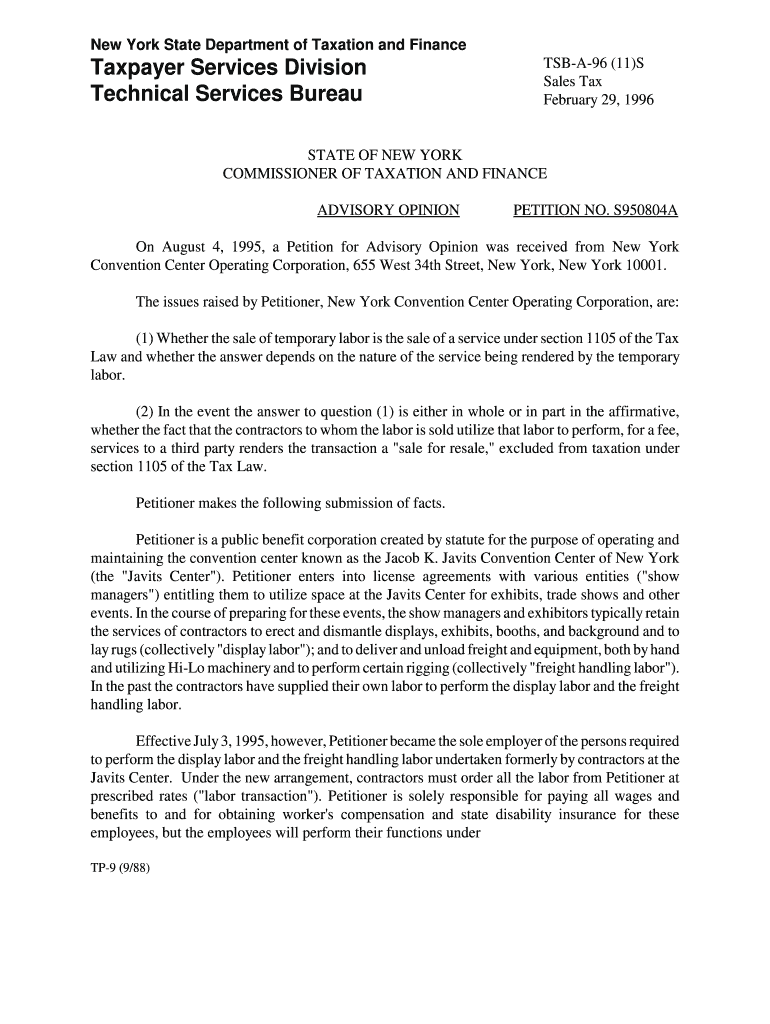







Definition and Purpose of TSB-A-96 (11)S
The document TSB-A-96 (11)S is an advisory opinion from the New York State Department of Taxation and Finance. It explores the tax implications associated with temporary labor services provided by the New York Convention Center Operating Corporation. This form specifically evaluates whether the sale of temporary labor qualifies as a taxable service under section 1105 of the Tax Law. Importantly, it outlines which services are subject to taxation and identifies certain exemptions, such as those relating to dismantling displays when these services are billed separately. By addressing tax responsibilities of contractors and petitioners, the advisory provides essential guidance on tax collection and exemption certificates.
Steps to Complete the TSB-A-96 (11)S
- Understand the Scope: Ensure clarity about the tax implications of temporary labor services provided.
- Review Relevant Services: Identify which services could be taxable as per section 1105 and which might qualify for exemptions.
- Document Exemptions: Separate services like dismantling displays and confirm they are billed on separate lines to maintain exemption eligibility.
- Gather Required Information: Prepare necessary information about your services, including descriptions and billing methods.
- Complete Tax Collection: Implement appropriate tax collection strategies, ensuring compliance with the advisory opinion guidelines.
- Consult with Tax Experts: Seek professional advice for nuanced interpretation and application of New York Tax Law specifications.
Key Elements of the TSB-A-96 (11)S
- Taxable Services: Clarifies which temporary labor services fall under taxable criteria.
- Exemption Guidelines: Specifies conditions under which services can be treated as exempt.
- Billing Practices: Highlights the need for separate billing to qualify for tax exemptions.
- Tax Collection Responsibilities: Details the obligations of both contractors and petitioners in tax collection and submission.
- Exemption Certificates: Discusses the documentation required to support tax exemption claims.
Who Typically Uses the TSB-A-96 (11)S
Organizations and individuals involved with temporary labor services related to large events or exhibitions often utilize this form. Businesses operating in New York, especially those dealing with convention centers or similar venues, rely on it to understand their tax compliance responsibilities. Contractors and tax professionals use the form to navigate the complex tax landscape, ensuring that they meet all necessary compliance requirements.


Important Terms Related to TSB-A-96 (11)S
- Temporary Labor Services: Services provided for a limited time, often associated with large-scale events or exhibitions.
- Section 1105: A section of the New York Tax Law specifying taxable services.
- Tax Exemptions: Conditions under which certain services might not be subject to sales tax.
- Exemption Certificates: Documentation required to validate claims for tax exemptions.
Examples of Using the TSB-A-96 (11)S
- Convention Centers: A convention center hires temporary workers to set up and dismantle booths. The services related to setup might be taxable, while dismantling, if billed separately, could be exempt.
- Event Organizers: An organizer contracts labor for a fair. By understanding the advisory, they correctly itemize invoices to separate taxable services from exempt ones.
- Contractor Businesses: A contractor providing temporary event services uses the advisory to inform their billing practices, ensuring compliance with New York tax laws.
Penalties for Non-Compliance
Failing to comply with the tax implications outlined in TSB-A-96 (11)S can lead to penalties, including fines and interest charges on overdue taxes. Contractors who improperly classify services or neglect to collect appropriate taxes may face audits or legal action from the New York State Department of Taxation and Finance. It is crucial for businesses to adhere to all specified guidelines to avoid financial penalties and maintain good standing with tax authorities.
Digital vs. Paper Version
Both digital and paper versions of TSB-A-96 (11)S may be available; however, accessing the document online offers several advantages. Digitally accessing the form allows easier sharing and storage, helps prevent misunderstandings about the document’s stipulations, and ensures quick access to updates or revisions made by the tax department. Utilizing an online service like DocHub can streamline the process, enabling easy management of digital documentation.
Software Compatibility (TurboTax, QuickBooks, etc.)
Modern tax preparation software like TurboTax or QuickBooks can simplify managing tax implications referenced in TSB-A-96 (11)S. These tools can assist businesses in tracking taxable services, separating exempt tasks appropriately, and ensuring compliance with New York State tax laws. Integrating this advisory into digital platforms can enhance accuracy in tax reporting and prevent potential issues related to misclassification of services.




