
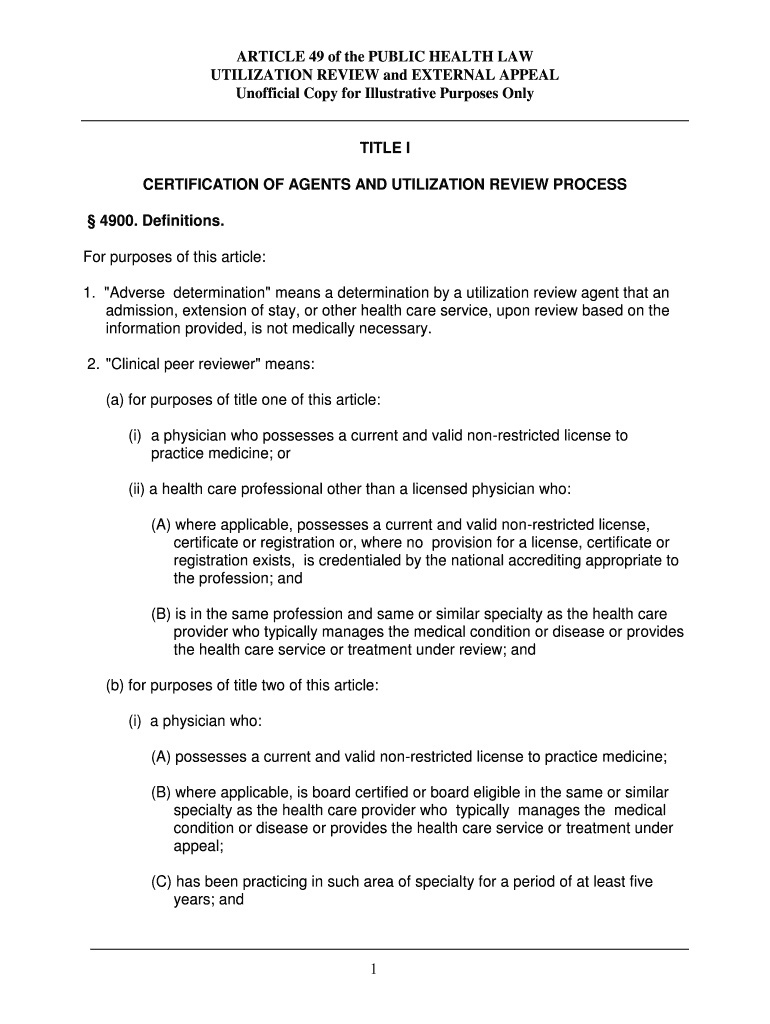







Definition & Purpose of Article 49 of the Public Health Law
Article 49 of the Public Health Law is designed to set out the framework for utilization review and external appeals concerning healthcare services in the United States. It establishes the processes and standards that govern how health care plans evaluate the necessity and appropriateness of services provided to enrollees. This article defines critical terms and clarifies the roles and responsibilities of utilization review agents, emphasizing the importance of timely communication, confidentiality, and adherence to clinical standards in decision-making. The article ensures that healthcare service evaluations are conducted fairly, providing enrollees with the right to appeal adverse determinations.
Key Elements of Article 49
Utilization Review Process
The utilization review process is a critical component of Article 49. Utilization review agents are responsible for assessing the necessity, appropriateness, and efficiency of healthcare services provided to enrollees. This process involves several stages, each designed to protect patient rights and ensure that healthcare services meet established clinical standards.
- Initial Review: Conducted by a utilization review agent to determine the immediate appropriateness of the healthcare services in question.
- Appeal Rights: Enrollees have the right to appeal any adverse determinations resulting from the initial review. This appeal must be submitted within a specific timeframe to be valid.
External Appeal Procedures
Article 49 establishes a structured process for external appeals, which enrollees can pursue if dissatisfied with the internal appeal results.
- Eligibility for External Appeals: Enrollees must meet specific criteria to be eligible for an external appeal. These appeals are typically sought when internal options have been exhausted.
- Clinical Peer Reviewers: External appeals require involvement from independent clinical peer reviewers to ensure unbiased evaluations of the healthcare services rendered.
Important Terms Related to Article 49
Understanding key terms is essential for navigating Article 49 effectively. Key terms include:
- Adverse Determination: A decision by a health care plan that denies, reduces, or terminates a requested healthcare service.
- Clinical Standards: Established medical guidelines and protocols used to assess the appropriateness of healthcare services.
- Utilization Review Agent: An individual or entity responsible for conducting utilization reviews as prescribed by Article 49.
Legal Use and Compliance
Article 49 mandates compliance with specific legal and ethical standards to protect patient rights during utilization review processes.
- Timely Communication: Agents must communicate decisions promptly to minimize delays in healthcare delivery.
- Confidentiality: Patient information must be handled with strict confidentiality throughout the review and appeal processes.
Who Typically Uses Article 49
Healthcare Providers and Insurers
- Providers: Engage with Article 49 to understand their rights and responsibilities in utilization reviews and appeal processes.
- Insurers: Employ the regulations within Article 49 to design and execute compliant utilization review procedures.
Enrollees
Enrollees, or plan members, use Article 49 to advocate for fair healthcare service evaluations and pursue appeals as needed to resolve disputes regarding service determinations.
State-Specific Rules and Variations
While Article 49 outlines federal guidelines, individual states may have variations or additional regulations.
- State Addendums: Some states enhance the basic framework of Article 49 with supplementary regulations to address local healthcare dynamics.
- State Offices: Many states have dedicated offices or ombudsmen to assist with issues arising under Article 49.
Steps to Complete an Article 49 Process
- Understand Your Rights: Patients and providers should familiarize themselves with the rights and responsibilities outlined in Article 49.
- Initiate Utilization Review: The review process typically begins with an internal evaluation by the healthcare provider or insurer.
- File an Internal Appeal: If an adverse determination is made, an initial appeal can be filed within the specified time limit.
- Pursue External Appeal: Should the internal appeal not yield a favorable outcome, an external appeal might be warranted.
Examples of Using Article 49
Real-World Scenarios
- Denied Service Coverage: An enrollee denied necessary surgery challenges the decision through both internal and external appeal processes.
- Expedited Appeals for Urgent Care: In an urgent medical situation, Article 49 permits expedited reviews and appeals to prevent harm or prevent medical crises.
These examples illustrate the practical applications of Article 49 and highlight its role in protecting patient rights in the healthcare system.




