
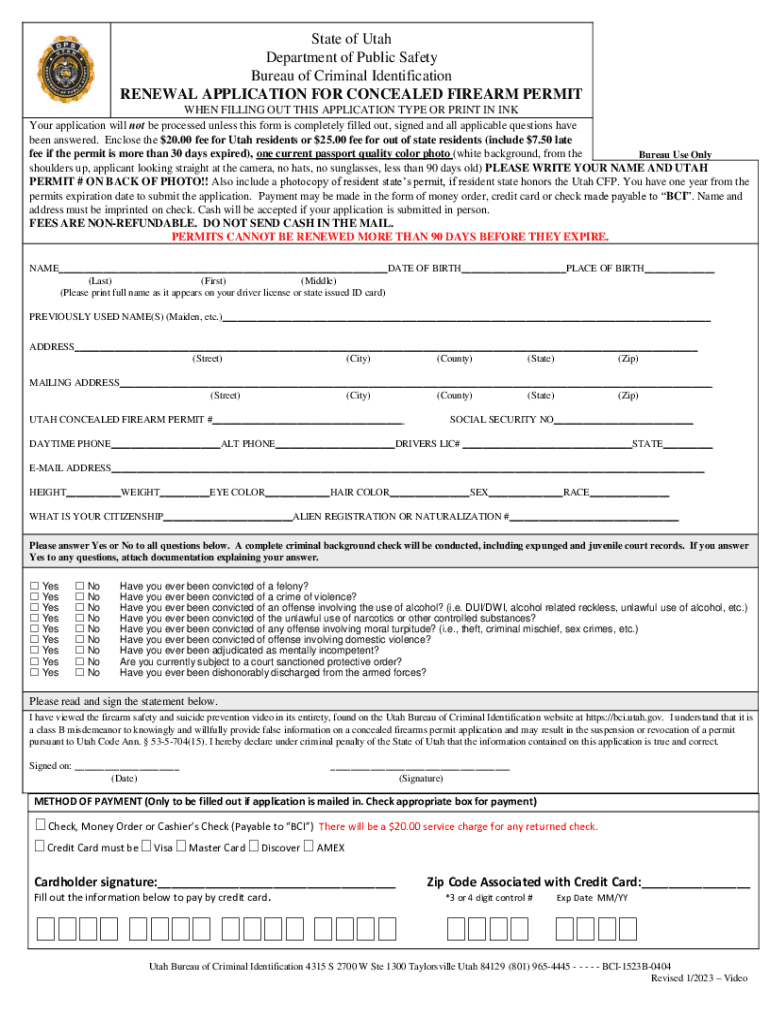







Definition and Meaning of the State of Utah Department of Public Safety Bureau of
The State of Utah Department of Public Safety (DPS) Bureau of encompasses various divisions responsible for maintaining public safety and regulatory functions within Utah. The Bureau of Criminal Identification, a key component, manages the issuance of concealed firearm permits. It handles aspects like background checks, security regulations, and firearm safety education. Understanding its framework aids applicants and professionals in navigating public safety concerns within the state.
How to Use the State of Utah Department of Public Safety Bureau of Services
Individuals and agencies interact with Utah's DPS Bureau for various purposes, such as obtaining permits, accessing criminal records, and participating in training programs. The process begins by identifying the relevant division: for firearm permits, contact the Bureau of Criminal Identification. Other divisions may focus on highway safety, emergency management, or driver license issuance. Proper utilization of these services requires adhering to specific procedural frameworks tailored to each division.
Steps to Complete the State of Utah Department of Public Safety Bureau of Application
-
Gather Required Documents:
- Provide identification, residency proof, and a recent photograph.
- Ensure submission of fingerprints if required for a background check.
-
Complete the Application Form:
- Fill out the application accurately, addressing personal details and eligibility questions.
- Include responses regarding criminal history and mental competency when applying for firearm-related permits.
-
Submit the Application:
- Choose your submission method: online, via mail, or in-person at designated locations.
- Attach all necessary documentation and payment of applicable fees.
-
Await Processing and Approval:
- Application processing times vary. Follow up if necessary for status updates.
- Upon approval, receive your permit or other documentation as issued by the Bureau.
Required Documents for Application
Applicants must submit several documents, including:
- A government-issued ID as proof of identity.
- Documents proving Utah residency.
- A recent passport-sized photograph.
- Relevant forms filled with accurate details. These documents ensure the verification of the applicant’s background and eligibility.
Eligibility Criteria for Applying
Eligibility requirements differ based on the specific service needed from the Bureau. Generally, applicants must:
- Be a resident of Utah, or provide valid reasons for applying as a non-resident.
- Be 21 years or older for firearm permits.
- Pass a criminal background check as part of the application process. Meeting these criteria is crucial for successful application processing.


Important Terms Related to the Bureau
Key terms relevant to the DPS Bureau of applications include:
- Concealed Firearm Permit (CFP): Official authorization for the concealed carrying of firearms.
- Background Check: A review of an individual's criminal and legal records.
- Residency Requirement: Conditions that mandate an applicant to reside in Utah. These terms provide clarity on regulatory processes and requirements.
Legal Use and Responsibilities
Holding a permit issued by the State of Utah DPS Bureau comes with specific legal responsibilities. Permit holders must adhere to:
- Utah gun laws and regulations.
- Safe handling and storage practices for firearms.
- Understanding and compliance with renewal procedures, if applicable. Failure to comply may result in penalties or revocation of the permit.
Submission Methods and Processing Time
Applications can be filed online, mailed, or submitted in person. Each method has specific guidelines:
- Online Submissions: Quick and often preferred for ease of use.
- Mail Submissions: May take longer due to postal processing.
- In-Person: Provides a direct avenue for submitting documents and asking questions. Processing times vary, but applicants are typically notified within a standard period as defined by the Bureau.
Penalties for Non-Compliance
Non-compliance with the requirements or misuse of permits leads to penalties, which may include:
- Revocation of permits/licenses.
- Fines imposed by the Department of Public Safety.
- Potential legal action if laws are breached significantly. Maintaining compliance is crucial to avoid these repercussions.




