If you had to describe your child in their teen years, what 2026

Get Form
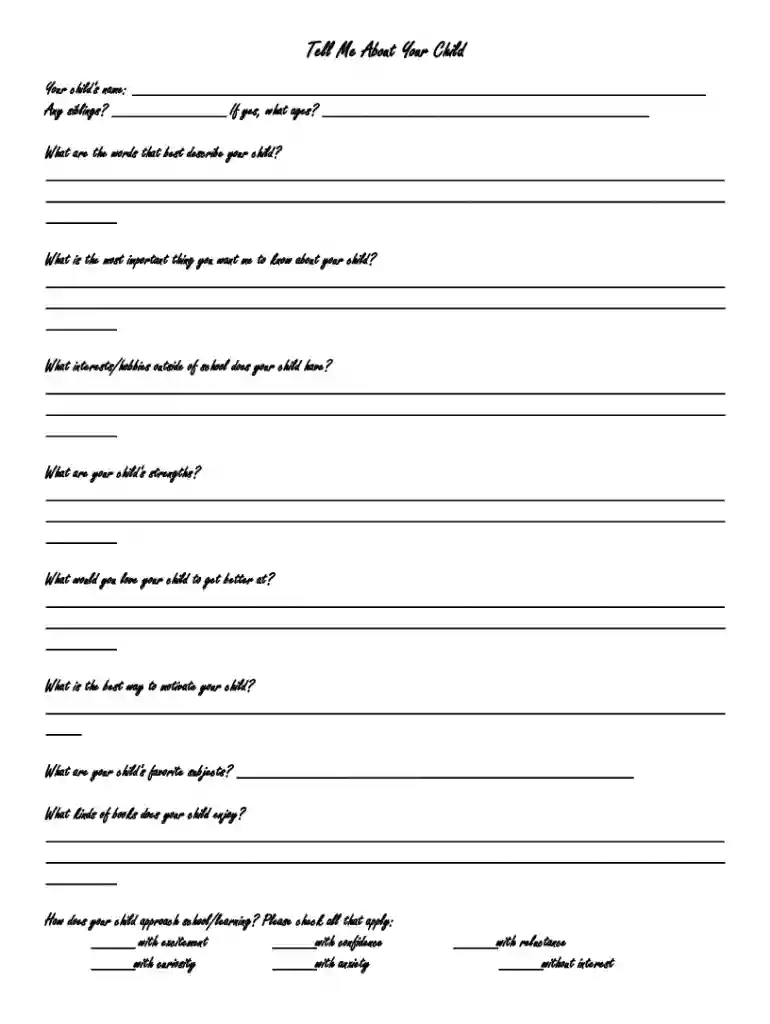
If you had to describe your child in their teen years, what Preview on Page 1

Here's how it works

01. Edit your form online
Type text, add images, blackout confidential details, add comments, highlights and more.

02. Sign it in a few clicks
Draw your signature, type it, upload its image, or use your mobile device as a signature pad.

03. Share your form with others
Send it via email, link, or fax. You can also download it, export it or print it out.

Definition and Purpose of the Form

The form titled "If you had to describe your child in their teen years, what" is a questionnaire designed to gather comprehensive insights from parents about their teenage children. This form enables educators, psychologists, and program developers to understand a child's personal attributes, behavioral tendencies, educational needs, and social interactions during their formative teenage years. By collecting this information, stakeholders can tailor educational strategies and programs to better support each child's development.

How to Use the Form

To utilize the form effectively, parents should complete each section with thoughtful and detailed answers. It's important to reflect on specific examples to ensure the information accurately encapsulates the child’s behaviors, personality traits, and intellectual strengths. Parents are encouraged to use anecdotes when describing characteristics to provide additional context. This approach facilitates a fuller understanding, allowing professionals to interpret the information more effectively when supporting the child's development.

Steps to Complete the Form

  1. Start by reading the instructions carefully to understand what each section intends to capture about the child.
  2. Fill in personal information such as the child's full name, age, and grade level.
  3. Describe the child’s strengths and interests in areas such as academics, extracurricular activities, and personal hobbies.
  4. Provide insights into learning approaches that work best for your child, such as visual aids or hands-on learning.
  5. Identify any areas of concern, including social skills or academic challenges.
  6. Express preferred communication methods for liaising with educators or program facilitators regarding the child's progress.
  7. Review your responses for accuracy and completeness before submission.

Key Elements of the Form

  • Personal Details: Basic information about the child, including age and schooling.
  • Strengths and Interests: Areas where the child excels or shows keen interest, providing insights into potential career paths or academic focus.
  • Learning Approaches: Methods and techniques that enhance the child’s learning experience, helping to optimize instructional strategies.
  • Concerns and Challenges: Identified issues that might require special attention or intervention from educators or counselors.
  • Communication Preferences: Channels through which parents prefer to receive updates and communicate regarding their child's development.

Examples of Form Utilization

This form might be used by:

  • School Counselors: To create individualized educational plans that cater to the unique needs of each student.
  • Psychologists: For preliminary assessments before conducting detailed evaluations of a child's behavioral or learning difficulties.
  • Extracurricular Program Directors: To tailor programs that align with the child's interests and strengths, enhancing engagement and participation.

Important Terms Related to the Form

  • Descriptors: Characteristics or attributes used to describe the child’s personality or abilities.
  • Anxiety Levels: A measure of how stress or anxiety might impact the child's learning or social interactions.
  • Cognitive Styles: Referring to how the child processes information and their preferred methods of learning.

Legal Use and Confidentiality

Information provided in the questionnaire is often protected under privacy laws like the Family Educational Rights and Privacy Act (FERPA) in the U.S. This ensures that responses are kept confidential and are only used for the purpose of enhancing the child's educational journey. Educators and administrators must obtain explicit consent from parents or guardians before sharing information outside the intended scope.

Digital vs. Paper Version

The form is often available in both digital and paper formats. The digital version can be completed online and may provide the convenience of electronic submission. The paper version can be completed by hand and mailed or submitted in person if digital access is limited or if parents prefer a physical document trail.

By understanding and utilizing the form "If you had to describe your child in their teen years, what," stakeholders can better assist children during a critical period of their development, providing targeted support that fosters growth and addresses individual needs.

be ready to get more

Complete this form in 5 minutes or less

Get form

Got questions?

We have answers to the most popular questions from our customers. If you can't find an answer to your question, please contact us.
Contact us
List of Adjectives for Children DeterminedLeaderNurtured Understanding Fierce Courageous Unique Gifted Compassionate Hard-working Believable Affectionate Involved Meticulous Easy-going23 more rows
The enduring characteristics of an individuals behavior, attitude, and feelings in everyday social situations make up personality. There are many influences on an individuals personality, including culture, genetic makeup, and early family life.
Synonyms of children kids. youths. juveniles. youngsters. teenagers. cubs. adolescents. chicks.
Adlers theory suggests that the youngest children tend to be outgoing, sociable, and charming. While they often have more freedom to explore, they also often feel overshadowed by their elder siblings, referred to as youngest child syndrome.
ing to Galen, the imbalance of pairs resulted in one of the four temperament categories (or personality types): sanguine (being optimistic and social), choleric (being short-tempered and irritable), melancholic (being analytical and quiet), and phlegmatic (being relaxed and peaceful).

Security and compliance

At DocHub, your data security is our priority. We follow HIPAA, SOC2, GDPR, and other standards, so you can work on your documents with confidence.


Learn more
ccpa2
pci-dss
gdpr-compliance
hipaa
soc-compliance

People also ask

Key traits that determine a childs personality include: Activity level (how active the child is) Distractibility (degree of concentration) Intensity (how loud the child is) Regularity (predictability of biological functions, such as appetite, sleep) Sensory threshold (sensitivity to physical stimuli)
The 4 Types of Kids Personalities Choleric the dominant child. Strong-willed, passionate, outspoken, bold, determined, and competitive. Sanguine the expressive child. Imaginative, playful, social, talkative, and active. Melancholic the analytical child. Phlegmatic the loyal child.
A child ( pl. children) is a human being between the stages of birth and puberty, or between the developmental period of infancy and puberty. The term may also refer to an unborn human being.

Related links