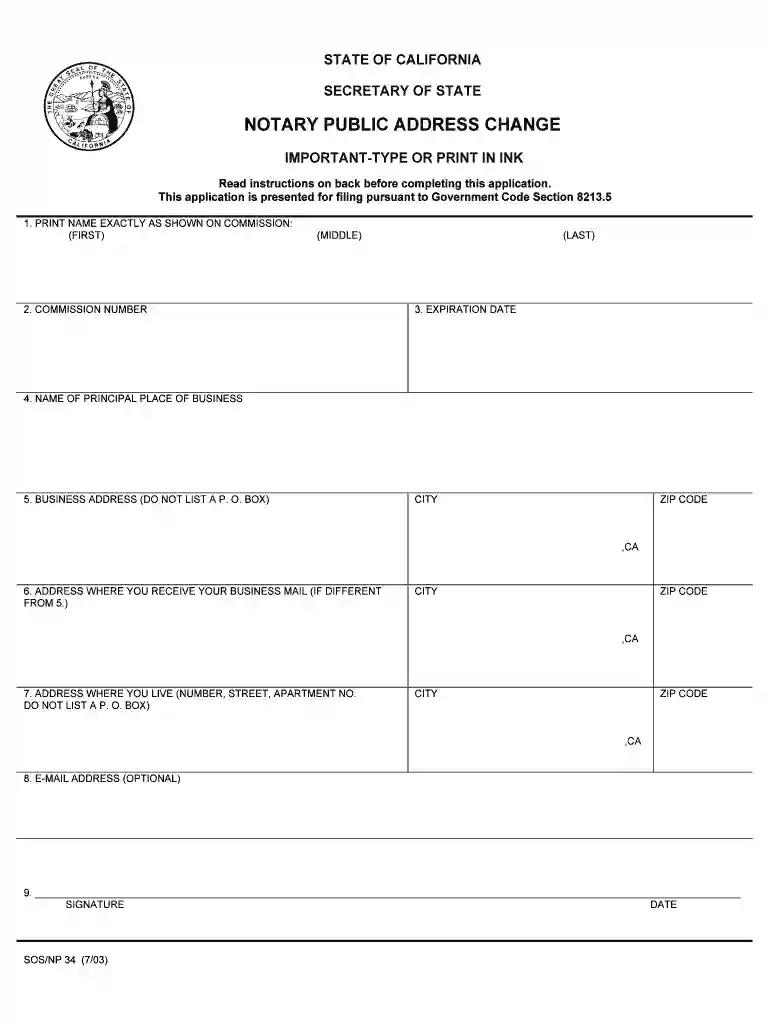
Mail completed form by certified mail to: Secretary of State, Notary - sos ca 2026

Get Form
Mail completed form by certified mail to: Secretary of State, Notary - sos ca Preview on Page 1

Here's how it works

01. Edit your form online
Type text, add images, blackout confidential details, add comments, highlights and more.

02. Sign it in a few clicks
Draw your signature, type it, upload its image, or use your mobile device as a signature pad.

03. Share your form with others
Send it via email, link, or fax. You can also download it, export it or print it out.

Definition and Purpose

The "Mail completed form by certified mail to: Secretary of State, Notary - sos ca" is a specific process followed by Notary Publics in California to officially change their address with the Secretary of State's office. This form is vital for ensuring that their official records remain updated and reflect their current contact information. Completing and mailing this form to the designated address through certified mail helps maintain the authenticity and legal standing of the notary records. Certified mailing provides proof of dispatch and receipt, critical for maintaining a clear record of compliance with state requirements.

How to Use the Form

  1. Obtain the Form: The first step involves acquiring the appropriate address change form, which is typically available from the California Secretary of State's website or office.
  2. Fill Out the Form: Carefully enter all required fields, including personal information and details of the new address.
  3. Double-Check for Accuracy: Before mailing, verify that all information is correct to avoid delays or rejections.
  4. Prepare for Submission: Attach any required supporting documents and enclose the completed form in an envelope for mailing.
  5. Mail the Form: Send the completed form via certified mail to the specified mailing address of the California Secretary of State, Notary Section. This confirms delivery and ensures there is a receipt of submission.

Steps to Complete the Form

  1. Personal Information: Begin by entering your full legal name, notary commission number, and contact information.
  2. Current Address: Provide your existing address as recorded with the Secretary of State.
  3. New Address: Indicate the new address you wish to update in the state's records.
  4. Business Details: If applicable, include details about the notary service, such as business name and contact information.
  5. Review and Sign: Thoroughly review all entries for errors or omissions and sign the form to validate the information provided.
  6. Assembly and Mailing: Attach any necessary support documents, seal the envelope, and send it via certified mail for tracking and verification.

Who Typically Uses the Form

This form is primarily utilized by notaries within California who need to update their official mailing or business address with the Secretary of State. Notaries may include those who handle legal, business, or financial documents that require notarization in accordance with California laws. Keeping updated contact details is crucial to receive important documentation and notices from the state.


decoration image ratings of Dochub

Legal Implications of Certified Mail

Sending this form via certified mail carries specific legal assurances. It provides:

  • Proof of Mailing: Ensures a certified record of when the form was dispatched.
  • Proof of Receipt: Confirms when the Secretary of State's office received the form, safeguarding against claims of unreported address changes.
  • Legitimacy and Compliance: Helps maintain compliance with state requirements, reinforcing trust in the notary's services.

Key Elements of the Form

  • Personal and Contact Details: Accurate personal information ensures that records are up-to-date and any correspondence from the state reaches the correct address.
  • Address Information: Exact details of the new address are crucial to avoid any miscommunication or loss of important documents.
  • Signatory Confirmation: The signature of the notary confirms the authenticity of the changes and personal responsibility for the accuracy of the information provided.

State-Specific Rules

The California Secretary of State has particular rules about updating notarial commission details. Notaries must:

  • Report Address Changes Promptly: Typically within 30 days of moving.
  • Use Specified Forms: Only approved forms will be considered valid for processing such updates.
  • Pay Any Required Fees: Check for any associated processing fees.

Examples of Form Use

A newly relocated notary has updated their residence. To ensure that their commission, correspondence, and legal documents align with this change, they complete this form and mail it via certified mail, confirming receipt and compliance. Another notary may move their business offices, requiring them to update their principal place of business on official records through a similar process.

Penalties for Non-Compliance

Failure to update one’s address with the Secretary of State can lead to:

  • Formal Warnings or Notice: From the state regarding outdated records.
  • Potential Suspension: Of notary commission until compliance is met.
  • Administrative Penalties: If the failure to update leads to miscommunication or legal discrepancies.

Required Documents

When submitting the form, ensure to include:

  • Valid Identification: To verify identity, such as a driver's license or passport.
  • Notary Commission Details: Like your commission certificate.
  • Proof of New Address: Utility bills or lease agreements for verification.

Providing a comprehensive understanding and following these instructions will ensure a smooth transition when updating your address with California’s Secretary of State office.

be ready to get more

Complete this form in 5 minutes or less

Get form

Got questions?

We have answers to the most popular questions from our customers. If you can't find an answer to your question, please contact us.
Contact us
Willfully failing to discharge faithfully any of the duties required of a Notary is punishable by up to a $1,500 civil penalty (Government Code 8214.15[a]). Depending on the type of identification violation, the civil penalty could skyrocket to $10,000 (Civil Code 1185).
Willful failure to deliver the notary journal and other notarial records to the county clerk within the appropriate time is a misdemeanor, and the notary public is personally liable for damages to any person injured by the non-delivery. (California Government Code section 8209(a).)
Exam results will be available 15 business days after the examination. CPS HR Consulting will mail the exam results to applicants. A score of 70 or more is required to pass the exam. Exam results will not be discussed over the telephone.
Leaving Your Current Position You must take the supplies with you. Your commission, seal, and notary journal belong to you. You must always keep your seal and journal in your possession. Never give them to anyone, including your employer.
The completed form can be mailed to Secretary of State, Document Filing Support Unit, P.O. Box 944228, Sacramento, CA 94244-2280 or delivered in person to the Sacramento office, 1500 11th Street, 3rd Floor, Sacramento, CA 95814.

Security and compliance

At DocHub, your data security is our priority. We follow HIPAA, SOC2, GDPR, and other standards, so you can work on your documents with confidence.
Learn more
ccpa2
pci-dss
gdpr-compliance
hipaa
soc-compliance

People also ask

California: Upon resignation or non-renewals, notaries are required to deliver notary journals within 30 days to the county clerks office where their oaths are on file.
2:35 5:52 And then youre going to place your notary stamp here. And this California acknowledgement isMoreAnd then youre going to place your notary stamp here. And this California acknowledgement is complete moving on to the California Jurat the purpose of the California.
The journals remain yours until you resign your commission or let it expire, then you have to turn them in to the county clerk. The clerk will keep the journals on file, usually for up to 10 years or so, depending on the county and the space they have for storage.

Related links