






Definition & Meaning
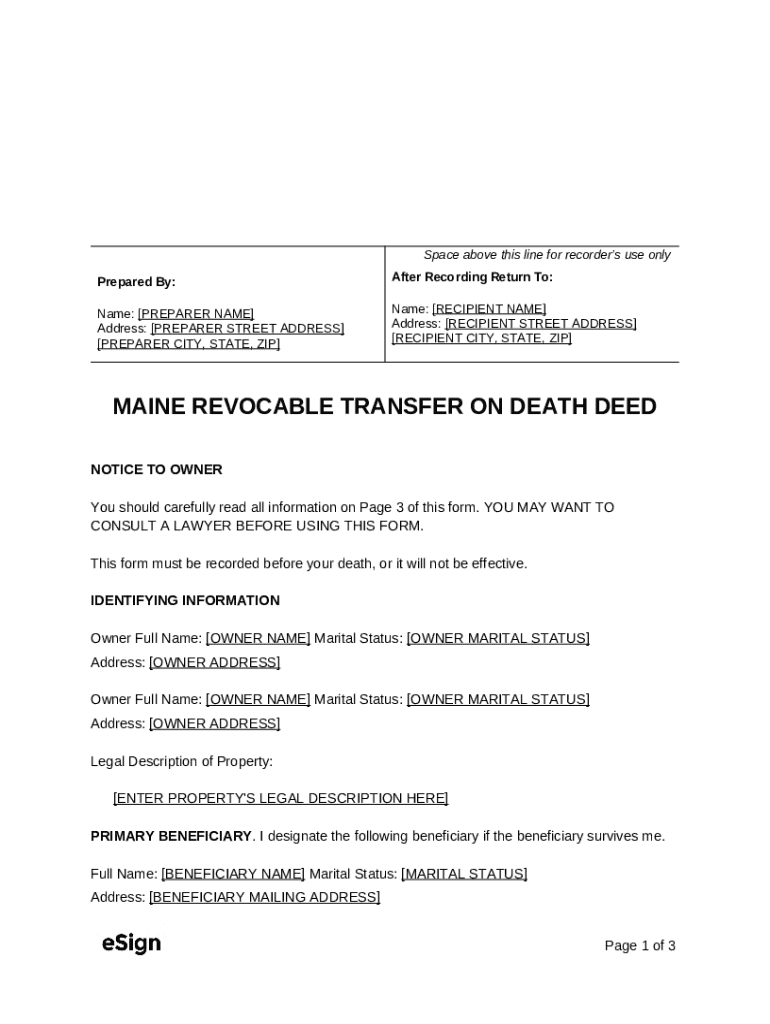
The Maine Transfer on Death Deed Form, also known as a Revocable Transfer on Death Deed, is a legal instrument used to transfer real property to designated beneficiaries upon the death of the property owner, without requiring probate proceedings. This deed enables a straightforward process for property succession and is an essential document for estate planning in Maine. Unlike other property transfer methods that involve elaborate legal and court proceedings, this deed simplifies the transfer process by allowing the property to bypass probate.
Features
- Probate Avoidance: Allows property to pass directly to beneficiaries, bypassing the probate process.
- Revocable Nature: The property owner can revoke or alter the deed at any time during their lifetime.
- Beneficiary Designation: Owners can specifically name beneficiaries to inherit the property.
How to Use the Maine Transfer on Death Deed Form
The use of the Maine Transfer on Death Deed Form involves several critical steps to ensure the document is legally binding and effective. The form is used primarily to assign property rights to individuals or entities without engaging in the formal probate process upon the owner’s death.
Practical Steps
- Consult a Lawyer: To ensure that the form complies with legal requirements and considers personal circumstances.
- Complete the Form: Fill out all necessary sections, including owner and beneficiary details.
- Sign and Notarize: The form must be signed and notarized to be legally binding.
- Record the Deed: File the completed and notarized deed with the county recorder’s office.
Steps to Complete the Maine Transfer on Death Deed Form
Completing this form requires careful attention to detail and adherence to legal standards. Here is a step-by-step process to guide you:
- Gather Required Information: Collect information about the property, the owner, and the designated beneficiaries.
- Fill Out the Form:
- Owner's Details: Complete the section with the property owner's name and contact information.
- Property Description: Accurately describe the property to be transferred.
- Beneficiary Designation: Clearly state the beneficiaries’ names and contact information.
- Signature and Notarization: Both mandatory for the deed's validity.
- Recording the Deed: Submit the document to the local county’s recording office for filing.
Legal Use of the Maine Transfer on Death Deed Form
This deed is designed to legally change the ownership of property upon the owner's death while avoiding probate. It is crucial that the form is filled out correctly and conforms to Maine’s legal regulations to ensure its validity.
Key Considerations
- Revocation: Can be revoked or modified any time before the owner's death.
- Compliance: Must comply with state-specific laws and must be recorded properly to be binding.
- Lawyer Consultation: Strongly advised for drafting and reviewing the document.
Important Terms Related to Maine Transfer on Death Deed Form
Understanding key terms associated with the Maine Transfer on Death Deed Form is essential for its proper utilization.
Terms
- Probate: A legal process in which a will is reviewed to determine whether it is valid and authentic.
- Beneficiary: A person designated to receive the benefit of the property upon the owner's death.
- Revocation: The act of recalling or voiding a deed.
State-Specific Rules for the Maine Transfer on Death Deed Form
Maine has specific rules governing the use of transfer on death deeds, which ensure compliance and validity.
State Regulations
- Recording Requirement: Must be recorded in the county where the property is located to take effect.
- Notarization: Required to confirm the authenticity of the owner's signature.
- State Law Compliance: Subject to Maine state property laws and estate regulations.
Key Elements of the Maine Transfer on Death Deed Form
Certain critical components ensure the deed's effectiveness and validity.
Essential Sections
- Identifying Information: Includes the property owner’s and beneficiaries’ details.
- Legal Description of Property: A precise description for identification.
- Signature and Notarization: All signatures must be notarized.
Examples of Using the Maine Transfer on Death Deed Form
Real-life scenarios illustrate the practical benefits and applications of this deed form.
Scenario Examples
- Single Family Home: A property owner transfers ownership of their home to their children to avoid probate.
- Vacant Land: Owner ensures land is passed on to a charitable organization without probate proceedings.
Each scenario demonstrates the efficiency and effectiveness of a transfer on death deed in avoiding complex probate issues while securing property for the next generation or beneficiaries.