01. Edit your michigan inspection online
Type text, add images, blackout confidential details, add comments, highlights and more.

Type text, add images, blackout confidential details, add comments, highlights and more.

Draw your signature, type it, upload its image, or use your mobile device as a signature pad.

Send form tr 13a via email, link, or fax. You can also download it, export it or print it out.
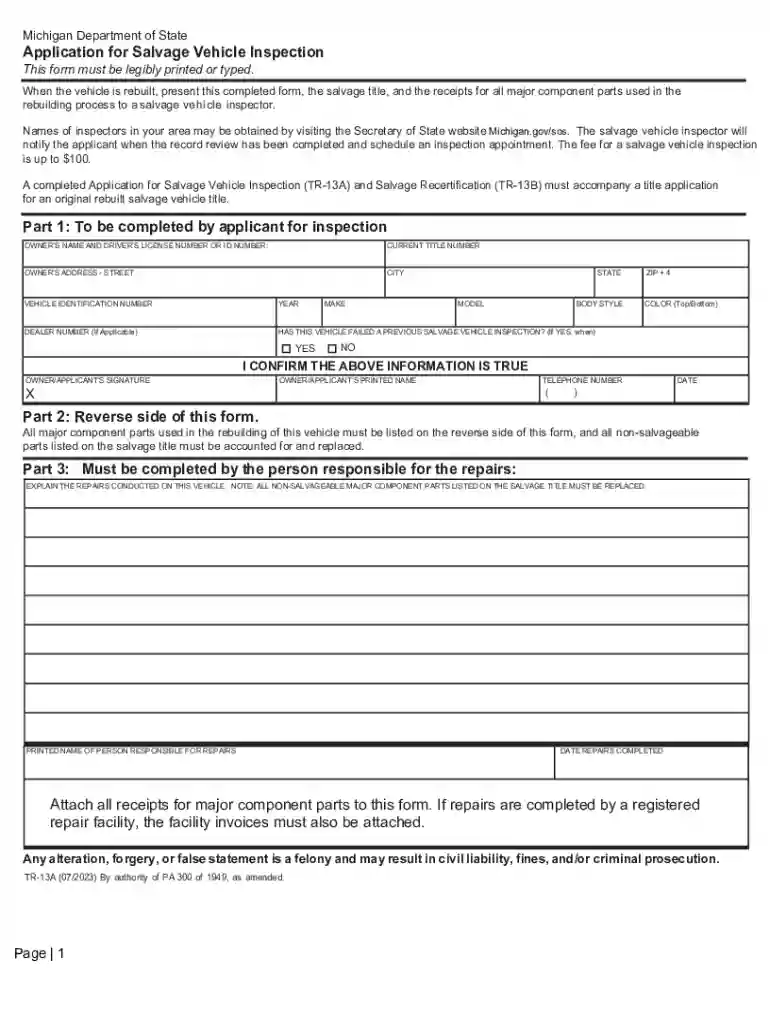
The TR-13a Application for Salvage Vehicle Inspection Vehicle Dealer is a form used by vehicle dealers in the state of Michigan. This application facilitates the process of inspecting rebuilt salvage vehicles, ensuring they meet state safety and operational standards before being put back on the road. The primary goal is to ascertain that the vehicle has been restored properly after a significant accident or damage that caused it to be deemed a total loss. This form is a critical tool for dealers to demonstrate compliance with state regulations and validate that a vehicle is fit for resale or use.
Gather Necessary Documentation: Before filling out the TR-13a form, collect all required documents, including the salvage title, receipts for major component parts used in repairs, and any prior inspection reports. These documents are essential to verify the work done on the vehicle.
Detail Vehicle Repairs: Fill in the section of the form that requires a detailed account of all repairs conducted. This includes listing each major component that has been repaired or replaced, such as the engine, transmission, or airbags.
Certification by a Licensed Mechanic: Ensure that a licensed mechanic certifies the repairs. This includes signing off on the work done, attesting that all repairs meet the necessary safety standards. The mechanic's contact information and license number must be included in the form.
Fee Payment: Include the inspection fee, which can be up to $100. Payment methods vary, so confirm the acceptable forms of payment with the Michigan Department of State.
Submit the Application: The completed form, along with supporting documents and payment, can be submitted to the appropriate state department. Check the submission methods available, such as mail or in-person drop-off, to ensure timely processing.
This application is primarily used by licensed vehicle dealers in Michigan who handle vehicles with salvage titles. These dealers need to ensure the vehicles are restored according to state regulations before these vehicles can be sold or registered. Additionally, individuals purchasing a salvage vehicle for personal use may also engage with a licensed dealer to complete the necessary inspections using this form.


The TR-13a Application is part of Michigan's regulatory framework to ensure that vehicles rebuilt from salvage titles meet safety requirements before being used on the road. Compliance with these regulations not only ensures road safety but also protects consumers from purchasing vehicles with unaddressed damages. Completing this form in adherence with the state guidelines helps avoid legal penalties and ensures the vehicle conforms to Michigan’s vehicular safety standards.
The TR-13a Application can be submitted through various channels, although availability may vary based on state provisions:
Consider the case of a vehicle dealership that acquires vehicles with salvage titles for resale. By using the TR-13a Application, the dealership can document and verify all repairs have been made according to Michigan's safety standards. This process assures potential buyers of the vehicle’s safety and compliance with state regulations. Similarly, an individual wanting to restore a personal vehicle deemed a total loss would use this form to evaluate and certify the repairs before registration and use.
Michigan has specific rules governing the restoration and inspection of salvage vehicles, which the TR-13a Application adheres to. Dealers must ensure they are up-to-date with state-specific guidelines, as these can influence the procedures for salvage vehicle inspections. Checking the Michigan Department of State’s official guidance can provide the most current requirements and protocols to follow.
We've got more versions of the michigan inspection form. Select the right michigan inspection version from the list and start editing it straight away!
At DocHub, your data security is our priority. We follow HIPAA, SOC2, GDPR, and other standards, so you can work on your documents with confidence.