




01. Edit your form online
Type text, add images, blackout confidential details, add comments, highlights and more.

Type text, add images, blackout confidential details, add comments, highlights and more.

Draw your signature, type it, upload its image, or use your mobile device as a signature pad.

Send it via email, link, or fax. You can also download it, export it or print it out.
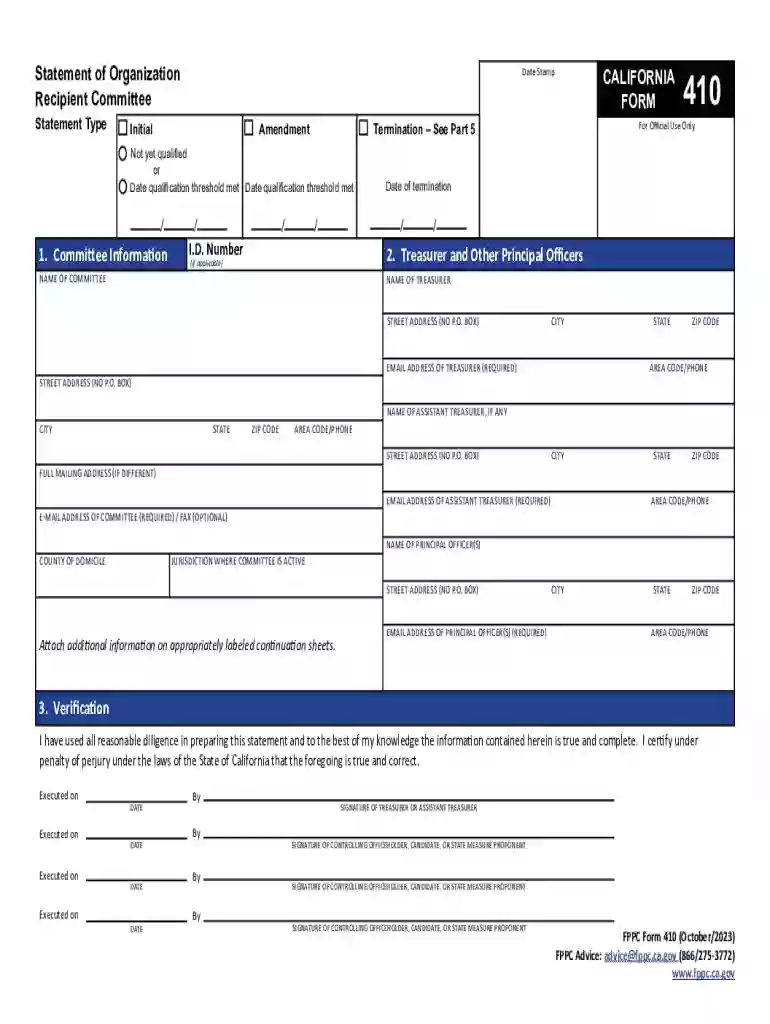
The Statement of Organization, also known as Form 410, is essential for political committees in California. This form is used to formally register with the Secretary of State, as required by the Fair Political Practices Commission (FPPC). Committees that raise $2,000 or more in contributions must file Form 410 to disclose their intent to operate, ensure transparency, and provide essential information about the committee’s purpose and financial activities.
Completing Form 410 requires attention to detail and accurate information. The process involves several key steps:
Gather Necessary Information: Before filling out the form, gather details about your committee, including its name, address, and contact information. You also need financial account details and specifics about the committee treasurer and principal officers.
Identify the Type of Committee: Determine whether your committee is a recipient, independent expenditure, or major donor. This categorization affects reporting responsibilities and disclosure requirements.
Fill Out Basic Sections: Enter the committee’s name, address, and any identification numbers. Clearly define the primary mission and scope of your political activities.
Designate a Responsible Officer: Assign a treasurer or another responsible individual who will ensure compliance with all financial and legal obligations.
Sign and Date: Ensure that the form is signed and dated by an authorized committee member, certifying the accuracy of the information provided.
Submit the Form: Send the completed Form 410 to the Secretary of State’s Political Reform Division, ensuring it is submitted within ten days of qualifying as a committee.
Adhering to filing deadlines for Form 410 is crucial to avoid penalties. Initial registration must occur within ten days of receiving or spending $2,000 or more. Amendments to the form should be filed promptly if there are changes to the committee’s details, such as its address or leadership. Timely filings are a critical aspect of maintaining good standing and transparency with the FPPC.
Essential elements of Form 410 include the committee’s name, purpose, and contact information. Accurate disclosure of the committee’s bank account and treasurer's details is also required. Additionally, the form must indicate the type of committee and the expected duration of its activities. A comprehensive understanding of these elements ensures compliance and effective organization.
Form 410 is primarily used by political committees in California, such as:
Each type of committee has unique reporting requirements and responsibilities under California's political finance laws.


Understanding the legal requirements related to Form 410 is crucial for maintaining compliance. Political committees must adhere to legal standards outlined by the FPPC, which include transparent reporting of financial contributions and expenditures. Violations, such as failing to file or providing incorrect information, can lead to penalties or disqualification. Committees must regularly review and update Form 410 to ensure ongoing compliance.
The form can be obtained from the California Secretary of State's website or directly from the FPPC. It is available in a downloadable PDF format, which can be filled out digitally or printed for manual completion. Committees should ensure they have the most current version of the form and consult the FPPC guidelines for further instructions.
Failure to comply with filing and reporting requirements can result in significant penalties. These may include fines, legal consequences, and damage to the committee’s reputation. It is essential to maintain accurate records, adhere to deadlines, and fully disclose all committee activities to avoid these repercussions. Regular audits and internal checks can help ensure compliance and prevent potential violations.
Form 410 is governed by state-specific regulations unique to California. These rules mandate precise reporting and disclosure practices tailored to the state's political landscape. Committees should consult legal advisors or refer to FPPC resources to fully understand the state-specific requirements and ensure that all aspects of their filing are in compliance with California laws.
We've got more versions of the statement-of-organization-form-410 form. Select the right statement-of-organization-form-410 version from the list and start editing it straight away!
At DocHub, your data security is our priority. We follow HIPAA, SOC2, GDPR, and other standards, so you can work on your documents with confidence.
Form 410 Statement of Organization The Form 410 must be filed within 10 days of receiving $2,000 in contributions. When filing the Form 410, include a $50
Statement of Organization Recipient Committee (form 410) Amendment # 1323890. California Secretary of State. Tesoro Corporation is a FORTUNE 100 company and


