







Understanding the In re L S - Supreme Court Ohio Case
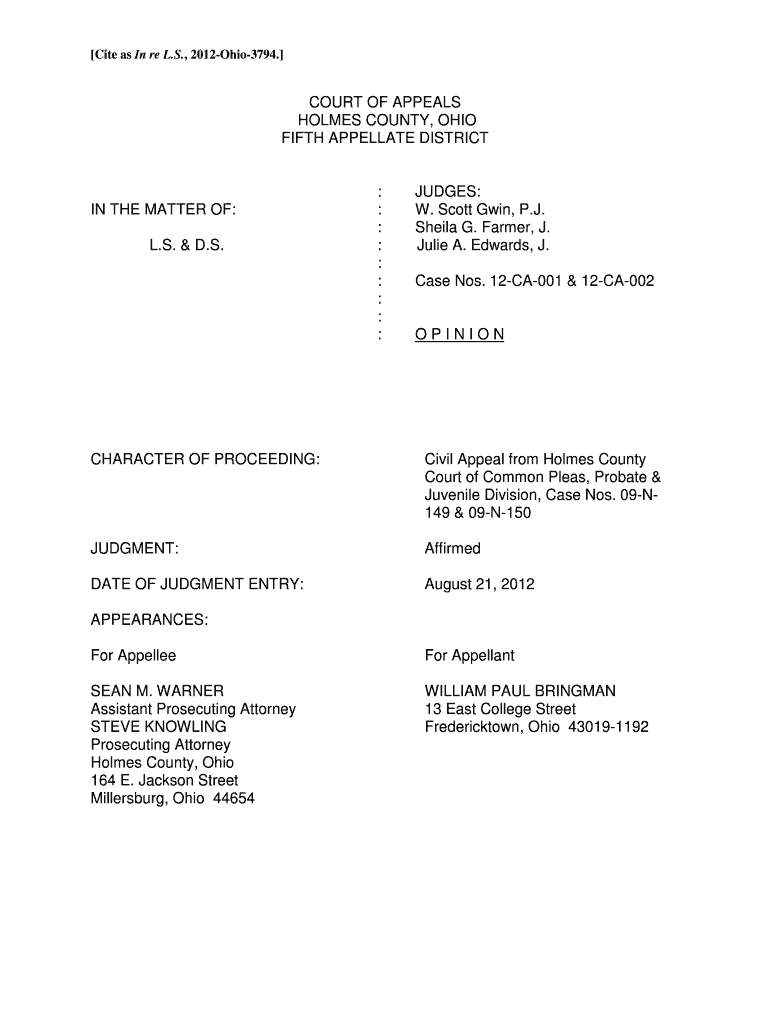
The "In re L S - Supreme Court Ohio" refers to a legal case from the Ohio Court of Appeals concerning the custody of children L.S. and D.S., with a focus on determining the appropriateness of granting legal custody to their relatives, Doyle and Lydia Lee. This case is foundational in understanding the intricacies of family law related to custody issues and the factors considered by courts in determining the best interests of children.
Definition & Meaning
In legal contexts, "In re" is a term used to denote cases involving certain subjects or individuals, primarily used in legal proceedings such as bankruptcy, probate, and custody cases. In the context of "In re L S - Supreme Court Ohio," it denotes the legal proceedings involving the minor L.S. and related custody matters considered in the Ohio court system.
Key Elements of the Case
Several factors were pivotal in the appellate court's decision to uphold the lower court’s ruling:
- Neglect Concerns: Evidence presented highlighted concerns regarding neglect and unsanitary living conditions in the parents’ home.
- Impact on Well-being: Considerations were given to the potential negative impacts on the children’s well-being if visitation were not supervised.
- Legal Custody Decision: The decision to grant legal custody to relatives was affirmed, ensuring the children's best interests were prioritized.
Legal Use of the Form
In family law cases, legal practitioners may refer to case details like "In re L S" to draw parallels or distinctions in ongoing or future custody cases. These cases provide precedent and guidance on how similar situations might be adjudicated, emphasizing factors like the child's welfare, living conditions, and parental capabilities.
Importance of the Case
- Child Welfare: The case underscores the court’s role in safeguarding child welfare by ensuring living conditions and parental interactions support their healthy development.
- Precedent Setting: It serves as a reference point for legal professionals dealing with custody disputes, emphasizing the need for detailed evaluations of home environments and child-care arrangements.
- Parental Responsibility: Highlights the legal obligations of parents to provide a safe and nurturing environment, reinforcing that failure can result in custody changes.
State-Specific Rules in Ohio
Ohio has unique legal standards for custody cases, prioritizing the best interests of the child above all:
- Supervised Visitation: Courts may order supervised visitation when concerns about a parent’s environment or behavior could potentially harm the child.
- Relatives as Custodians: The court often considers placing children with relatives if the biological parents are deemed unsuitable, providing continuity and stability in the child's life.
How to Use the In re L S Case as a Legal Reference
Legal practitioners can utilize the findings and conclusions from the "In re L S" case to inform their arguments in court or draft custody petitions:
- Reference Neglect Evidence: Use documented neglect as a benchmark for assessing similar claims.
- Evaluate Living Conditions: Advocate for thorough evaluations of home environments when arguing custody modifications.
- Highlight Precedent: Cite the case to reinforce arguments for or against changing visitation arrangements.
Examples of Applying This Case in Practice
- Custody Evaluations: In cases where neglected living conditions are suspected, referencing "In re L S" can strengthen a petition for custody reevaluation.
- Parental Coaching: Legal teams may use the case to encourage parents to improve living conditions to avoid losing custody.
- Visitation Orders: When punitive measures like supervised visits are contested, citing this case helps demonstrate the court's commitment to child welfare.
Steps Involved in Custody Modifications
Understanding the steps and legal criteria in custody cases similar to "In re L S" can be beneficial in preparing for court proceedings:
- Initial Evaluation: Gather comprehensive evidence of current living conditions and parental involvement.
- Court Petition: Present a petition outlining concerns and proposed changes, supported by evidence.
- Hearing and Decision: Attend hearings where evidence is reviewed, and decisions regarding custody or visitation are made.
- Follow-Up Actions: Depending on the court’s decision, either comply with new terms or prepare an appeal if necessary.
Potential Legal Outcomes and Considerations
When dealing with custody cases similar to "In re L S," consider possible outcomes:
- Granting of Custody to Relatives: A court may favor custodianship by relatives over the biological parents under certain conditions.
- Supervised Visits: Courts may institute supervised visits if unsupervised interactions pose risks to the child.
Understanding and applying the intricacies of cases like "In re L S" is crucial for legal professionals aiming to protect and advocate for children's well-being in custody disputes within Ohio.




