
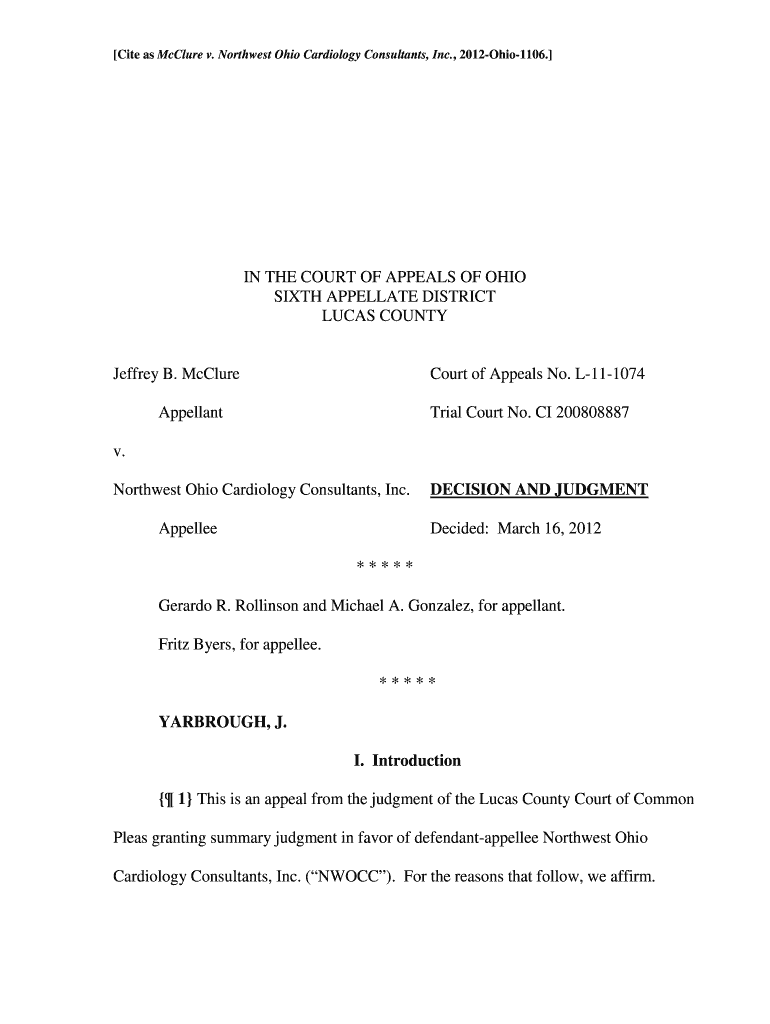







Understanding the McClure v Northwest Ohio Cardiology Consultants Case
The McClure v Northwest Ohio Cardiology Consultants case is significant for understanding employment agreements and legal proceedings within the context of Ohio law. Dr. Jeffrey McClure, the appellant, contested his termination terms, specifically regarding the deduction of tail insurance costs from his account receivable payment. The court's decision to affirm the trial court's ruling highlights the importance of clearly defined employment contracts and the implied duty of good faith and fair dealing in legal settings.
Legal Use and Implications
The McClure v NWOCC case serves as a precedent for employment contract disputes, particularly in Ohio. The court's decision reinforces that employment agreements must explicitly outline terms, such as deductions and termination procedures, to avoid legal challenges. Employers and employees should ensure that contracts clearly state all obligations and terms to minimize misunderstandings and potential conflicts. This case exemplifies how courts interpret contractual language and the importance of its clarity, which is applicable across similar jurisdictions.
Key Elements of the Case
The court assessed several critical elements in McClure v NWOCC. These included:
- Contractual Provisions: The contract's explicit allowance for tail insurance deductions was a focal point.
- Good Faith and Fair Dealing: The court considered whether NWOCC violated this implied duty.
- Summary Judgment: The justification for NWOCC's favor was based on the contract's clear language.
Understanding these elements helps in analyzing similar disputes about employment contracts and the legal arguments that may arise.
Steps to Understand Court Decisions
- Review Contractual Agreements: Examine the specifics of the employment contract, including all clauses relevant to deductions and terminations.
- Analyze Court Rulings: Understand the court's reasoning for upholding or overturning initial judgments, especially focusing on document interpretations.
- Consider Legal Implications: Reflect on how similar clauses in different cases might be interpreted based on this precedent.
State-Specific Rules and Precedents
While the McClure case is rooted in Ohio's legal environment, state-specific rules can influence the interpretation of employment contracts. It's crucial to recognize:
- Ohio's Legal Standards: This case underscores how Ohio courts prioritize contract clarity.
- Comparative State Laws: Some states may have different legal precedents or statutory requirements impacting case outcomes.
Understanding these nuances assists legal professionals in applying relevant precedents to cases within their jurisdiction.
Who Typically Uses This Court Decision
Legal practitioners, particularly those specializing in employment law, benefit from studying McClure v NWOCC. It serves as a guide for drafting clear contractual terms and preparing for court proceedings. Additionally, corporate legal counsel and human resource professionals can apply the insights gained from this case to prevent disputes.
Importance of Employment Contract Clarity
This case exemplifies the necessity of clear and concise employment agreements:
- Avoid Legal Disputes: Explicit terms help minimize misunderstandings and litigation.
- Ensure Fair Practices: Clearly defined clauses protect both parties' interests.
- Facilitate Legal Processes: Unambiguous contracts lead to smoother legal proceedings and fewer prolonged disputes.
Examples and Real-World Scenarios
Consider a scenario where a company includes a clause about post-termination payments being subject to certain deductions. Drawing from McClure v NWOCC, if challenged, courts will likely examine:
- The specific language used: Did the contract explicitly state these deductions?
- Historical practices: Was this clause consistently applied across similar cases?
- Legislative compliance: Are these practices in line with state employment laws?
These real-world applications demonstrate how companies and individuals can prepare for potential legal challenges regarding employment contracts.
Penalties for Non-Compliance
Failing to adhere to the clear terms outlined in employment contracts can result in significant penalties, such as:
- Legal costs: Financial burdens from litigation processes.
- Reputational damage: Negative public perception and loss of trust.
- Regulatory fines: Potential sanctions from state agencies if contractual breaches also violate statutory requirements.
Evaluating these risks emphasizes the importance of compliance in contract management.
Digital vs. Paper Versions
While the court decision itself is a legal document, understanding it requires access to:
- Digital Databases: Online legal resources for reviewing case law and precedents.
- Paper Copies: Traditional document analysis for in-depth reviews.
Both formats are crucial for comprehensive legal research and ensuring detailed understanding of complex cases.




