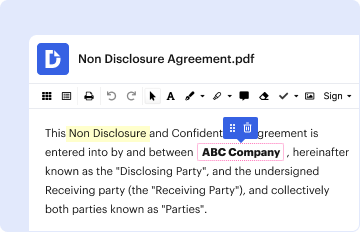
Type text, add images, blackout confidential details, add comments, highlights and more.
02. Sign it in a few clicks
Draw your signature, type it, upload its image, or use your mobile device as a signature pad.
03. Share your form with others
Send it via email, link, or fax. You can also download it, export it or print it out.
How to use or fill out MM 2 0 1 2 - tax ohio with our platform
Ease of Setup
DocHub User Ratings on G2
Ease of Use
DocHub User Ratings on G2
Click ‘Get Form’ to open the MM 2 0 1 2 - tax ohio document in the editor.
Begin by filling in your Federal Employer Identification Number (FEIN) and Ohio charter or license number if applicable. Ensure you use black ink and uppercase letters for clarity.
Complete the sections for the name and address of the pass-through entity, including any changes by checking the appropriate box.
In Schedule I, input your total income from Schedule II and total deductions from Schedule III. Calculate your net allocable income or loss as instructed.
Proceed to Schedule IV to determine your apportionment ratio based on property, payroll, and sales figures. Follow the weighted calculations carefully.
Fill out Schedule V with investor information, ensuring accuracy in ownership percentages and tax amounts paid.
Review all entries for completeness before saving your work. Utilize our platform's features to sign and distribute the completed form easily.
Start using our platform today to streamline your MM 2 0 1 2 - tax ohio form completion for free!
Schedule M-2 on Form 1120 is used to reconcile the corporations retained earnings from the beginning to the end of the tax year. It provides a clear picture of changes in retained earnings by detailing net income, distributions, and other adjustments.
How do I calculate sales tax in Ohio?
Ohio levies sales tax of 5.75% on a state level plus 0.75% to 2.25% on a county level and in some cases there is a 0.5% special sales tax. As of October 2022, the average combined sales tax rate is 7.26%.
Do I use 1 or 0 for tax withholding in Ohio?
Line 1: If you can be claimed on someone elses Ohio income tax return as a dependent, then you are to enter 0 on this line. Everyone else may enter 1.
How do I calculate sales tax on a car in Ohio?
Add your vehicles selling price and documentation fee to calculate your sales tax. Remember to look up your countys tax rate on the Ohio Department of Taxation website. You can do this by multiplying the sum of the selling price and the documentation fee.
What is sales tax in Ohio per dollar?
Ohio has a 5.75 percent state sales tax rate and an average combined state and local sales tax rate of 7.24 percent. Ohio has a 1.30 percent effective property tax rate on owner-occupied housing value. Ohio does not have an estate tax or inheritance tax.
Related Searches
Mm 2 0 1 2 tax ohio calculatorMm 2 0 1 2 tax ohio pdfMm 2 0 1 2 tax ohio 2021Mm 2 0 1 2 tax ohio 2022Ohio withholding form 2025Ohio IT 1040 instructions 2024Ohio IT 1040 form 2024Ohio tax withholding form
People also ask
Is Ohio sales tax 7%?
The state sales and use tax rate is 5.75 percent. Counties and regional transit authorities may levy additional sales and use taxes. For more information about the sales and use tax, look at the options below.
How do you calculate sales tax from total?
Sales Tax Calculation Formulas Sales tax amount = original price sales tax rate as a decimal. Sales tax rate as a decimal = sales tax percent / 100. Total price after tax: Original price before tax = total price after tax / (1 + sales tax rate as a decimal) Sales tax amount = total price after tax - price before tax.
What is the $750 tax credit in Ohio?
Scholarship Donation Credit If you file as single or married filing separately, the maximum credit is $750. If you file as married filing jointly, the maximum credit is $1,500. You may qualify if a Pass-Through Entity (PTE) that you have ownership interest in donated money to an approved SGO.
Related links
2024 Ohio IT 1040
- Total Withholding. 1. Total of all Ohio state tax withheld on pages 1 and 2 as well as any additional pages. Enter here and on line 14 of your Ohio IT 1040
The Emission Performance warranty applies to your 2017 Nissan vehicle ONLY when both of the following occur. 1. The vehicle fails to meet applicable emissions
Cookie consent notice
This site uses cookies to enhance site navigation and personalize your experience.
By using this site you agree to our use of cookies as described in our Privacy Notice.
You can modify your selections by visiting our Cookie and Advertising Notice.