







Definition and Meaning
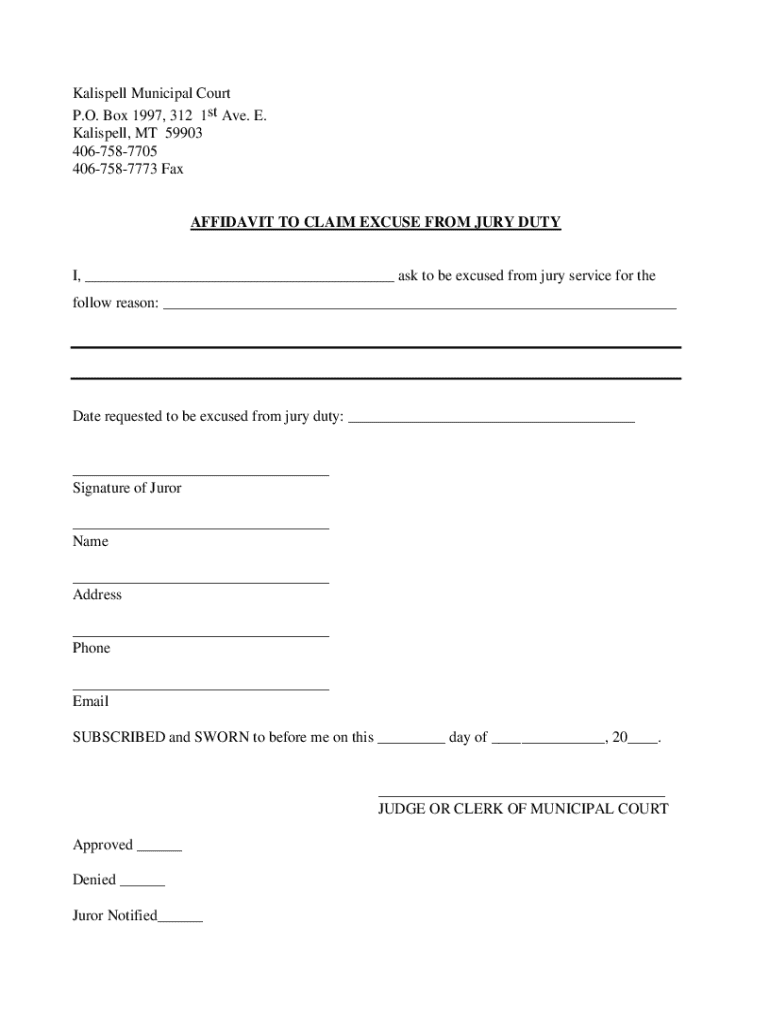
An "Affidavit to Claim Excuse" is a formal legal document used by individuals seeking exemption from responsibilities such as jury duty. In the context of the Kalispell Municipal Court, this affidavit allows a juror to formally request to be excused based on specific personal circumstances. The document requires the juror to provide detailed personal information, explain the reason for their request, and submit a signature to validate their claim. The court then reviews the affidavit and either approves or denies the excusal.
How to Use the Affidavit to Claim Excuse
-
Obtain the Form: Access the "Affidavit to Claim Excuse" from your local courthouse or official municipal court website. It may be available for download as a PDF.
-
Complete Personal Information: Fill in necessary identification details, including your full name, address, and juror identification number, if applicable.
-
State Your Reason: Clearly explain your reasoning for the request. This might include health issues, financial hardship, or caregiving responsibilities.
-
Provide Supporting Details: Include additional information or documentation that supports your claim, such as a doctor's note or employer verification.
-
Sign the Affidavit: Ensure that you electronically or physically sign the document in the designated area to affirm the truthfulness of your statements.
-
Submit for Review: Send the completed affidavit to the appropriate court office, following the guidelines provided for submission.
Steps to Complete the Affidavit to Claim Excuse
-
Step 1: Obtain a copy of the form from the appropriate source. This step ensures you are using the correct version required by the court.
-
Step 2: Fill in personal details, such as your name and contact information accurately to avoid processing delays.
-
Step 3: Detail the reason for your excusal request. Be explicit about your circumstances and how they prevent you from fulfilling jury duty obligations.
-
Step 4: Attach any necessary documents that substantiate your claims.
-
Step 5: Sign and date the affidavit to verify your statement.
-
Step 6: Submit the testimony through the preferred method, usually by mail or in-person at the court office.
Key Elements of the Affidavit to Claim Excuse
-
Personal Information Section: A segment where jurors provide identifiers such as full names, addresses, and any associated juror numbers.
-
Reason for Request: A mandatory part where individuals state their justification for the excuse in detail. This could include medical conditions, financial strain, or other significant responsibilities.
-
Signature Section: A required component where the juror affirms the accuracy and truthfulness of their provided information via a signature line.
-
Court Approval/Denial Area: A designated area for court officials to approve or deny the request, often including a space for commentary or additional instructions from the court.
Legal Use of the Affidavit to Claim Excuse
The affidavit serves as a legally binding document used within the judicial system to manage jury duty participation. Upon submission, it becomes a part of the case file, tracking the juror's request and the court's decision. Improper use or falsification of the affidavit can lead to legal penalties, including contempt of court.
Eligibility Criteria
To use an "Affidavit to Claim Excuse," individuals must generally be:
-
Summoned for Jury Duty: Only those who have received an official jury summons are eligible to request an excuse.
-
Facing Genuine Hardship: The request must be based on significant hardship or conflict, such as health issues, financial difficulties, or caregiving obligations.
-
Able to Provide Documentation: Supporting evidence, when applicable, must accompany the affidavit to substantiate the claims made.


Form Submission Methods
Jurors may submit the affidavit through various methods depending on the court's policies:
-
Online Submission: Some courts may allow electronic submissions via a designated portal.
-
Mail: Traditional postal submission remains a standard method.
-
In-Person: Direct submission at the court’s office offers immediate delivery and possible instant feedback on the filing.
Examples of Using the Affidavit to Claim Excuse
-
Health Reasons: A juror provides a doctor's note detailing a condition that makes participation impractical.
-
Financial Hardship: An affidavit claiming financial distress, supplemented with documentation like a letter from an employer or pay stubs.
-
Caregiver Responsibilities: A parent or guardian explaining caregiving duties with documentation such as school or daycare schedules.
These examples highlight scenarios where individuals might seek to be excused, showcasing the affidavit's flexibility and applicability to diverse circumstances.




