




01. Edit your form online
Type text, add images, blackout confidential details, add comments, highlights and more.

Type text, add images, blackout confidential details, add comments, highlights and more.

Draw your signature, type it, upload its image, or use your mobile device as a signature pad.

Send it via email, link, or fax. You can also download it, export it or print it out.
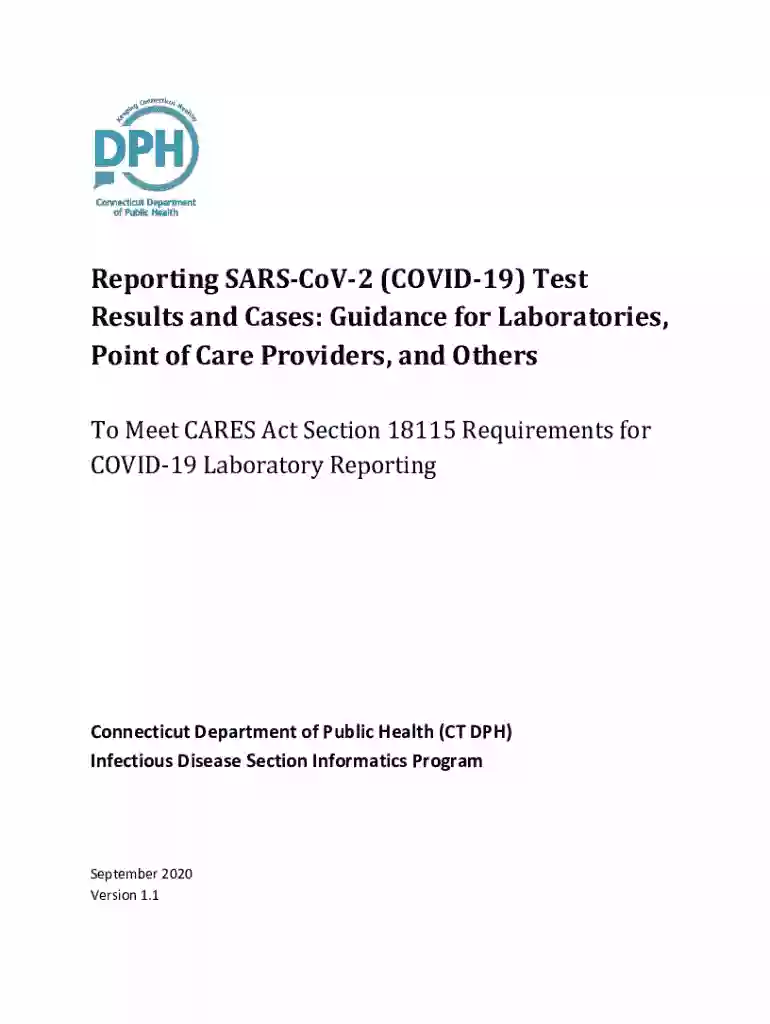
The "Reporting SARS-CoV-2 (COVID-19) Test Results and Cases" form serves as a critical tool for laboratories and healthcare providers across the United States to report COVID-19 test results accurately. Originating from the CARES Act requirements, this form ensures that essential data reaches public health authorities, enabling effective monitoring and response to the pandemic. Encompassing data elements such as patient demographics and test outcomes, the form ensures uniformity and accuracy in reporting procedures.
Gather Required Information
Ensure all necessary information, including patient demographics, test results, and case details, is collected before starting the form.
Enter Patient Details
Fill out the patient's full name, date of birth, and address. Accurate input of this data is crucial for identifying cases.
Record Test Information
Include the type of test conducted, test date, and the result. Different tests may include PCR, antigen, or antibody assessments.
Confirm Case Details
Enter any additional case details that might affect data analysis, such as symptoms onset date or hospitalization status.
Review and Submit
Double-check all entries for accuracy and any required fields. Submit the form through the preferred reporting method, ensuring it reaches the appropriate public health authorities promptly.
Primarily, this form is used by laboratories conducting COVID-19 tests and point-of-care providers who administer these tests. These entities are responsible for ensuring that test results are reported to state health departments. Such data is critical for healthcare professionals, epidemiologists, and policy-makers for tracking the pandemic's progression and making informed decisions.
Each U.S. state may have particular requirements for reporting test results, so it is essential for entities completing the form to be familiar with their state’s specific guidelines. For instance, Connecticut requires specific data elements to be reported to the Connecticut Department of Public Health (CT DPH), emphasizing the importance of accurate patient information and various reporting methods.
Laboratories Reporting
A lab conducting a high volume of COVID-19 tests utilizes HL7 electronic reporting to streamline data submission to health departments efficiently.
Clinical Context
A point-of-care provider conducting rapid antigen tests at a local health clinic may use manual reporting methods due to lower test volumes.
Mobile Testing Sites
Mobile units collecting test samples could submit results daily via flat file submissions, enhancing data flow continuity to state health systems.
Failure to report SARS-CoV-2 test results and cases accurately or promptly may result in penalties, including fines or legal action, as it can hinder public health efforts to control and monitor the spread of COVID-19. Compliance with both federal and state reporting mandates ensures timely public health responses and is legally enforced.
The form can be obtained directly from state health department websites or may be provided by the laboratory information management systems (LIMS) used by testing entities. These forms are often integrated into electronic health record systems and available in various digital formats for ease of use.
We've got more versions of the Reporting SARS-CoV-2 (COVID-19) Test Results and Cases form. Select the right Reporting SARS-CoV-2 (COVID-19) Test Results and Cases version from the list and start editing it straight away!
| Versions | Form popularity | Fillable & printable |
|---|---|---|
| 2020 | 4.8 Satisfied (31 Votes) |
At DocHub, your data security is our priority. We follow HIPAA, SOC2, GDPR, and other standards, so you can work on your documents with confidence.
CMS-certified long-term care (LTC) facilities may submit point-of-care SARS-CoV-2 testing data to CDCs National Healthcare Safety Network (NHSN).
Nov 11, 2025 Reporting of COVID-19 Results. All positive COVID-19 test results must be reported to public health. If you dont currently have an accountRead more


