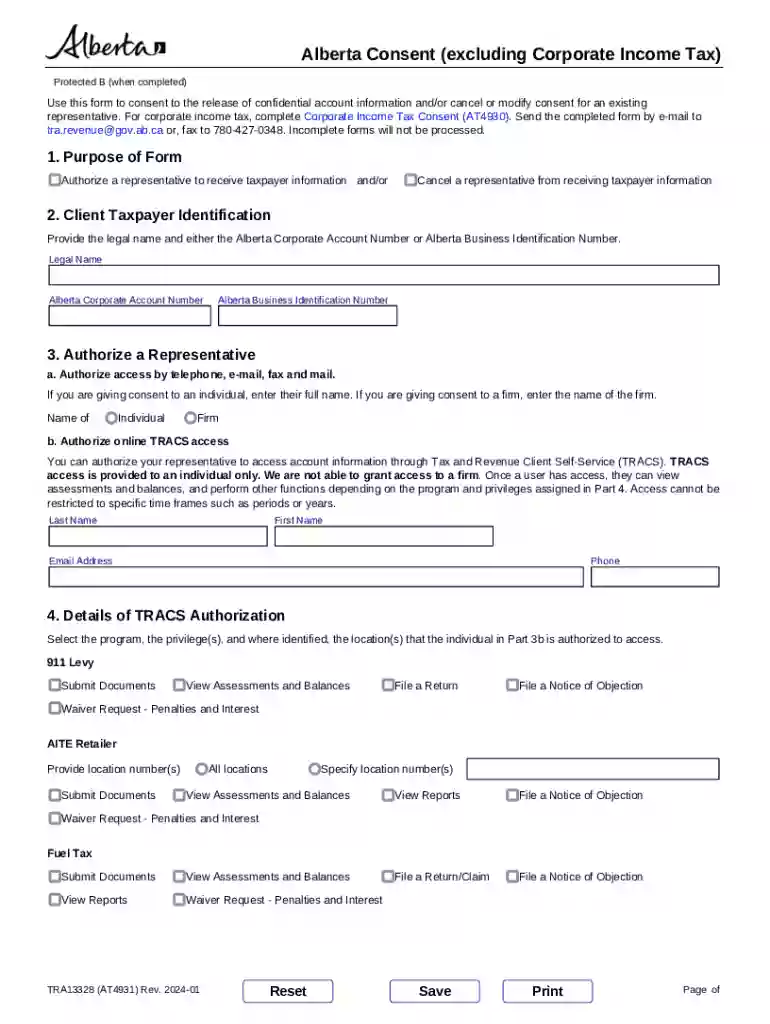
Alberta Consent (excluding Corporate Income Tax) Stakeholders use this form to grant consent to rele 2026

Get Form
alberta consent form Preview on Page 1

Here's how it works

01. Edit your alberta consent form online
Type text, add images, blackout confidential details, add comments, highlights and more.

02. Sign it in a few clicks
Draw your signature, type it, upload its image, or use your mobile device as a signature pad.

03. Share your form with others
Send alberta consent income via email, link, or fax. You can also download it, export it or print it out.

Definition & Meaning

The "Alberta Consent (excluding Corporate Income Tax) Stakeholders use this form to grant consent to rele" is a formal document used by Alberta taxpayers. It authorizes or cancels the authorization of a representative to access their confidential account information, excluding Corporate Income Tax matters. This form is vital for maintaining control over who can access sensitive taxpayer information, ensuring that only authorized personnel can view or modify such data. Understandably, this kind of consent is crucial in preserving taxpayer privacy and ensuring compliance with legal and financial protocols.

How to Use the Alberta Consent Form

Stakeholders use the Alberta Consent form to manage access to their tax-related information by either granting or revoking permissions for representatives. To use the form effectively:

  1. Identify the individual or organization you wish to authorize or deauthorize.
  2. Clearly mark sections for granting or revoking access.
  3. Provide accurate taxpayer identification, such as Social Security Number (SSN) or Taxpayer Identification Number (TIN).
  4. Specify the type of access given to the representative—full, view-only, etc.
  5. Review the form thoroughly for accuracy before submission.

Steps to Complete the Alberta Consent Form

Filling out the Alberta Consent form involves several key steps to ensure accuracy and legal compliance:

  1. Gather Necessary Information: Collect all relevant details, including taxpayer identification numbers and representative information.

  2. Fill Out Taxpayer Section: Complete the section dedicated to taxpayer details, ensuring that all personal information is correct.

  3. Specify Representative Details: Input the names and contact information of the individuals or firms being authorized or deauthorized.

  4. Define Access Privileges: Clearly specify which documents or data sets the representative is allowed to access.

  5. Certification and Signature: The taxpayer must certify the form and provide their signature to validate the consent.

  6. Submission: Submit the completed form according to the guidelines, whether online or via mail.

Key Elements of the Alberta Consent Form

Several critical elements make up the Alberta Consent form:

  • Taxpayer Identification Details: Key identifying information crucial for processing the form accurately.
  • Representative Authorization: Sections that outline who is being authorized and the extent of their access.
  • Access Privileges: Defines what information the authorized party can access and any limitations.
  • Certification: Confirms the legitimacy of the taxpayer's authorization through a signature.

Legal Use of the Alberta Consent Form

The legal framework surrounding the Alberta Consent form is designed to protect taxpayer information. It complies with privacy laws and regulations, ensuring that taxpayer data is only accessible to authorized individuals. Misuse of this form can lead to legal repercussions, emphasizing the necessity for stakeholders to understand its legal boundaries and implications.

Who Typically Uses the Alberta Consent Form

The form is generally utilized by:

  • Individual Taxpayers: Those looking to authorize accountants or legal representatives to manage their tax affairs.
  • Business Entities: Companies that need to permit their financial teams or external advisors to handle tax-related matters.
  • Tax Professionals: Accountants and tax advisors who require consent from their clients to access sensitive tax information.
decoration image ratings of Dochub

Important Terms Related to the Alberta Consent Form

Understanding key terms associated with the Alberta Consent form can help stakeholders use it correctly:

  • Authorization: The process of granting permissions to access specific information.
  • Revocation: The act of canceling previously granted access.
  • Confidential Information: Any data that is protected under privacy laws and requires consent for access.

Form Submission Methods

There are multiple ways to submit the Alberta Consent form:

  • Online: Digital submission through secure government or authorized platforms.
  • Mail: Sending the completed form to the appropriate tax authority by post.
  • In-Person: Direct submission at a designated drop-off location for immediate processing.

Penalties for Non-Compliance

Non-compliance with regulations related to the Alberta Consent form can result in:

  • Fines: Monetary penalties for either the taxpayer or the unauthorized representative.
  • Legal Action: Consequences that could involve legal proceedings for breaches of data privacy.
  • Loss of Authorization: Revocation of permissions if misuse or fraudulent activity is detected.
be ready to get more

Complete this form in 5 minutes or less

Get form

Got questions?

We have answers to the most popular questions from our customers. If you can't find an answer to your question, please contact us.
Contact us
correspondence issued by TRA. If you are a first-time filer, the BIN is mentioned in your registration approval letter. The account number is the nine- or ten-digit corporate account number (CAN) found on the correspondence issued by TRA.
Failure to file penalties If you file your return late, a penalty applies. The penalty is 5% of the unpaid tax that is due on the filing deadline, plus 1% of this unpaid tax for each complete month that the return is late, up to a maximum of 12 months.
Alberta Corporate Account Number (CAN) Both Alberta-based businesses and those formed in another province or country must be incorporated within Alberta and have a CAN . The CAN is the same as the Corporate Access Number indicated on the Alberta Certificate of Incorporation.
Corporate income tax rates Albertas general corporate income tax rate is currently 8%, the lowest among Canadian provinces. Albertas small business tax rate is 2% (see current and historical corporate income tax rates).
Go to Pay Your Taxes Online. Click on your financial institution and follow the instructions provided. Select Alberta Finance and the program that you are making a payment for. For example, Alberta Finance Corporate Income Tax located under Provincial Alberta.

Security and compliance

At DocHub, your data security is our priority. We follow HIPAA, SOC2, GDPR, and other standards, so you can work on your documents with confidence.

Learn more
ccpa2
pci-dss
gdpr-compliance
hipaa
soc-compliance
be ready to get more

Complete this form in 5 minutes or less

Get form

People also ask

The profit of a corporation is taxed to the corporation when earned, and then is taxed to the shareholders when distributed as dividends. This creates a double tax. The corporation does not get a tax deduction when it distributes dividends to shareholders. Shareholders cannot deduct any loss of the corporation.

Related links