
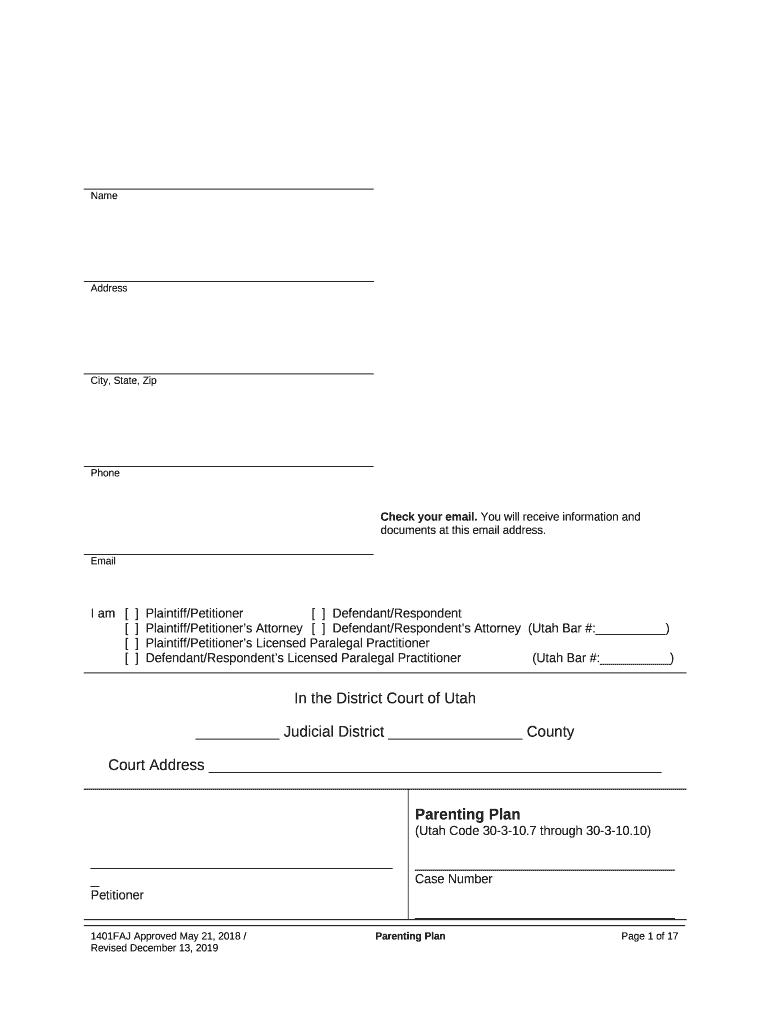







Definition and Purpose of the Parenting Plan
The Parenting Plan is a formal document used to delineate the responsibilities and arrangements for child custody and parenting time following a separation or divorce. It acts as a guideline to ensure consistent parenting practices and prioritizes the best interests of the children involved. The document typically includes sections that address physical custody, decision-making authority, and the methods for resolving disputes between parents.
Child Custody and Parenting Time
- Physical Custody: Specifies where the children will reside and who will provide day-to-day care.
- Parenting Time: Outlines the schedule that determines when each parent will spend time with the children.
Decision-Making Authority
- Educational Decisions: Who is responsible for making decisions regarding the children’s education, including school choice and extracurricular activities.
- Healthcare Decisions: Identifies which parent makes healthcare-related decisions, particularly those involving non-routine medical care.
- Religious Practices: Outlines if and how the children will be raised within a particular faith.
How to Use the Parenting Plan
The Parenting Plan serves as a legal guide and reference for parents to manage their co-parenting responsibilities. It is used during legal proceedings as a demonstrative document of agreed responsibilities.
Establishing Consistency
- Routine Management: Helps create a consistent routine for children, minimizing disruptions in their lives.
- Resolving Conflicts: Provides a pre-established process for resolving disputes without needing court intervention.
Communication Methods
- Direct Communication: Encourages the use of agreed-upon platforms for effective communication between parents.
- Third-Party Mediation: In certain situations, involvement of a mediator might be necessary to address continuous conflicts.
Steps to Complete the Parenting Plan
Filling out the Parenting Plan requires careful consideration of various aspects of child-rearing and co-parenting.
- Gather Information: Collect necessary details about both parents and the children.
- Discuss Terms: Engagement in discussions to agree on custody arrangements, decision-making responsibilities, and parenting schedules.
- Draft the Document: Complete each section of the plan, reflecting agreed-upon arrangements.
- Review with Legal Counsel: Seek legal advice to ensure all legal formalities are accurately addressed.
- Submit for Approval: Submit the finalized document to the appropriate court for approval and filing.
Key Elements of the Parenting Plan
The Parenting Plan comprises several critical sections that collectively cover all facets of child custody and co-parenting arrangements.
Custody Arrangements
- Sole or Joint Custody: Defines whether one parent holds primary responsibility or if both share custody equally.
Financial Responsibilities
- Child Support: Establishes financial obligations for both parents, ensuring all expenses related to child-rearing are covered.
Travel and Relocation
- Travel Permissions: Outlines procedures to follow when traveling with the children, including obtaining consent.
- Relocation Clarity: Provides guidelines for what constitutes a permissible relocation and requisite notifications.
Legal Use of the Parenting Plan
In legal settings, the Parenting Plan is used to formalize custody arrangements and become part of the official records.
Court Approval
- Filing with Family Court: The plan is typically filed in family court, where it must be approved by a judge.
- Enforcement: Once approved, the Parenting Plan is legally enforceable and deviations can lead to legal consequences.
Modifications
- Amendments: The plan can be modified post-approval to reflect changing circumstances, subject to court consent.
Who Typically Uses the Parenting Plan
The primary users of Parenting Plans are parents in the process of divorce or separation, plus legal professionals who facilitate these agreements.


Parents
- Separated or Divorced Parents: The plan is crucial for those seeking an organized approach to co-parenting post-separation.
Legal Professionals
- Family Law Attorneys: Utilize the document as part of their service to ensure clients’ parental rights and responsibilities are clearly documented.
Important Terms Related to Parenting Plan
Understanding key terms is critical to effectively utilizing and navigating a Parenting Plan.
- Custodial Parent: The parent with whom the child lives most of the time.
- Visitation Rights: Refers to the scheduled rights of the non-custodial parent to spend time with the child.
- Mediation: A dispute resolution process involving a neutral third-party mediator.
State-Specific Rules for the Parenting Plan
While the general structure is standard, some specific state laws and regulations can influence the particulars of Parenting Plans.
Utah-Specific Requirements
- Mandatory Sections: Utah might stipulate certain obligatory sections in its Parenting Plans, such as a detailed conflict resolution process.
- State Jurisdiction: The location of legal proceedings is tied to the child’s primary residence or where one parent resides.
Variability Across States
- Custody Standards: Each state may have different parameters for determining custody, impacting how plans are structured and evaluated.
Filing Methods for the Parenting Plan
It is crucial to correctly file the Parenting Plan to make it a legally binding agreement.
Submission Procedures
- Court Submission: Generally, plans are submitted to family court either electronically or through hard copy.
- In-Person Approvals: Depending on jurisdiction, there might be a requirement for one or both parents to appear in court.
Documentation
- Required Attachments: Digital copies of identification and relevant legal documents may be necessary for submission.
By understanding and effectively utilizing the Parenting Plan, parents can ensure a stable and consistent environment for their children, fostering healthy co-parenting and minimalizing conflicts.




