




01. Edit your form online
Type text, add images, blackout confidential details, add comments, highlights and more.

Type text, add images, blackout confidential details, add comments, highlights and more.

Draw your signature, type it, upload its image, or use your mobile device as a signature pad.

Send it via email, link, or fax. You can also download it, export it or print it out.
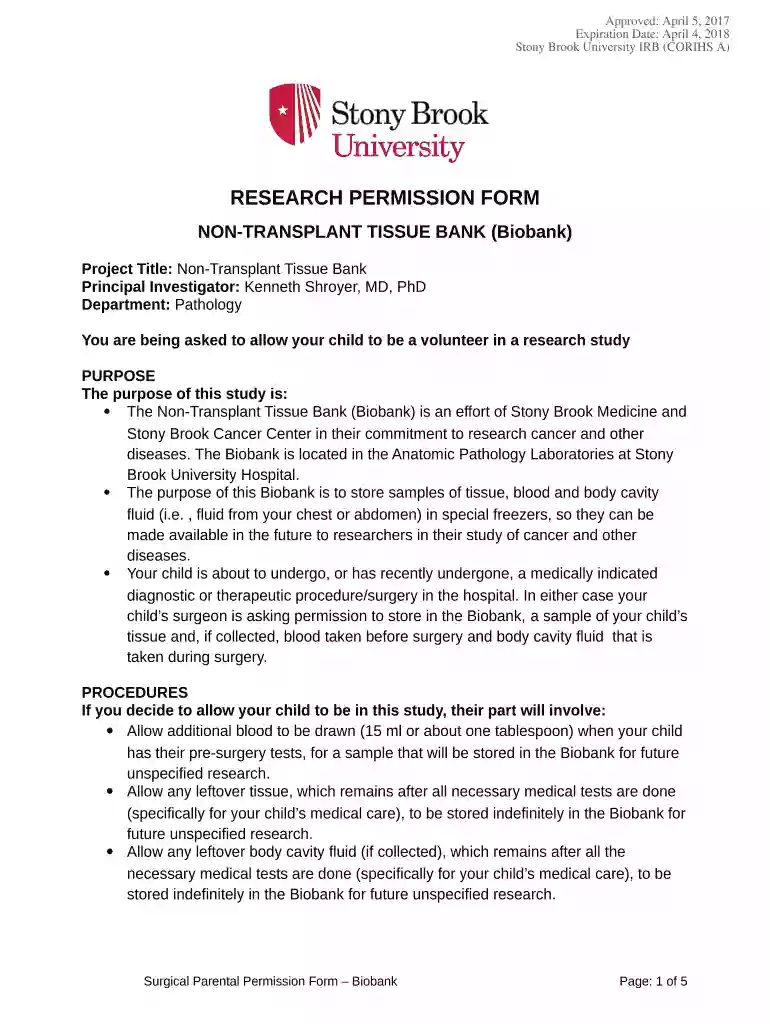
The research permission form at the Renaissance School of Medicine serves a critical role in facilitating medical studies involving human subjects. This form acts as an agreement wherein participants, often represented by their guardians or parents, consent to partake in research conducted by the institution. Primarily, it enables the collection of biological samples such as tissue, blood, and fluids for studies aimed at advancing cancer research. The form underscores the voluntary nature of participation, ensuring participants understand the study's purpose, the procedures involved, and any potential risks or benefits.
The form at the Renaissance School of Medicine typically includes several essential sections. It begins with the purpose of the study, providing a clear explanation of the objectives and expected outcomes. Sample collection procedures are outlined, detailing how and when samples will be gathered. The form also addresses confidentiality measures, describing how personal information will be safeguarded, and specifies participants' rights, ensuring they can withdraw at any time without repercussions. Additionally, sections detailing potential risks and benefits, although primarily emphasizing that direct benefits to participants might not be available, are also included.
To acquire the research permission form, potential participants or their legal guardians can access it through various channels. Directly contacting the Renaissance School of Medicine is often the most straightforward method. The form may also be available through affiliated healthcare facilities conducting research for the institution. In some cases, a digital version might be accessible through the school’s official website or via email upon request.
Filling out the research permission form involves several sequential steps.
Read Thoroughly: Begin by carefully reading the entire form to understand the study's scope, objectives, and what participation entails.
Fill Personal and Participant Information: Enter the necessary personal details accurately, including the participant's name and contact information.
Acknowledge Understanding: Sign sections that acknowledge your understanding of the study's purpose, confidentiality agreements, and your rights as a participant.
Consent to Participate: Indicate consent by signing and dating the form, confirming your willingness to participate under the specified terms.
The research permission form is primarily used by parents or legal guardians consenting on behalf of children participating in research. This is particularly relevant for studies conducted by the Non-Transplant Tissue Bank (Biobank) at Stony Brook University, affiliated with the Renaissance School of Medicine. Researchers and administrative staff at the school also engage with the form to ensure compliance with ethical guidelines and legal procedures.


The research permission form at the Renaissance School of Medicine has several legal tightropes to walk. It aligns with federal and state regulations, including those concerning human subject research and personal data protection. Legal compliance ensures the form can be used to legally obtain and use the biological samples and associated data for research purposes. Understanding and following these legal foundations helps in maintaining the integrity and legitimacy of the research process.
Understanding the terminology used within the research permission form is important for clarity and compliance.
Case studies from past research projects illustrate the form's application. For instance, a study exploring genetic markers for cancer progression involved obtaining parental consent through this form, which facilitated sample collection from pediatric participants. Another example highlights the form’s role in a long-term study tracking environmental impacts on childhood health, necessitating regular updates and re-consents as the study evolved.
We've got more versions of the research permission form - Renaissance School of Medicine form. Select the right research permission form - Renaissance School of Medicine version from the list and start editing it straight away!
At DocHub, your data security is our priority. We follow HIPAA, SOC2, GDPR, and other standards, so you can work on your documents with confidence.
Explore the Scholarly Concentrations Program at Renaissance School of Medicine, a four-year research and scholarly track for medical students aligned with
by WH Lu 2022 Cited by 2 The Renaissance School of Medicine at Stony Brook University designed and developed the Integrated Pain and Addiction Curriculum (iPAC) focusingRead more


