Employment Verification Letter Samples (Plus How To 2026

Get Form
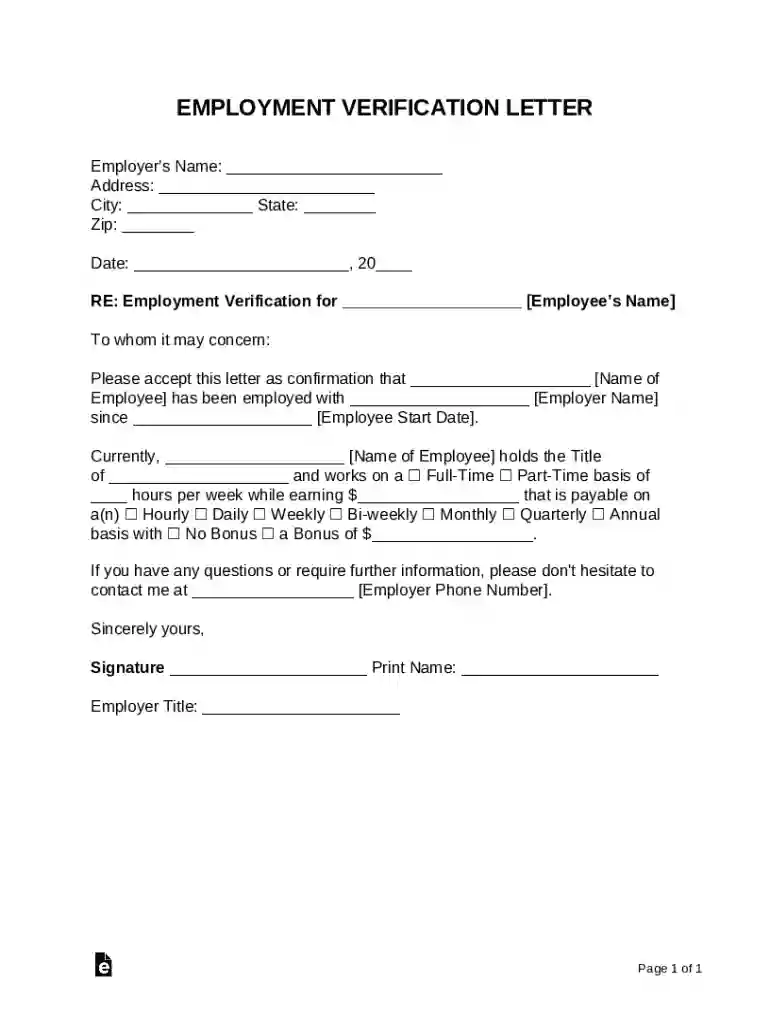
Employment Verification Letter Samples (Plus How To Preview on Page 1

Here's how it works

01. Edit your form online
Type text, add images, blackout confidential details, add comments, highlights and more.

02. Sign it in a few clicks
Draw your signature, type it, upload its image, or use your mobile device as a signature pad.

03. Share your form with others
Send it via email, link, or fax. You can also download it, export it or print it out.

Definition and Meaning

An employment verification letter is a formal document used to confirm an individual's employment status with their current or past employer. This letter typically contains essential details such as the employee's name, job title, start date, work hours, salary, and frequency of payment. It serves as official documentation that third parties, like banks or landlords, may require to verify someone's employment.

Components of the Employment Verification Letter

  • Employee Information: Full name, job title, and department.
  • Employment Details: Start date, current employment status, and job responsibilities.
  • Compensation Details: Salary or hourly wage, payment frequency, and any additional benefits.
  • Contact Information: Employer's contact details for further inquiries.

How to Use Employment Verification Letter Samples

Employment verification letter samples are templates that provide a structured format for employers to generate these documents efficiently. By using a sample, employers can ensure the inclusion of all necessary details in a standardized format.

Steps to Utilize Samples

  1. Choose a Template: Select a sample that suits your needs, ensuring it aligns with your company's letterhead and branding.
  2. Fill in Employee Details: Input all relevant employee information, ensuring accuracy.
  3. Confirm Employment Information: Verify the details of employment, such as job title and salary.
  4. Review for Completeness: Ensure all sections are filled out correctly and verify any company-specific requirements.

Steps to Complete the Employment Verification Letter

Step-by-Step Guide

  1. Gather Necessary Information: Collect all employee details, including job title, start date, and salary.
  2. Format the Letter: Begin with your company’s letterhead followed by a formal greeting.
  3. State the Purpose: Clearly indicate the letter's purpose, confirming the employment details.
  4. Include Employee Information: Provide the full name and job position of the employee.
  5. Detail Employment Terms: List job responsibilities, work hours, and compensation details.
  6. Provide Employer Contact Information: Include contact details for further verification.
  7. Sign and Date: Ensure the letter is signed by an authorized person, such as an HR manager.

Importance of Employment Verification Letters

Employment verification letters hold substantial importance for both employees and employers. They serve as proof of employment status, utilized in various official capacities.

Reasons for Request

  • Loan Applications: Lenders require confirmation of employment to assess creditworthiness.
  • Rental Agreements: Landlords may check employment to ensure tenants have a stable income.
  • Professional Licensing: Certain certifications may require employment verification.

Key Elements of the Employment Verification Letter

Essential Parts

  • Employee's Personal Information: Name, position, and department.
  • Employment Details: Start date, status (full-time/part-time), and location.
  • Compensation Information: Salary and additional benefits.
  • Contact Details for Verification: HR representative’s information for follow-up.

Legal Use of the Employment Verification Letter

Employment verification letters must comply with privacy laws and regulations, including the Fair Credit Reporting Act (FCRA) guidelines, when disclosing employee information.

Compliance Considerations

  • Consent Requirement: Obtain employee consent before releasing sensitive information.
  • Data Accuracy: Ensure all provided information is accurate and up-to-date.
  • Confidentiality: Maintain discretion and secure storage of employee details.

Practical Scenarios Using the Employment Verification Letter

Real-World Examples

  • New Job Applications: Confirming previous employment for potential employers.
  • Visa Applications: Providing evidence of employment for immigration purposes.
  • Bank Transactions: Verification for mortgage or loan approvals.

Who Typically Uses Employment Verification Letters?

Primary Users

  • Human Resources Departments: Generating letters for internal employees.
  • External Agencies: Institutions requiring employment status for processing requests.
  • Employees: For personal purposes such as financial transactions or housing.

These sections offer a comprehensive understanding of employment verification letters, from their definition and components to their real-world applications, ensuring that all relevant aspects are covered for greater utility.

be ready to get more

Complete this form in 5 minutes or less

Get form

Got questions?

We have answers to the most popular questions from our customers. If you can't find an answer to your question, please contact us.
Contact us
To Whom It May Concern, This letter is to verify that [Former Employees Full Name] was employed at [Company Name] from [Start Date] to [End Date]. During their time with us, they held the position of [Job Title] in the [Department Name]. We confirm that [Former Employees Name] left the company in good standing.
Those requesting employment or salary verification may access THE WORK NUMBER online at using DOLs code: 10915. You may also contact the service directly via phone at: 1-800-367-5690.
When creating a template for employment verification letters on company letterhead, you might include: Companys name and contact details. Employees name, job title and dates of employment. Requesting partys name and contact information. Type of information requested. Preferred delivery method.
What Should Be Included in an Employment Verification Letter? The employees full name. Employer name. Employer address. Name and address of the third party requesting the letter. Job title (and description optional) Employment start date (and end date if applicable) Current or final salary.
An income verification letter can be written by an employer or other selected parties, such as an accountant or HR manager. Employees can also write their own letter if they want, as long as the details are confirmed by their employer, accountant, or another relevant individual, depending on the circumstances.

Security and compliance

At DocHub, your data security is our priority. We follow HIPAA, SOC2, GDPR, and other standards, so you can work on your documents with confidence.

Learn more
ccpa2
pci-dss
gdpr-compliance
hipaa
soc-compliance

People also ask

A verification of employment (VOE) letter is a formal document provided by an employer to confirm an individuals work history and job details. These letters typically include information such as the employees job title, dates of employment, current or past salary (if applicable), and the employers contact details.
An employment verification letter usually includes the employees full name, job title, dates of employment, and employment status. Some letters may also include salary details, pay period, work location, and the employers contact information, depending on the request.
Employee verification letter for past employee This letter is to confirm that Alberto Marino was employed as a Senior User Experience Researcher at Ready Grocery from May 5, 20XX to September 27, 20XX.

Related links