




01. Edit your the tragedy of romeo and juliet prologue annotation activity online
Type text, add images, blackout confidential details, add comments, highlights and more.

Type text, add images, blackout confidential details, add comments, highlights and more.

Draw your signature, type it, upload its image, or use your mobile device as a signature pad.

Send it via email, link, or fax. You can also download it, export it or print it out.
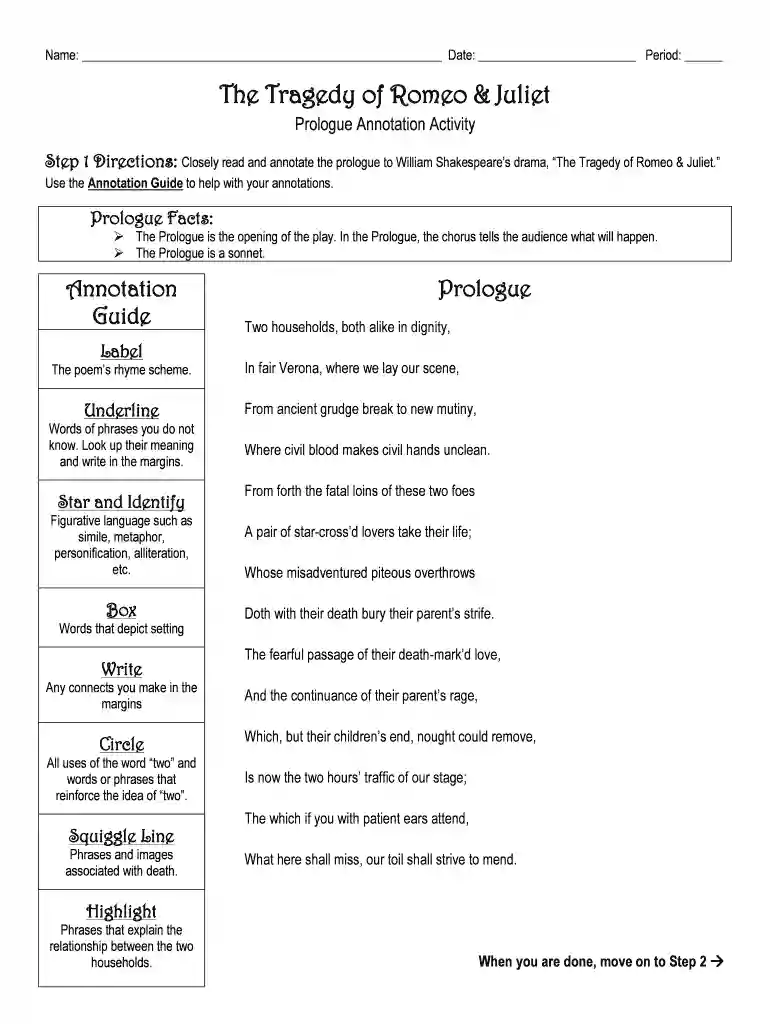
The "Romeo and Juliet Prologue Annotation Activity" involves a detailed examination and analysis of the prologue from William Shakespeare’s 'The Tragedy of Romeo & Juliet.' This academic exercise is designed for students to gain a deeper understanding of the text's elements. It focuses on identifying and interpreting the rhyme scheme, figurative language, and themes such as duality and death, which are crucial in understanding the play's context and literary value. The activity encourages participants to explore the setting and symbolism within the prologue, facilitating an enhanced literary appreciation.
To effectively utilize the "Romeo and Juliet Prologue Annotation Activity," students should begin by reading the prologue thoroughly, either individually or in groups. During this reading, participants should take note of unfamiliar words or concepts, marking them for further investigation. Once the initial reading is complete, students should annotate the text, identifying key elements such as:
These annotations serve as a foundation for answering the set of questions provided with the activity, which typically involves interpreting the language and themes in a modern context. Lastly, the activity may require students to rewrite the prologue in modern English, preserving its original meaning while making it accessible to contemporary readers.
The annotation activity for the prologue of "The Tragedy of Romeo & Juliet" includes several critical elements that guide students through a comprehensive analysis:
Each of these elements helps students to connect deeply with the text, improving both their analytical skills and appreciation of Shakespearean literature.
Each of these steps helps students methodically break down the text, ensuring nothing vital is overlooked during analysis.
The annotation activity serves multiple educational purposes. It enables students to:
By engaging with the prologue through such analytical practices, students cultivate a broad knowledge base that is applicable to other areas of study.
Practical implementation of the annotation activity varies widely across educational settings:
These examples illustrate the diverse contexts in which the activity can be effectively utilized to enrich students' educational experiences.
Several important terms are key to successfully completing the "Romeo and Juliet Prologue Annotation Activity":
These terms equip students with a necessary toolkit for analyzing the prologue in depth.
Outside the classroom, skills honed through this activity extend to numerous real-world scenarios:
These applications highlight the broader relevance and utility of engaging with Shakespearean texts through structured activities.
At DocHub, your data security is our priority. We follow HIPAA, SOC2, GDPR, and other standards, so you can work on your documents with confidence.


