




01. Edit your form online
Type text, add images, blackout confidential details, add comments, highlights and more.

Type text, add images, blackout confidential details, add comments, highlights and more.

Draw your signature, type it, upload its image, or use your mobile device as a signature pad.

Send it via email, link, or fax. You can also download it, export it or print it out.
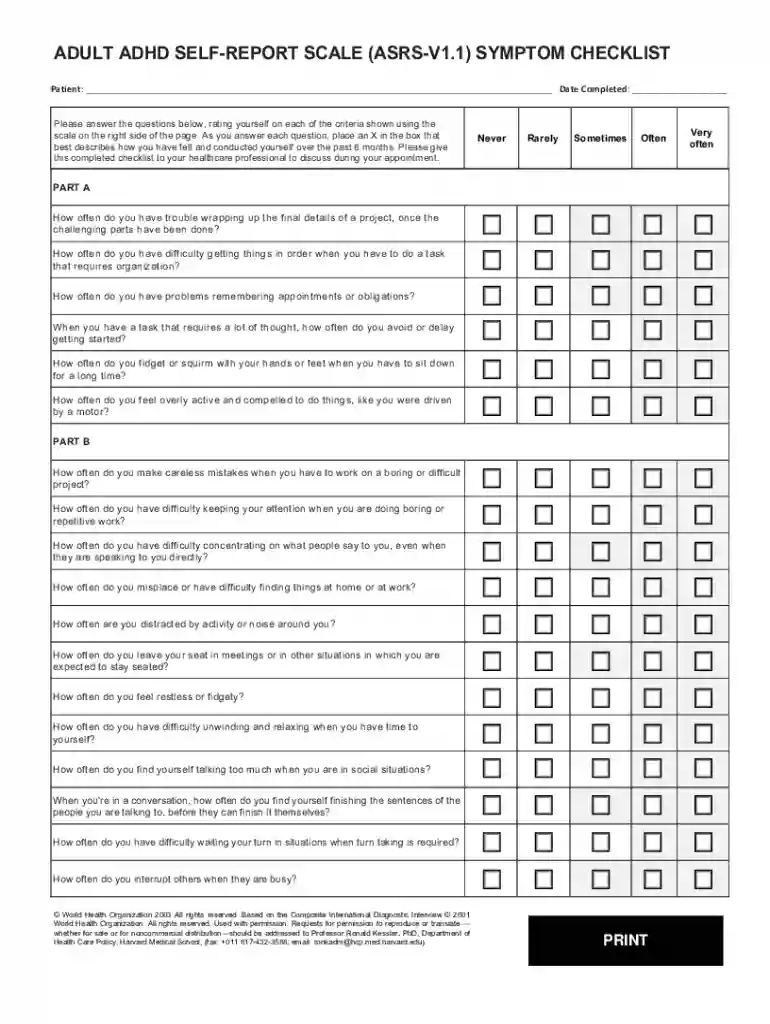
The Adult ADHD Self-Report Scale (ASRS-v1.1) Symptom Checklist is a screening tool designed to identify symptoms and functional impairments related to Attention Deficit Hyperactivity Disorder (ADHD) in adults. This checklist, crafted by the World Health Organization (WHO) in collaboration with various psychiatric experts, helps to highlight issues like attention deficits, and impulsivity, which are characteristic of ADHD. Its structured format allows individuals to self-assess their symptoms systematically, facilitating conversations with healthcare providers regarding further diagnosis and treatment options.
To use the ASRS-v1.1 effectively, an individual should complete the checklist by rating their experiences over the past six months. The scale includes a series of questions focused on the frequency of specific behaviors and feelings. Each question is rated on a scale of 0 to 4, with 0 representing 'never' and 4 indicating 'very often.' After completing the checklist, individuals should review their scores with a healthcare professional to determine if further evaluation or a formal diagnosis is necessary.
The ASRS-v1.1 is commonly used by adults who suspect they may have ADHD, as well as by mental health practitioners who need to evaluate symptoms as part of an initial screening process. It can be valuable for both healthcare settings and individual self-assessments, particularly for adults seeking to understand their behavior in different contexts, such as work or personal relationships.


The ASRS-v1.1 is a screening tool and not a substitute for a full clinical evaluation. While it helps identify potential indicators of ADHD, only a qualified professional can provide a formal diagnosis. Using the checklist as part of consultation with a healthcare provider ensures that results are interpreted correctly within the context of an individual's broader health profile.
In the United States, the use of diagnostic tools like the ASRS-v1.1 may be influenced by state-specific healthcare regulations. Healthcare providers should be familiar with local guidelines to ensure the checklist is used appropriately. It's important to note that while federal guidelines offer a standard approach, states may have additional requirements for evaluation and treatment of ADHD.
A professional who struggles with time management and focusing during meetings uses the ASRS-v1.1 to identify symptoms that may suggest ADHD. The checklist highlights frequent issues with attention, prompting discussions with their employer about possible accommodations.
A college student experiencing difficulties in concentrating and organizing study schedules completes the checklist. The results show significant inattentive symptoms, leading them to seek a full assessment from a campus mental health service.
The ASRS-v1.1 is available in both digital and paper formats. The digital version provides ease of use and immediate results analysis, while the paper format may be more accessible in settings where digital tools are limited. Digital platforms often offer additional features, like automated scoring and data visualization, which can enhance the assessment process.
While the ASRS-v1.1 is widely used, other alternatives for ADHD screening include the Conners Adult ADHD Rating Scales and the Barkley Adult ADHD Rating Scale. Each tool provides a different approach to symptom assessment, offering varied perspectives on ADHD indicators.
By providing a thorough understanding of the Adult ADHD Self-Report Scale (ASRS-v1.1) Symptom Checklist, individuals and healthcare providers can effectively utilize this tool to better understand potential ADHD symptoms in adults, facilitating more accurate diagnoses and treatment strategies.
At DocHub, your data security is our priority. We follow HIPAA, SOC2, GDPR, and other standards, so you can work on your documents with confidence.


