




01. Edit your form online
Type text, add images, blackout confidential details, add comments, highlights and more.

Type text, add images, blackout confidential details, add comments, highlights and more.

Draw your signature, type it, upload its image, or use your mobile device as a signature pad.

Send it via email, link, or fax. You can also download it, export it or print it out.
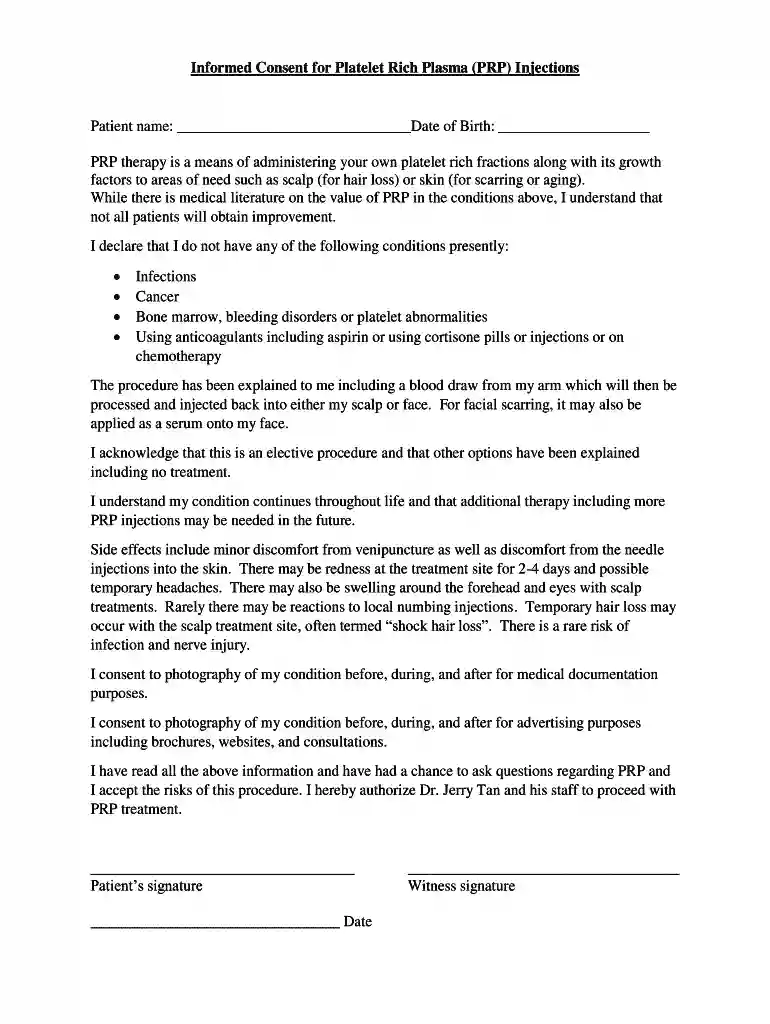
Informed consent for Platelet Rich Plasma (PRP) injections is a critical document used in the medical industry to ensure that patients are thoroughly educated about the procedure before agreeing to undergo treatment. This document details the process of PRP injections, potential benefits, risks, and side effects. It serves as a legal acknowledgment that the patient understands the information provided and consents to the procedure willingly. PRP injections are commonly used for conditions like hair loss and skin rejuvenation, and the consent form plays a vital role in ensuring transparent communication between healthcare providers and patients.
The form contains essential components designed to protect both the patient and the healthcare provider. Some of the key elements include:
Procedure Description: Detailed explanation of what PRP injections entail, including how the plasma is extracted and injected.
Potential Risks and Side Effects: Comprehensive list of possible adverse effects, ranging from mild to severe, that patients might experience during or after the procedure.
Patient Medical History: Information on pre-existing conditions or allergies that might affect the treatment outcome.
Consent for Photography: Permission for using photographs for medical documentation and, if agreed upon, for advertising.
Signature and Date: The final section where the patient signs to indicate their understanding and agreement to proceed with the treatment.
Completing the informed consent form involves several crucial steps to ensure accuracy and thoroughness:
Review the Procedure Details: The patient must carefully read the section describing the purpose, process, and expected outcomes of PRP injections.
Understand the Risks: Patients should pay particular attention to the potential risks and side effects, asking the healthcare provider questions as needed.
Provide Medical History: Enter any relevant medical history, including current medications and known allergies, that could impact treatment.
Consent for Documentation: Decide whether to allow photographs for medical records or broader purposes, and initial any sections requiring agreement.
Signing and Dating: The final verification step involves signing and dating the form, indicating full understanding and consent.
This document is used primarily by healthcare providers to confirm their patients are informed about the procedure they are about to undergo. Here’s how it typically works:
Pre-Treatment Discussion: Before the PRP session, the physician discusses the form, ensuring the patient has no doubts or questions.
Documentation: Once the form is understood and signed, it becomes a part of the patient's medical record, providing legal coverage for the healthcare provider.
Future Reference: Both the patient and provider can refer to the signed consent if there are questions or concerns post-treatment.
Legally, the informed consent form is a protective measure. By signing, the patient acknowledges awareness of the procedure’s nature, benefits, and risks. This legal document can be crucial in the event of a dispute or if the patient experiences a complication. The document upholds patient rights and supports healthcare providers in maintaining ethical standards.
Primarily utilized by clinics and hospitals offering aesthetic and regenerative medicine treatments, these forms are signed by patients receiving PRP treatments. Physicians, dermatologists, and cosmetic surgeons rely on them as part of the patient intake process to ensure transparency and consent.


Platelet Rich Plasma (PRP): A concentration of platelets derived from the patient’s own blood, used to promote healing.
Autologous Treatment: A procedure where the donor and recipient are the same person, minimizing the risk of adverse reactions.
Centrifugation: The process of spinning blood to separate its components, thereby concentrating the platelets.
Anaphylaxis: A potential severe allergic reaction that patients need to be aware of, even though it's rare in autologous treatments.
In real-world scenarios, informed consent forms are used across various cases:
Hair Restoration Clinics: PRP forms are signed by patients undergoing treatment for androgenetic alopecia.
Orthopedic Practices: Athletes might sign these before getting PRP injections for joint injuries.
Cosmetic Dermatology Clinics: Patients might consent before skin rejuvenation treatments aimed at reducing wrinkles or scars.
Although informed consent is a standard practice in the U.S., the specifics can vary by state due to differing medical board regulations and standards. Healthcare providers must stay informed about state-specific rules to ensure compliance. Some states may have more stringent guidelines concerning the documentation needed and the details required about potential risks, necessitating careful adaptation of the consent forms.
At DocHub, your data security is our priority. We follow HIPAA, SOC2, GDPR, and other standards, so you can work on your documents with confidence.

by SN Pai 2024 Cited by 3 A legally valid and evidence-based informed consent form for PRP injections would ensure patients rights, and encourage open communication and transparency
28 patients (30 joints) accepted treatment after informed consent. 22 knees, 4 hips, 2 shoulder glenohumeral joints and 1 first carpo-metacarpal (1st CMC) jointRead more


