







Definition & Meaning
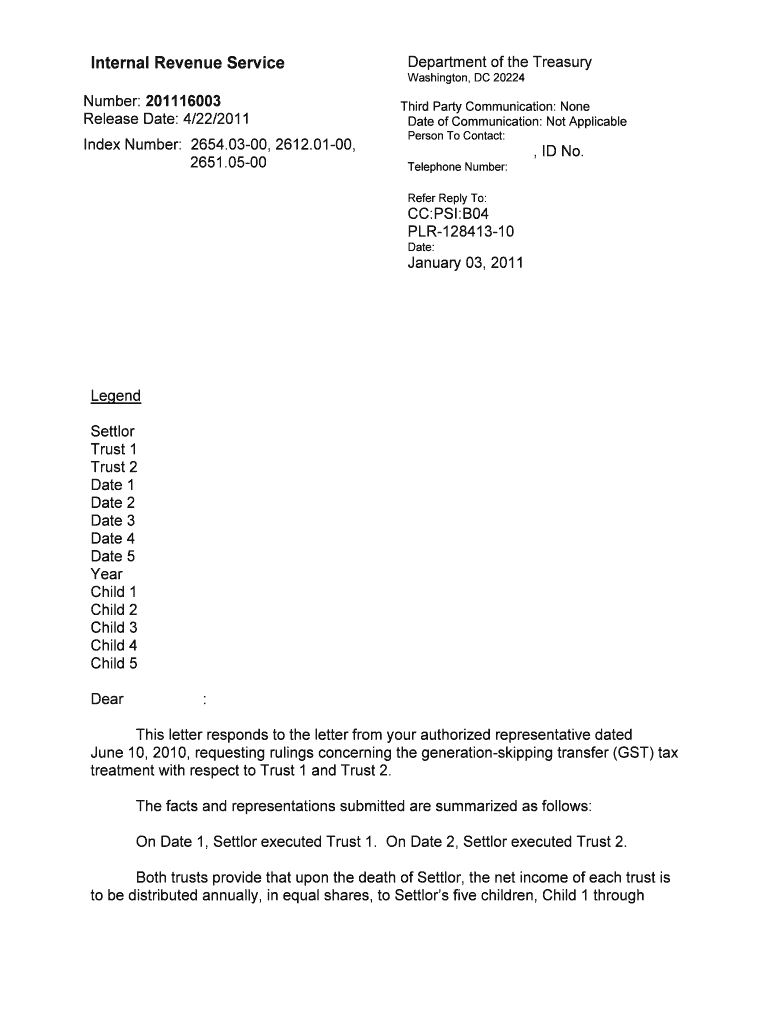
The "Internal Revenue Service Number: 201116003 Release Date: 4 22 2011 Department of the Treasury Washin" refers to a specific Private Letter Ruling (PLR) issued by the IRS. A PLR is a written decision by the Internal Revenue Service in response to a taxpayer's request for guidance on particular tax matters. These rulings are valid only for the taxpayer who requested it but can provide insight into the IRS's interpretation of tax regulations. The number "201116003" indicates the sequence and year (2011) of the ruling, while "Release Date: 4 22 2011" specifies when it was made available.
How to Use the Internal Revenue Service Number: 201116003
Understanding a specific PLR, such as 201116003, involves examining the ruling document in detail. Tax professionals may use PLRs to assess how similar tax issues might be evaluated. They should:
- Analyze the taxpayer’s situation described in the ruling.
- Identify the IRS's reasoning and conclusions.
- Compare the facts of the ruling with their current tax case for potential guidance.
PLRs can be particularly useful for understanding complex tax situations involving trusts, like the generation-skipping transfer tax implications highlighted in this ruling.
Steps to Obtain a Private Letter Ruling
Securing a PLR involves a formal process with specific steps:
- Prepare a Written Request: Clearly outline the facts, circumstances, and questions for which the ruling is sought.
- File the Request: Submit the written request to the IRS. Fees and additional documentation may be required.
- Review and Communication: The IRS will review the request and may communicate for additional information or clarification.
- Receive the Ruling: Once the analysis is complete, the IRS issues the PLR, which applies solely to the taxpayer involved in the request.
Taxpayers often engage tax professionals to assist with drafting and filing these requests due to their complexity.
Important Terms Related to the Ruling
Several key terms and concepts are critical to understanding this PLR:
- Generation-Skipping Transfer Tax (GST): A federal tax on transfers of property to a beneficiary (skip person) that is at least two generations younger than the donor.
- Skip Person: Someone who is at least 37.5 years younger than the donor or two generations younger.
- Settlor: The person who creates a trust.
- Distributions: Payments made by a trust to its beneficiaries.
Tax professionals often use these definitions to navigate the intricacies of trust and estate planning.
Legal Use of the Ruling
While the Internal Revenue Service Number: 201116003 is legally binding only for the requesting taxpayer, it offers broader legal insights. Tax professionals can reference the legal standards and interpretation applied by the IRS when advising on similar cases. It's crucial to understand the specific legal context and facts presented to apply the ruling appropriately.
IRS Guidelines
The IRS provides specific guidelines for each PLR, presenting detailed commentary on relevant tax laws, such as sections of the Internal Revenue Code, applicable to the taxpayer’s situation. These guidelines outline the IRS’s interpretation and are essential for understanding how specific provisions were applied in the ruling context.
Filing Deadlines / Important Dates
While the specific PLR does not impact general filing deadlines, it may offer insights into timelines for actions that taxpayers need to take concerning trust funds and distributions. Keeping track of such dates ensures compliance with IRS requirements and regulations.
Required Documents for PLR Requests
Taxpayers must submit precise and comprehensive documentation when requesting a PLR. Required documents typically include:
- Detailed descriptions of the transactions or situations.
- A summary of relevant facts and applicable tax laws.
- Supporting legal arguments and citations.
- A statement regarding any factual representations and declarations about their completeness and accuracy.
Documentation is crucial for IRS evaluators to understand the situation fully and issue an informed ruling.
Form Submission Methods (Online / Mail / In-Person)
Requests for PLRs are typically submitted through mail to the IRS, as electronic submissions might not be available for such detailed inquiries. It is critical to follow IRS instructions on submission formats and mailing addresses to ensure timely processing of the request.




