







Definition & Meaning
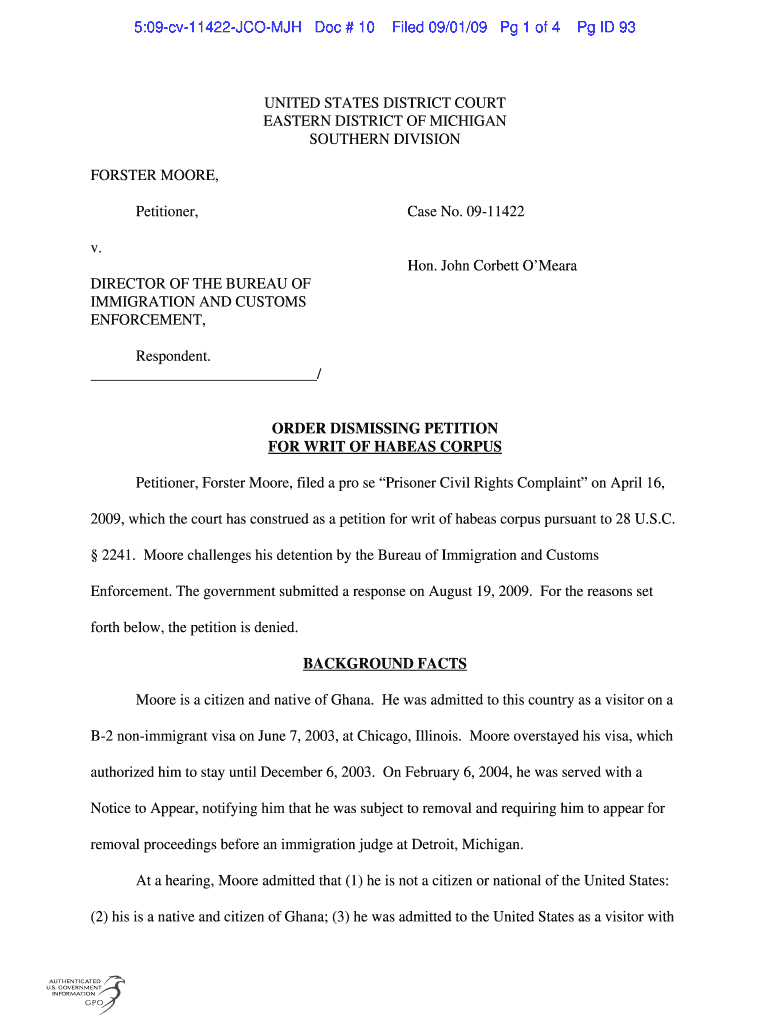
"5:09-cv-11422-JCO-MJH Doc # 10" refers to a specific legal document associated with a case filed in the United States District Court for the Eastern District of Michigan. The case number "5:09-cv-11422" identifies the specific legal proceeding, while "JCO-MJH" are the initials of the presiding district judge and magistrate judge. "Doc # 10" indicates the tenth document filed in the case docket. This document, in particular, relates to the court's order dismissing Forster Moore's petition for a writ of habeas corpus regarding his immigration detention issues.
Legal Use of the 5:09-cv-11422-JCO-MJH Doc # 10
The court order "5:09-cv-11422-JCO-MJH Doc # 10" plays a pivotal role in legal proceedings as it determines the outcome of a specific petition or motion filed by the petitioner—in this instance, Forster Moore. The document outlines the legal reasoning adopted by the court to arrive at its decision, including the interpretation of relevant immigration statutes and any cited legal precedents. It's essential for practitioners, such as attorneys or legal researchers, who need to understand the rationale of the court's judgment in cases involving similar immigration or detention issues.
Steps to Complete the 5:09-cv-11422-JCO-MJH Doc # 10
- Review Initial Case Materials: Gather all the baseline documents associated with case number "5:09-cv-11422".
- Analyze Legal Requirements: Understand what is required to address the document content fully, focusing on the specific legal context.
- Draft Legal Arguments: For those responding or appealing, draft appropriate legal arguments or filings following the court's decision.
- Ensure Compliance: Verify all submissions comply with court protocols, particularly concerning form and timeliness.
- Submit Appropriate Filings: Depending on the outcome and future intentions, file an appropriate response to the order or prepare for any subsequent appellate action.
Key Elements of the 5:09-cv-11422-JCO-MJH Doc # 10
The document includes several critical components that outline the court's decision:
- Case Background: Details of Moore's initial petition and the immigration context.
- Judicial Reasoning: Explanation of the court’s interpretations of relevant laws and statutes.
- Conclusion: Final decision of the court dismissing the petition.
- Impact on Parties: Effects and implications of this decision on the petitioner and potential future legal options.
Importance of the 5:09-cv-11422-JCO-MJH Doc # 10
This document serves as a crucial piece of legal literature, especially for cases involving immigration detention and compliance processes. It highlights how various facets of the law are applied in real-world scenarios, offering valuable insights and precedents for similar cases.
- Understanding Legal Precedents: Provides a reference point for how similar cases might be resolved in the future.
- Guidance for Legal Practitioners: Helps attorneys anticipate possible outcomes and prepare more robust defenses or arguments for their clients.
Examples of Using the 5:09-cv-11422-JCO-MJH Doc # 10
- Case Study Analysis: Legal scholars might use this document to illustrate how courts handle habeas corpus petitions in immigration contexts.
- Legal Education: Law professors could incorporate the document into curriculum discussions on detention law and judicial decision-making.
- Comparative Legal Research: It may serve as a comparative basis for examining judicial responses in various jurisdictional contexts.
Who Typically Uses the 5:09-cv-11422-JCO-MJH Doc # 10
Various parties have an interest in this document:
- Immigration Lawyers: To understand its implications for clients in similar positions.
- Legal Scholars & Researchers: For research and case studies on immigration law and judicial decision-making.
- Government Agencies & Courts: To reflect on precedents and guide future decisions regarding detention and deportation cases.
- Defendants & Petitioners: Individuals like Forster Moore, and their legal representatives, to strategize following the court's decision.


Digital vs. Paper Version
Forms and documents used in legal systems can be accessed in both digital and paper formats. While a traditional paper version involves physical documentation managed within court records, the digital version allows for easier access and dissemination:
- Access & Convenience: Facilitates a broader reach and quicker retrieval for legal professionals.
- Efficiency: Enhances workflow processes, especially through tools like DocHub for collaborating, editing, and signing digitally without needing physical copies.
Form Submission Methods
Usually, legal forms and court documents can be submitted through several channels:
- Online Electronic Filing: Most federal courts use Electronic Case Filing (ECF) systems.
- Mail: Conventional postal services are still an option for submissions not required to be electronic.
- In-Person Delivery: Direct submissions to a court clerk can be mandated for particular filings.
Given these considerations, understanding the specific submission requirements for the 5:09-cv-11422-JCO-MJH Doc # 10 is crucial to ensuring compliance with procedural rules.
Application Process & Approval Time
When seeking information related to such an order:
- File a Freedom of Information Act (FOIA) Request: Access court documents where they remain public records.
- Expected Timeline: Approval times for such requests vary depending on jurisdiction and specific case-related protocols.




