







Definition & Purpose of the Distribution of 1998 and 1999 Cable Royalty Funds
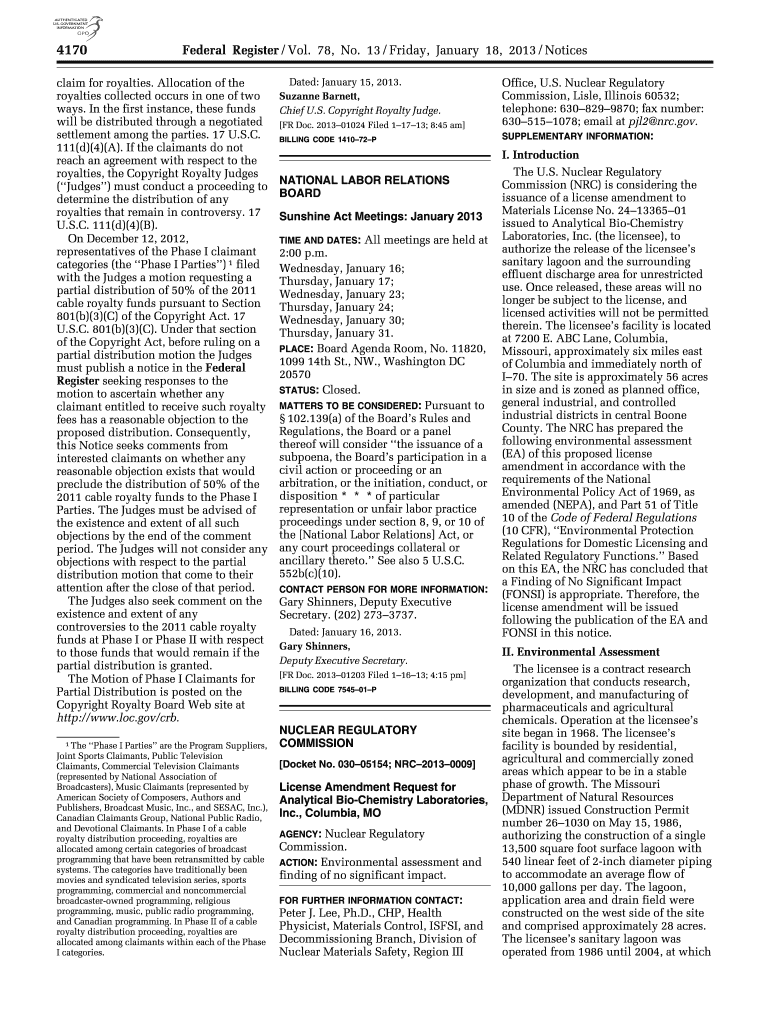
The "Federal Register :: Distribution of 1998 and 1999 Cable Royalty Funds" refers to the formal allocation process of royalties collected from cable companies for the retransmission of broadcast signals. The purpose is to distribute these funds among eligible copyright holders, such as content creators and broadcasters whose works were part of cable retransmissions. This process ensures that creators are fairly compensated for the use of their intellectual property, thereby supporting the ongoing creation of broadcast content.
How to Use the Distribution Form
Utilizing the form for the distribution of cable royalty funds involves submitting detailed claims. Claimants must provide specific information about the rights they hold and the broadcast content involved. The form also requires public comments on any objections to proposed distributions, facilitating transparency and fairness in the allocation process. Users must be familiar with the intricacies of claiming such royalties to ensure they receive the correct distribution.
Key Details to Include
- The nature of the claimant's content participation
- Specific rights held by the claimant
- Any objections to the proposed distribution should be clearly stated
Obtaining the Form
The form for the distribution of the 1998 and 1999 cable royalties is available through official channels, typically published in the Federal Register or accessible via the U.S. Copyright Office's website. It can be obtained by contacting the U.S. Copyright Royalty Board directly or through digital platforms that archive such legal documentation.
Steps to Complete the Form
- Gather Necessary Information: Collect full details of your broadcast content and ownership rights.
- Access the Form: Obtain the form from official sources like the Federal Register or the U.S. Copyright Office.
- Complete Required Sections: Fill out the form in detail, emphasizing the rights and specifics of your broadcast content.
- Submit Public Comments: If applicable, provide comments regarding any disputes of proposed distributions.
- Final Review and Submission: Double-check all entered information for accuracy before submitting.
Detailed Guidance
- Ensure all ownership details and rights are current and accurate.
- Keep copies of all submissions for your records.
Importance of the Distribution
The distribution of royalty funds is crucial as it ensures creators and copyright holders receive due compensation for the use of their work by cable providers. This compensation is a vital part of sustaining the creative industries and incentivizing the production of new content, which ultimately benefits consumers with a wider array of programming.
Benefits of Proper Distribution
- Fair compensation for intellectual property use
- Encouragement of content creation
- Support for the broadcasting ecosystem
Eligible Claimants and Their Use Cases
Typically, eligible claimants for the cable royalty funds include content producers, distributors, and broadcasters whose works were retransmitted via cable services in the years specified. Common use cases for these funds include reinvestment into new content production and covering operational costs associated with content creation and distribution.
Key Elements of the Distribution Process
Several critical factors are involved in the distribution process:
- Eligibility Criteria: Only those with legally recognized rights to the broadcast content are eligible.
- Public Commentary: Stakeholders can object to or support distributions, ensuring a fair process.
- Timing and Scheduling: Understanding distribution timelines is crucial for effective participation.
State-Specific Rules and Variations
While cable royalty fund distribution primarily follows federal guidelines, there may be variations or additional requirements at the state level. It's important for claimants to be aware of any state-specific rules that could impact their claims or distribution amounts.
Legal Framework and Compliance
Compliance with legal requirements is paramount when dealing with the distribution of cable royalty funds. The process is governed by federal regulations and involves scrutiny by U.S. Copyright Royalty Judges, ensuring that all steps adhere to strict legal standards to prevent any form of misallocation or fraud.
Examples and Case Studies
Providing practical examples and case studies can illustrate how different entities successfully engage in the distribution process:
- Case Study 1: A major broadcaster receives a significant distribution due to their high volume of retransmitted content.
- Case Study 2: An independent content creator gains compensation for their films being featured on cable networks.
These examples highlight the practical application and benefits of participating in the cable royalty funds distribution process.




