
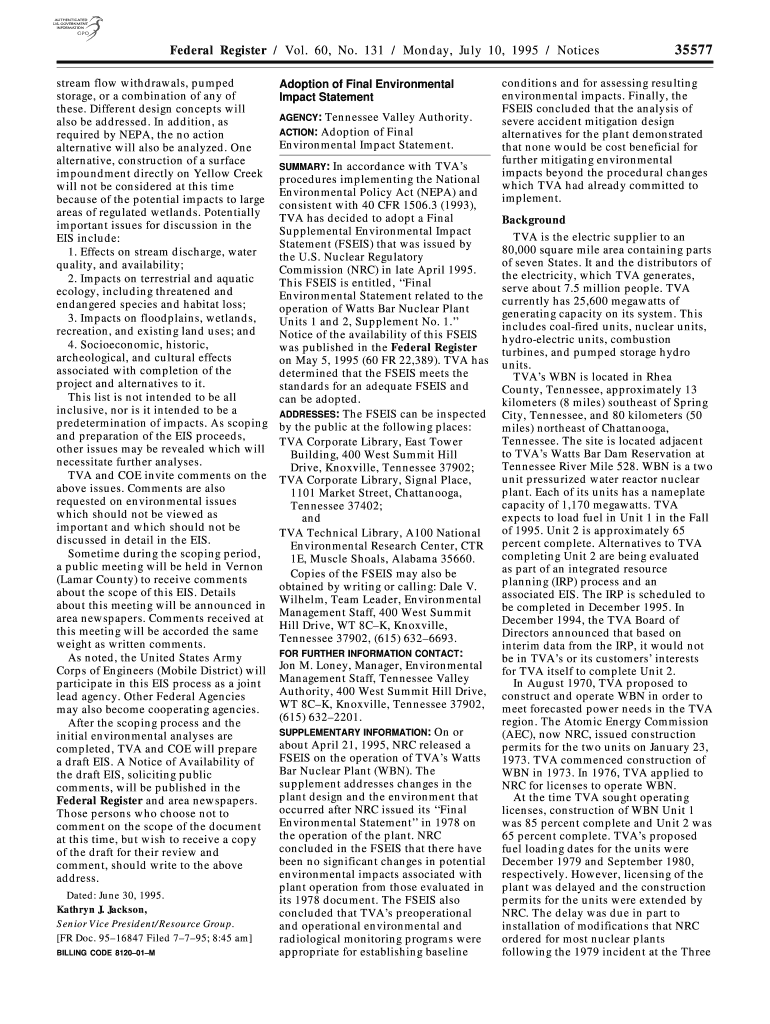







Definition & Meaning
The "60 FR 35577 - Adoption of Final Environmental Impact - gpo" represents a specific regulatory code associated with the environmental impact assessment process. It is a formal declaration included in the Federal Register, identifying the procedures and findings related to the assessment's results. This document is crucial for understanding how environmental considerations are integrated into federal projects, providing transparency and ensuring public awareness and participation in environmental decision-making processes. The code signifies that the outlined impacts have been officially reviewed and adopted, often involving multiple agencies and stakeholders.
How to Use the 60 FR 35577 - Adoption of Final Environmental Impact - gpo
Utilizing the "60 FR 35577" involves understanding its application in environmental reviews for federal projects. It serves as a reference point for compliance with environmental regulations. When utilizing this document, agencies must:
- Review Procedural Guidelines: Ensure all environmental assessments align with the specified methodologies.
- Conduct Public Consultations: Engage with community stakeholders to gather input and address concerns.
- Integrate Findings: Incorporate the environmental impacts identified into project plans.
- Compliance Verification: Verify that all aspects of the environmental statement adhere to federal standards.
This standardized process helps ensure that development and operations mitigate adverse environmental impacts effectively.
How to Obtain the 60 FR 35577 - Adoption of Final Environmental Impact - gpo
Accessing this document requires navigating governmental resources:
- Federal Register Online: Search directly on the Federal Register's website for comprehensive access to the document.
- Government Printing Office (GPO): Physical copies can be requested or purchased through official channels.
- Library Archives: Many public and university libraries maintain archives of government documents.
- Agency Websites: Relevant federal agency portals often host links or resources to obtain environmental documents.
These avenues ensure that stakeholders, researchers, and the public can easily access necessary documentation.
Steps to Complete the 60 FR 35577 - Adoption of Final Environmental Impact - gpo
Completing the process encompassed by "60 FR 35577" involves a series of structured steps:
- Project Proposal Development: Outline the proposed federal project requiring environmental review.
- Initial Screening: Determine the need for an environmental impact statement (EIS).
- Public Scoping: Engage stakeholders to identify major concerns and areas of focus.
- Draft EIS Preparation: Document potential impacts and propose mitigation strategies.
- Public Review: Release draft for public commentary, ensuring feedback integration.
- Final EIS Submission: Modify documents per feedback, submit for federal adoption.
- Record of Decision (ROD): Ensure issuance of a formal decision recognizing the findings.
Each step underscores transparency and responsiveness to ecological and public interests.
Key Elements of the 60 FR 35577 - Adoption of Final Environmental Impact - gpo
Understanding the key elements of this regulation aids in compliance and effective environmental planning:
- Environmental Impact Analysis: Evaluation of the proposed action's environmental consequences.
- Mitigation Strategies: Approaches to reduce harmful impacts on natural and human environments.
- Alternatives Consideration: Exploration of feasible project modifications that lessen adverse effects.
- Public Involvement: Requirements for public participation and input throughout the process.
- Documentation: Comprehensive reporting and documentation standards ensuring regulatory adherence.
These components are vital for ensuring comprehensive environmental protection and project sustainability.
Important Terms Related to 60 FR 35577 - Adoption of Final Environmental Impact - gpo
Familiarity with certain terminology enhances understanding of this document:
- NEPA: National Environmental Policy Act, which underpins the environmental review process.
- EIS (Environmental Impact Statement): A detailed report on the environmental impacts of a proposed action.
- Scoping: Initial process to define the range and depth of issues to be addressed in the EIS.
- Record of Decision (ROD): Final decision document stating chosen actions and mitigating measures.
- Public Comment Period: Duration allotted for stakeholders to review and provide input on the draft EIS.
Grasping these terms is essential for navigating environmental regulations effectively.
Legal Use of the 60 FR 35577 - Adoption of Final Environmental Impact - gpo
The legal application of "60 FR 35577" involves adhering to environmental laws and regulations:
- Federal Compliance: Ensuring that federal projects meet environmental standards and legal requirements.
- Litigation Avoidance: Addressing potential legal challenges by comprehensively considering and documenting environmental impacts.
- Permitting and Approvals: Supporting the process for obtaining necessary environmental permits.
- Implementation of Mitigation Measures: Legally mandated measures to minimize identified environmental impacts.
Complying with these legal standards is critical to project success and environmental stewardship.
Examples of Using the 60 FR 35577 - Adoption of Final Environmental Impact - gpo
Practical examples illustrate the document’s application in real-world scenarios:
- Infrastructure Projects: Utilizing the document in planning new transportation systems that require comprehensive environmental assessments.
- Energy Development: Applying guidelines to evaluate impacts of new energy facilities on local ecosystems.
- Public Land Management: Assessing activities that impact federal lands, like logging or recreational developments.
- Water Resource Projects: Incorporating environmental review processes in dam construction or water diversion initiatives.
These examples demonstrate the pivotal role played by environmental assessments in sustainable development practices.




