







Definition & Meaning
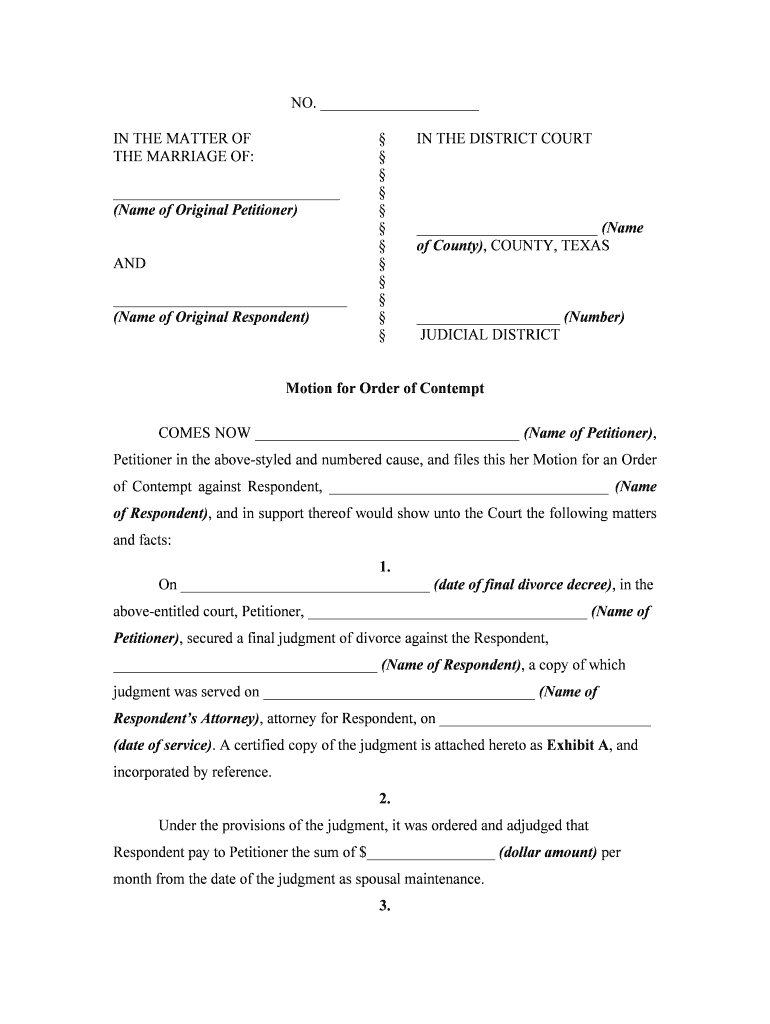
A "motion contempt form" is a legal document typically used in family law or civil proceedings to address a party's non-compliance with a court order. In the context of a divorce case, for instance, this form is submitted by the petitioner to compel the respondent to adhere to obligations such as spousal support or child custody arrangements. The form outlines how the respondent failed to comply with the specific order, provides evidence of the non-compliance, and requests the court to enforce the order. This type of motion is crucial when a party's lack of compliance disrupts the intended outcomes of a legal judgment.
How to Use the Motion Contempt Form
Using a motion contempt form involves several precise steps to ensure its effectiveness in court. First, identify the court order that has not been followed. Next, gather evidence showing the respondent’s non-compliance, such as payment records or communication logs. The form must be filled with accurate details, including personal information and a detailed account of the non-compliance instance. Attach any supporting documents that reinforce your claim. Once completed, the form should be filed with the appropriate court, and the other party must be notified about the filing through acceptable legal means, such as a process server.
How to Obtain the Motion Contempt Form
Obtaining a motion contempt form usually requires contacting the clerk's office at the court where the original order was issued. Many courts provide these forms on their official websites, where they can be downloaded and printed. Alternatively, you can visit the courthouse in person to collect a physical copy. Legal assistance services and online legal form libraries may also offer downloadable versions of this form. Ensure that you acquire the correct form compatible with the jurisdiction where the order was issued, as rules and versions can vary by state.
Steps to Complete the Motion Contempt Form
Completing a motion contempt form involves a series of detailed steps:
- Identify the Court Order: Reference the specific court order that is not being complied with.
- Gather Evidence: Collect all supporting documentation that demonstrates non-compliance.
- Fill Out Personal Details: Input your personal information and that of the respondent.
- Detail the Non-Compliance: Clearly articulate how the respondent failed to adhere to the court order.
- Specify the Relief Sought: Indicate what action you want the court to take to enforce compliance.
- Attach Supporting Documents: Include all collected evidence and any other supporting materials.
- File the Form: Submit the completed form to the court and serve a copy to the respondent.
- Prepare for Hearing: Await scheduling of the court hearing for the motion.
Why Use the Motion Contempt Form
The motion contempt form serves as a vital legal tool to uphold the integrity of court orders. By filing this motion, individuals ensure that all parties involved in a legal proceeding adhere to the terms set forth by the court. It acts as a mechanism to protect the rights of the petitioner and underlines the seriousness of the respondent’s non-compliance. Using this form can lead to enforcement actions such as fines, penalties, or other court-ordered remedies, thereby fostering accountability and fairness in legal matters.
Who Typically Uses the Motion Contempt Form
The motion contempt form is generally used by petitioners who are parties to a legal proceeding where an existing court order has not been followed. This can include individuals involved in divorce proceedings, child custody disputes, spousal support arrangements, or any civil matter requiring adherence to court-imposed directives. Legal professionals, such as attorneys, often assist in preparing and filing these forms on behalf of their clients. Additionally, individuals representing themselves in court may use this form to enforce compliance and seek remedies for violations of court orders.


Legal Use of the Motion Contempt Form
The legal use of a motion contempt form is rooted in the authority of the court to enforce its own orders. This form is grounded in the principle that court decisions must be respected and followed. Filing such a motion is a legal right available to parties seeking to compel compliance with specific terms outlined in prior court judgments. It signifies a formal request for judicial intervention to rectify non-compliance issues, and the court has the discretion to impose penalties, sanctions, or corrective actions based on the findings from the motion hearing.
Key Elements of the Motion Contempt Form
Key elements of a motion contempt form typically include:
- Court Case Information: Case number, court name, and judge details.
- Parties Involved: Names and contact information of both petitioner and respondent.
- Order in Question: Detailed description and date of the original court order.
- Allegations of Non-Compliance: Specific claims of how the respondent has failed to adhere to the order.
- Evidence and Documentation: Attached proof supporting the allegations.
- Relief Requested: Clearly defined actions or remedies being sought from the court.
- Sworn Declaration: A statement verifying the truthfulness and accuracy of the information provided.
Each of these components must be carefully completed to ensure the motion is heard and adjudicated promptly by the court.




