




01. Edit your form online
Type text, add images, blackout confidential details, add comments, highlights and more.

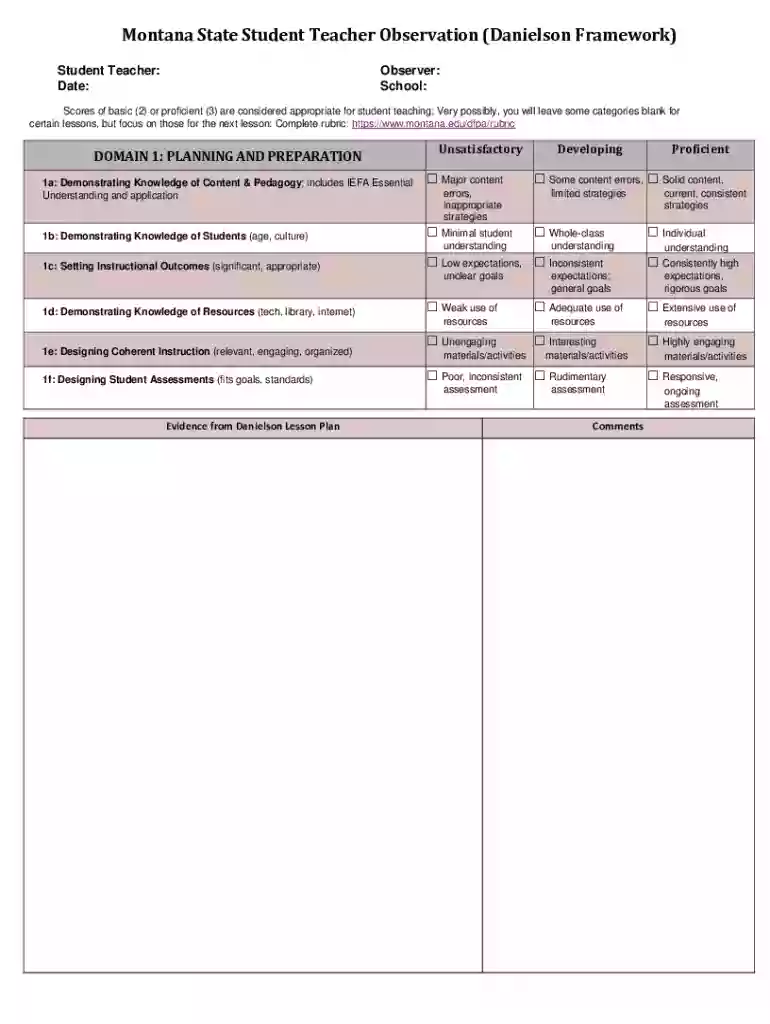
Type text, add images, blackout confidential details, add comments, highlights and more.

Draw your signature, type it, upload its image, or use your mobile device as a signature pad.

Send it via email, link, or fax. You can also download it, export it or print it out.
The Danielson Framework Observation Tool is a comprehensive evaluation system designed to assess and improve teaching practices. It is based on Charlotte Danielson's Framework for Teaching and focuses on four main domains: Planning and Preparation, Classroom Environment, Instruction, and Professional Responsibility. Each of these domains contains specific criteria used to evaluate educators' performance levels, ranging from unsatisfactory to proficient. This tool is integral to providing structured feedback, with the goal of enhancing both teaching effectiveness and professional growth within educational settings.
Educators and evaluators can use the Danielson Framework Observation Tool as a structured guide to observe and assess teaching practices. To effectively use the tool, evaluators should familiarize themselves with the criteria outlined in each of the four domains. Observations typically occur in a classroom setting, where the evaluator records evidence of the teacher's performance according to the framework. After observations, evaluators provide feedback, which helps teachers understand their strengths and areas for improvement. This collaborative process ensures that educators receive constructive guidance tailored to their instructional needs.
The Danielson Framework Observation Tool can be found through various educational resources, including professional development organizations, educational institutions, and certain state education departments. It is often available in both digital and print formats, allowing for flexibility in its use. Educational entities that use the framework can often provide access to the tool and may offer training sessions to help educators and evaluators effectively implement it within their teaching and assessment practices. For those who need direct access, contacting a school district's professional development coordinator or searching for resources online may be effective methods.
The tool includes several key elements central to effectively evaluating teaching performance. These include specific criteria for each domain, a rubric outlining performance levels, and guidelines to support objective assessment. The framework emphasizes measurable indicators of effective teaching, such as creating a supportive classroom environment and demonstrating instructional expertise. This structured approach ensures evaluations are consistent, fair, and comprehensive, providing educators with actionable feedback. Understanding these elements is vital for both evaluators and teachers, as they form the basis for all assessments conducted using the framework.
One example involves evaluating a teacher's classroom management skills under the Classroom Environment domain. An evaluator might observe how the teacher establishes and maintains classroom norms, engaging students while minimizing disruptions. Another scenario could involve assessing instructional delivery, noting how well a teacher adapts lesson plans to student needs and encourages critical thinking. These real-world examples illustrate the tool's flexibility, as it can accommodate varied teaching styles and classroom settings while still offering detailed, specific feedback to educators.
The Danielson Framework Observation Tool is primarily used by school administrators, instructional coaches, and peers involved in the evaluation process. It is a preferred method in districts seeking a detailed and standardized approach to teacher assessment. Educators themselves also use it during self-assessment exercises to identify areas for professional growth. The tool's emphasis on four critical domains makes it applicable to various educational contexts, beneficial not only for new teachers seeking mentorship but also for experienced educators aiming to refine their skills.


The use of the Danielson Framework Observation Tool must comply with local, state, and federal educational guidelines. It is essential that institutions employing the tool ensure that their use aligns with applicable regulations concerning teacher evaluation processes. Legal compliance helps maintain the integrity and fairness of evaluation outcomes. Specific states may have additional rules regarding the deployment of formal observation tools, which schools must follow to remain compliant and uphold the tool's legality in assessing educators' performance.
We've got more versions of the Danielson Framework Observation Tool form. Select the right Danielson Framework Observation Tool version from the list and start editing it straight away!
| Versions | Form popularity | Fillable & printable |
|---|---|---|
| 2018 | 4.9 Satisfied (20 Votes) |
At DocHub, your data security is our priority. We follow HIPAA, SOC2, GDPR, and other standards, so you can work on your documents with confidence.
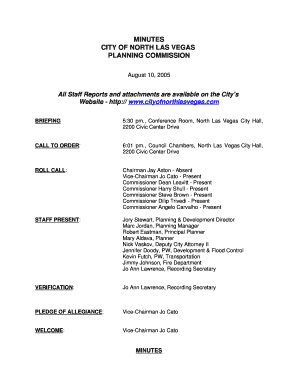
: Charlotte Danielson Framework for Teaching Observation. The Framework for Teaching Evaluation Instrument. DOMAIN 1: PLANNING AND PREPARATION Candidate Date.
The purpose of this project was to examine the validity of Charlotte Danielsons Framework for Teaching (FFT) for use with special education teachers.
Quantum gravity (QG) is a field of theoretical physics that seeks to describe gravity according to the principles of quantum mechanics. It.


