




01. Edit your form online
Type text, add images, blackout confidential details, add comments, highlights and more.

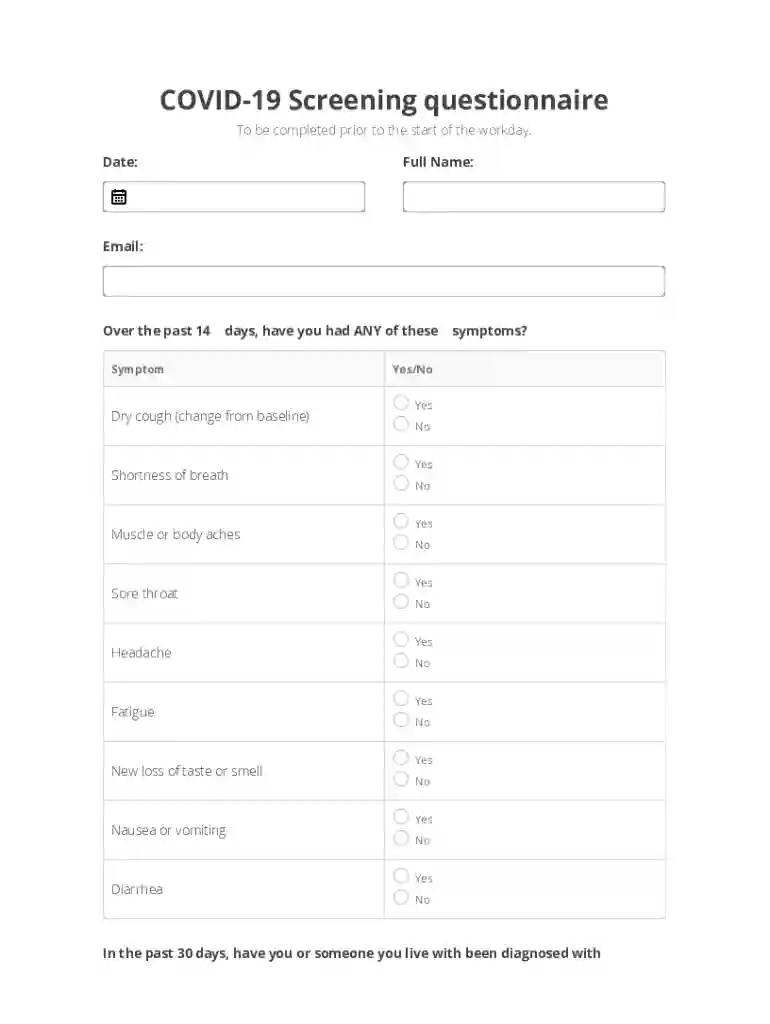
Type text, add images, blackout confidential details, add comments, highlights and more.

Draw your signature, type it, upload its image, or use your mobile device as a signature pad.

Send it via email, link, or fax. You can also download it, export it or print it out.
The COVID-19 Screening Questionnaire is a tool designed to assess potential exposure to COVID-19 and the presence of symptoms associated with the virus. It plays a critical role in maintaining workplace safety by helping employers identify individuals who may pose a risk of spreading the virus. This questionnaire is typically used in workplaces and other public venues to ensure that individuals are healthy before interacting with others. The form includes questions regarding recent travel history, symptoms experienced, and contact with confirmed COVID-19 cases.
The process of completing the COVID-19 Screening Questionnaire involves several key steps to ensure accurate and thorough responses:
Read All Instructions Carefully:
Prepare Required Information:
Symptom Assessment:
Exposure Risk Evaluation:
Verification and Signature:
Submission:
Utilizing the COVID-19 Screening Questionnaire offers multiple benefits in a workplace or communal setting:
Health and Safety Assurance:
Compliance with Public Health Guidelines:
Data for Decision Making:
A well-structured COVID-19 Screening Questionnaire typically includes several critical components:
Personal Identification Information:
Symptom Checklist:
Exposure Inquiry:
Health Declaration:
Privacy Notice:
The use of the COVID-19 Screening Questionnaire is subject to various legal considerations:
Compliance with Employment Law:
Data Protection Regulations:
Record-Keeping Requirements:
While the general principles of the COVID-19 Screening Questionnaire apply nationwide, state-based variations exist:
State Health Regulations:
Differing Legal Requirements:
Adapting to Local Outbreaks:
When choosing between digital and paper versions of the COVID-19 Screening Questionnaire, several factors must be considered:
Accessibility:
Efficiency and Speed:
Physical Reach:
Data Security:
The COVID-19 Screening Questionnaire sees widespread use among various organizations and sectors:
Workplaces:
Schools:
Healthcare Facilities:
Public Venues:


We've got more versions of the COVID-19 Screening Questionnaire form. Select the right COVID-19 Screening Questionnaire version from the list and start editing it straight away!
| Versions | Form popularity | Fillable & printable |
|---|---|---|
| 2021 | 4.9 Satisfied (33 Votes) |
At DocHub, your data security is our priority. We follow HIPAA, SOC2, GDPR, and other standards, so you can work on your documents with confidence.


COVID-19 Screening Questionnaire 1. Within the last 14 days: C) Have you experienced, or are you experiencing, any of the following (other than from a pre-
COVID-19 test, using an encased paper strip. It would detect the following STIs: Chlamydia, Gonorrhea, Syphilis, HPV (Human Papillomavirus), and Trichomonas
Have you tested positive for COVID-19 in the last 14 days? Do you have any of the following symptoms? Fever or chills? Achiness?


