Qualified Claimant's Statement 2026

Get Form
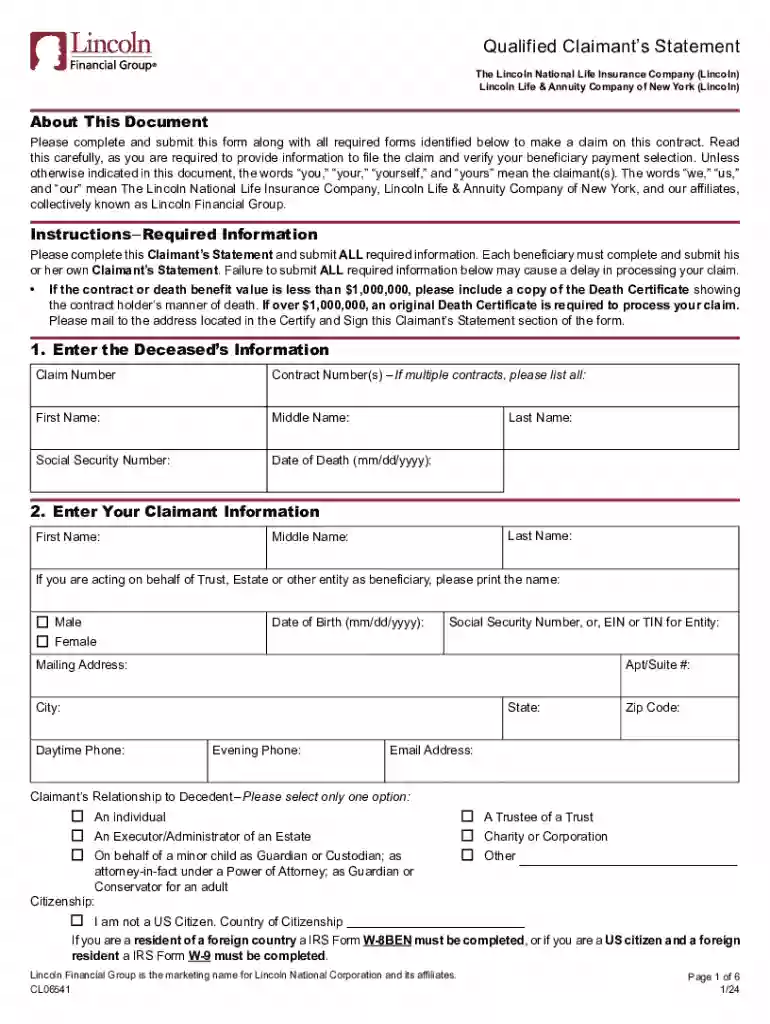
Qualified Claimant's Statement Preview on Page 1

Here's how it works

01. Edit your form online
Type text, add images, blackout confidential details, add comments, highlights and more.

02. Sign it in a few clicks
Draw your signature, type it, upload its image, or use your mobile device as a signature pad.

03. Share your form with others
Send it via email, link, or fax. You can also download it, export it or print it out.

Understanding the Qualified Claimant's Statement

The Qualified Claimant's Statement is an essential document for individuals filing a claim on an insurance contract, typically from organizations like Lincoln National Life Insurance Company. This form is designed to gather critical information about the claimant and the deceased to facilitate the processing of insurance claims. By comprehensively detailing the claimant's personal information and the deceased's details, insurance companies can accurately assess and expedite the claim process.

Key Elements of the Qualified Claimant's Statement

Several critical sections make up the Qualified Claimant's Statement, each serving a specific purpose:

  • Personal Information: This section requires the claimant's full name, contact details, and Social Security number for identification purposes.
  • Deceased's Information: Details about the deceased, such as their full name, date of birth, and Social Security number, must be provided.
  • Payment Preferences: Claimants must specify their preferred payment method, whether it is through a direct deposit or a mailed check.
  • Beneficiary Designation: The form includes space to list beneficiaries, often requiring up-to-date contact information for all beneficiaries.

How to Obtain the Qualified Claimant's Statement

Obtaining the Qualified Claimant's Statement is a straightforward process. Insurance providers typically make these forms available on their official websites. Alternatively, claimants can contact the insurance company's customer service department to request a physical or digital copy. It is essential to ensure that the form is current, as outdated forms may result in processing delays.

Steps to Complete the Qualified Claimant's Statement

Completing the Qualified Claimant's Statement requires careful attention to detail:

  1. Gather Necessary Information: Assemble all required personal and deceased's information, payment preferences, tax withholding selections, and beneficiary details.
  2. Fill Out the Form: Carefully input the collected information into the respective sections of the form.
  3. Review for Accuracy: Double-check all entries for completeness and accuracy to prevent processing delays.
  4. Sign and Date: Ensure the form is signed and dated correctly as a final step before submission.

Importance of the Qualified Claimant's Statement

The Qualified Claimant's Statement plays a pivotal role in ensuring claims are processed accurately and efficiently. By providing precise information, claimants help insurance companies administer payouts promptly and accurately, thereby mitigating potential disputes or complications.

Legal Use of the Qualified Claimant's Statement

The legal framework surrounding the use of the Qualified Claimant's Statement ensures that all claims made are legitimate and substantiated. Insurance providers utilize this form to maintain compliance with industry regulations and to ensure that claims are processed in alignment with legal standards, including proper verification of the claimant's and deceased's identities.

Important Terms Related to the Qualified Claimant's Statement

Several terms are crucial for understanding and completing the Qualified Claimant's Statement:

  • Claimant: The individual or entity making the claim for insurance benefits.
  • Beneficiary: The person(s) designated to receive the insurance payout.
  • SSN (Social Security Number): A unique identifier used in the processing of claims to ensure accurate identification and verification.

State-Specific Rules for the Qualified Claimant's Statement

Although the Qualified Claimant's Statement is widely recognized, specific states may have additional requirements or variations in the form. For instance, some states might necessitate notarization or additional forms of identification before submission. Claimants should verify that they comply with their state's particular regulations to avoid any processing disruptions.

Required Documents

When submitting the Qualified Claimant's Statement, several supporting documents are usually needed:

  • Death Certificate: A certified copy to validate the claim.
  • Identification Documents: For both the claimant and the deceased, including driver's licenses or state-issued IDs.
  • Policy Documentation: Relevant insurance policy details to confirm coverage and terms.

Form Submission Methods

Once completed, the Qualified Claimant's Statement can generally be submitted through various channels:

  • Online Submission: Many insurance companies offer online portals for form submission, providing a convenient and swift option.
  • Mailing the Form: Some claimants may choose to mail a physical copy of the completed form to the insurance provider.
  • In-Person Delivery: An option for those who prefer to deliver the form directly to a local office, offering immediate confirmation of receipt.

Common Variations of the Qualified Claimant's Statement

While the core content remains consistent across versions, there may be slight differences in the layout or additional fields in older or alternative versions of the form. It’s crucial for claimants to use the most up-to-date version provided by their specific insurance company to ensure compliance and avoid delays in processing.

By thoroughly understanding these aspects of the Qualified Claimant's Statement, individuals and businesses can navigate the process of filing an insurance claim more effectively, ensuring timely resolution and payout.

be ready to get more

Complete this form in 5 minutes or less

Get form

Got questions?

We have answers to the most popular questions from our customers. If you can't find an answer to your question, please contact us.
Contact us
Payments are made to the policy owner and are sent by check or Electronic Funds Transfer (EFT).
Once Lincoln Financial Group receives all necessary information to make a determination on your claim, a decision to approve or deny your claim will be made within 3 business days. Once your short-term disability claim is approved, Lincoln Financial Group will mail checks to your home on a bi-weekly basis.
1. Log in to your account at LincolnFinancial.com/Retirement. 2. To make a request, click Loan information or Withdrawal information under Important links for my plan.
Capacity is the legal authority that entitles you to claim proceeds. If you are claiming on your own behalf, you are an individual claimant and should indicate your capacity as Individual. Do not use any other title unless you are actually claiming in that capacity.
A claims examiner will review the claim within three to five business days of receipt. The claims examiner will follow up with the claimant, physician or employer if more information is needed. A claim decision will be made once we receive all needed information.

Security and compliance

At DocHub, your data security is our priority. We follow HIPAA, SOC2, GDPR, and other standards, so you can work on your documents with confidence.
Learn more
ccpa2
pci-dss
gdpr-compliance
hipaa
soc-compliance

People also ask

Claimant Statement FormIncome Annuity. Use this form to complete the settlement of your inherited income annuity contract. If you need more room for information or signatures, make a copy of the relevant page.
This form is used to collect information relating to the payment of death benefits. The information provided will be used to determine entitlement to death benefits. Persons are not required to respond to the collection of information unless it displays a currently valid OMB Control Number.
If I complete the form I received in the mail, how long will it take to get a check? It may take up to eight weeks once all required documentation is received. However, if you are the beneficiary claiming funds, it may take longer and additional documentation may be requested at a later date.