PPE Inspection - Safety-Lifting 2026

Get Form
PPE Inspection - Safety-Lifting Preview on Page 1

Here's how it works

01. Edit your form online
Type text, add images, blackout confidential details, add comments, highlights and more.

02. Sign it in a few clicks
Draw your signature, type it, upload its image, or use your mobile device as a signature pad.

03. Share your form with others
Send it via email, link, or fax. You can also download it, export it or print it out.

Definition and Meaning of PPE Inspection - Safety-Lifting

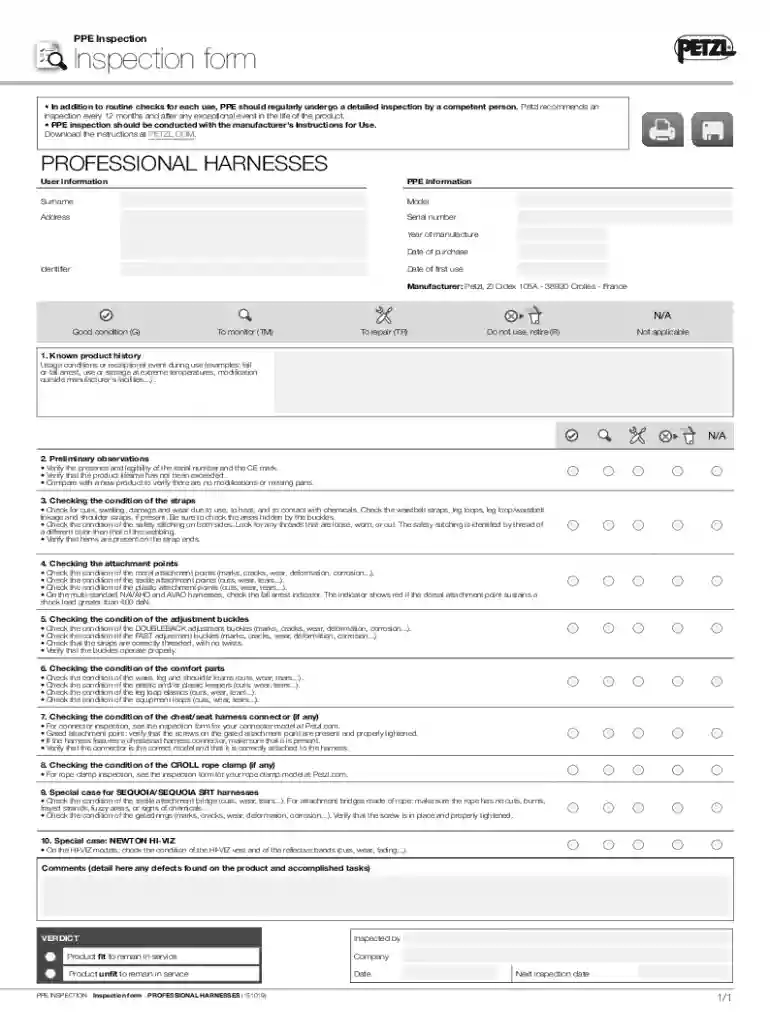
The PPE Inspection - Safety-Lifting form is specifically designed to ensure that personal protective equipment, particularly professional harnesses used in safety-lifting operations, meets safety standards. This form serves as an essential documentation tool for verifying that all components of the harnesses, including straps, attachment points, and buckles, are in optimal condition. Regular inspections, as outlined in this document, are crucial for maintaining workforce safety and compliance with occupational safety regulations.

Steps to Complete the PPE Inspection - Safety-Lifting

  1. Gather Necessary Tools and Equipment: Before starting the inspection, ensure that you have all required documents and tools, including the inspection checklist.
  2. Inspect Straps and Webbing: Check for signs of wear, cuts, or fraying in the straps. Ensure that the webbing is intact and has no surface contaminants.
  3. Examine Attachment Points: Verify that all attachment points are secure and free from corrosion or damage.
  4. Test Adjustment Buckles: Adjust all buckles to confirm they operate smoothly without undue force and that they lock securely in place.
  5. Review Comfort Parts: Inspect padding and other comfort parts for wear and ensure they are not compromised structurally.
  6. Document Findings: Record inspection results on the form, marking tested components and noting any defects or maintenance needs.

Why PPE Inspection - Safety-Lifting Is Essential

Regular completion of the PPE Inspection - Safety-Lifting is vital for several reasons:

  • Safety Compliance: Helps ensure compliance with industry safety standards and regulations.
  • Prevention of Accidents: Identifies potential hazards before they lead to workplace accidents.
  • Extended Equipment Life: Regular checks help prolong the usability of harnesses by identifying and rectifying issues promptly.
  • Insurance and Liability: Provides documentation that equipment has been checked and maintained, which can be crucial in insurance and regulatory reviews.

Key Elements of the PPE Inspection - Safety-Lifting

  • Inspection Checklist: A detailed list that guides the thorough examination of each harness component.
  • Condition Assessment: Evaluates visible and functional aspects, documenting any defects or concerns.
  • Certification Section: Space for the inspector to certify that the equipment has been reviewed.
  • Action Items: Notes for required repairs or replacements based on inspection findings.

Who Typically Uses the PPE Inspection - Safety-Lifting

This form is primarily utilized by:

  • Safety Inspectors: Professionals responsible for regulatory compliance and workplace safety.
  • Equipment Managers: Individuals overseeing the maintenance and deployment of protective equipment.
  • Worksite Supervisors: Responsible for ensuring their team uses safe equipment.
  • Training Coordinators: Using the form as a teaching tool for instructing new team members about safety standards.
decoration image ratings of Dochub

Legal Use of the PPE Inspection - Safety-Lifting

Compliance with safety regulations often requires documentation like the PPE Inspection - Safety-Lifting form. This form may be reviewed during audits conducted by safety regulators and is a legally recognized document proving adherence to safety protocols. Non-compliance or failure to maintain proper records can result in fines or legal action.

State-specific Rules for the PPE Inspection - Safety-Lifting

While the general principles of the PPE Inspection - Safety-Lifting form remain consistent, specific states may have additional requirements. For instance:

  • California: May have stricter guidelines under CAL/OSHA regulations concerning frequency and documentation of inspections.
  • New York: Requires additional signatures from certified inspectors for compliance.
  • Texas: May mandate additional reporting for failed inspections or equipment repairs.

Important Terms Related to PPE Inspection - Safety-Lifting

  • Competent Person: An individual designated to perform inspections who has the proper credentials and training.
  • Fall Arrest System: Equipment designed to stop a fall before the person reaches the ground.
  • Load Anchor Points: Specific areas where a harness is safely attached to support weight during lifting operations.
  • Inspection Certificate: Official documentation indicating equipment has been verified for safety compliance.
be ready to get more

Complete this form in 5 minutes or less

Get form

Got questions?

We have answers to the most popular questions from our customers. If you can't find an answer to your question, please contact us.
Contact us
A Thorough Examination, or LOLER inspection, is a systematic and detailed inspection of the lift and all of its associated equipment by a competent person who must then complete a written report. No remedial work is undertaken but recommendations, potential failures and actual failures are identified and reported on.
It is critical that all Personal Protective Equipment is visually examined by a competent person prior to being worn and thereafter at regular intervals (at least every 6 months). The user must always thoroughly examine their PPE before use.
These Regulations (often abbreviated to LOLER) place duties on people and companies who own, operate or have control over lifting equipment. This includes all businesses and organisations whose employees use lifting equipment, whether owned by them or not.
What types of protective clothing should be worn when lifting? Lightweight, flexible, tear and puncture-resistant clothing. Appropriate footwear, such as safety boots with slip-resistant soles. Protective gloves that are appropriate for the materials being handled.
Quite simply, the Lifting Operations and Lifting Equipment Regulations, otherwise known as LOLER or Lifting Equipment Inspection, is a detailed examination of lifting equipment that is carried out by a qualified or competent person, as defined by the Health and Safety Executive (HSE).

Security and compliance

At DocHub, your data security is our priority. We follow HIPAA, SOC2, GDPR, and other standards, so you can work on your documents with confidence.

Learn more
ccpa2
pci-dss
gdpr-compliance
hipaa
soc-compliance

People also ask

What lifting equipment needs a LOLER inspection and certificate? Cranes. Fork-lift trucks. Cherry pickers. Telehandlers. Motor vehicle lifts. Scissor lifts. Hoists. Elevated work platforms.
LOLER (Lifting Operations and Lifting Equipment Regulations) are a set of regulations designed to make lifting operations, and the use of lifting equipment, as safe as can be.
What is a PPE Inspection Plan? A PPE inspection plan is a systematic, structured approach to ensure that all PPE used in the workplace is in optimal condition and provides the intended protection against hazards.

Related links