
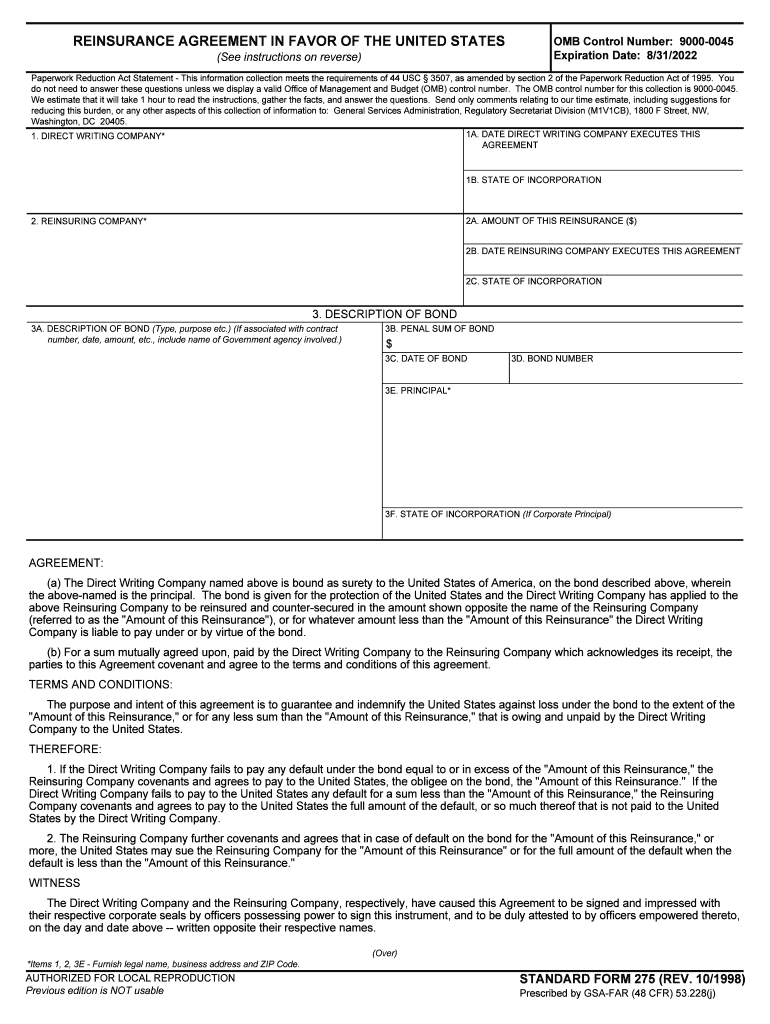







Definition and Meaning
The "Standard Form 275 - Reinsurance Agreement In - GSA" is a legally binding document used in the United States to facilitate a reinsurance agreement between a Direct Writing Company and a Reinsuring Company. It outlines the terms under which the Reinsuring Company agrees to indemnify the United States against any losses incurred by the Direct Writing Company under a specified bond. This form plays a crucial role in ensuring financial protection and risk management in government-related insurance scenarios. Reinsurance acts as a guarantee that the United States will receive compensation in the event of a loss, thereby maintaining stability and trust in government-backed insurance programs.
Key Elements of Standard Form 275
The Standard Form 275 comprises several critical components that ensure a comprehensive reinsurance agreement:
- Parties Involved: Identifies the Direct Writing Company and the Reinsuring Company, specifying their roles and responsibilities.
- Reinsurance Terms: Details the coverage limits, premium rates, and conditions under which the reinsurance will be effective.
- Indemnification Clause: Provides guidelines on how the Reinsuring Company will compensate the United States for any losses incurred.
- Default Provisions: Specifies the actions to be taken if the Direct Writing Company fails to fulfill its obligations, including steps for filing a claim.
- Execution and Filing: Includes instructions on how the form should be executed, signed by authorized officials, and filed for record-keeping and compliance purposes.
How to Use the Standard Form 275
Utilizing Standard Form 275 requires adherence to the established procedure to ensure its effectiveness and enforceability:
- Review the Agreement: Both parties should carefully examine the terms to ensure mutual understanding and agreement.
- Complete Required Details: Accurately fill in all necessary details, including the names of involved companies, coverage terms, and indemnification measures.
- Authorized Signatures: Obtain signatures from authorized representatives of both companies to validate the agreement.
- Submit the Form: File the completed and signed form with the appropriate government agency to ensure it is properly documented and enforceable.
- Retain Copies: Both parties should keep copies of the form for their records and future reference.
Legal Use of the Standard Form 275
This form is utilized within legal frameworks to mitigate risks associated with insurance policies backed by the U.S. government. By defining clear terms of reinsurance, it ensures legal recourse is available should the need for indemnification arise. Furthermore, the form includes compliance with federal laws and regulations, ensuring its legality and adherence to standard practices in governmental reinsurance procedures.
Steps to Complete the Standard Form 275
Filling out the Standard Form 275 involves the following steps:
- Gather Information: Collect all necessary information about the Direct Writing Company, the Reinsuring Company, and the terms of reinsurance.
- Enter Company Details: Input the legal names, addresses, and contact information of both parties.
- Specify Coverage Details: Clearly outline the coverage limits, terms, and conditions of the reinsurance agreement.
- Include Indemnification Terms: Enter details about how indemnification will be handled, including conditions for claims and payout processes.
- Sign and Date: Ensure the form is signed and dated by authorized representatives.
- Final Review: Conduct a thorough review to confirm accuracy and completeness before submission.
Who Typically Uses the Standard Form 275
This form is primarily used by:
- Insurance Companies: Firms involved in providing bonding services to the U.S. government.
- Reinsurance Firms: Companies that specialize in offering reinsurance services to mitigate risk.
- Government Agencies: Entities requiring assurances of financial backing through reinsurance to safeguard federal interests in various projects.


Eligibility Criteria
To enter into a reinsurance agreement using Standard Form 275, the involved parties must meet specific eligibility conditions, including:
- Licensing Requirements: Both the Direct Writing and Reinsuring Companies must be licensed and authorized to operate within the jurisdictions where they conduct business.
- Financial Stability: Companies need to demonstrate adequate financial solvency to ensure they can meet the terms of the agreement.
- Federal Compliance: Adherence to all relevant federal regulations governing reinsurance agreements.

Filing Deadlines and Important Dates
Careful attention must be paid to filing deadlines and important dates for the Standard Form 275:
- Execution Date: The form must be executed within the period stipulated in the reinsurance agreement.
- Renewal Dates: Pay attention to renewal clauses if the agreement is not perpetual and requires reissuance or renegotiation.
- Deadline for Claims: Any claims against the reinsurance should be made within the timeframes specified in the form to avoid forfeiture of rights.
Penalties for Non-Compliance
Failure to adhere to the terms and conditions of the Standard Form 275 can result in several penalties:
- Financial Penalties: These can be levied against parties breaching the agreement terms.
- Revocation of Licenses: Regulatory bodies may revoke or suspend the licenses of non-compliant companies.
- Legal Action: The federal government or affected parties may pursue legal action to recover owed sums or seek damages.
Examples of Using Standard Form 275
In practice, the Standard Form 275 might be used when:
- A government construction project requires reinsurance for bonds to protect taxpayer money.
- An insurance company wants to mitigate the risk associated with policies issued covering federal workers.
- A reinsurer enters an agreement with a primary insurer to share the risks of claims on government-backed insurance policies.
These examples highlight the form's role in maintaining financial security and compliance in significant legal and financial operations.




