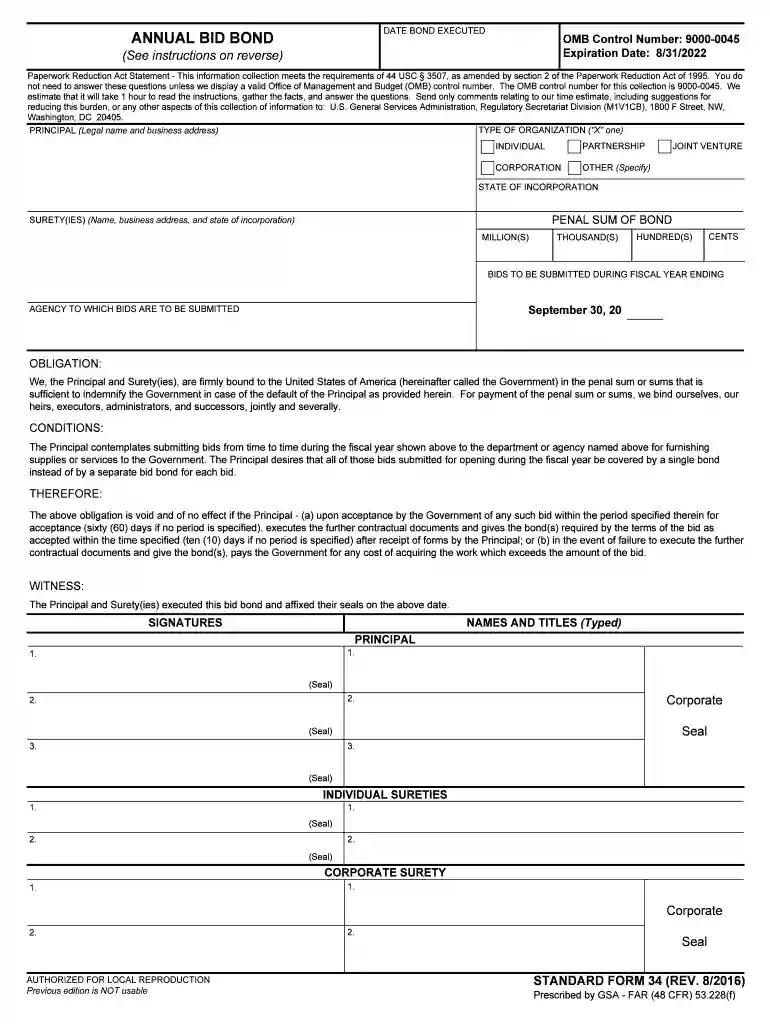
Standard Form 35 - Annual Performance Bond - GSA 2026

Get Form
Standard Form 35 - Annual Performance Bond - GSA Preview on Page 1

Here's how it works

01. Edit your form online
Type text, add images, blackout confidential details, add comments, highlights and more.

02. Sign it in a few clicks
Draw your signature, type it, upload its image, or use your mobile device as a signature pad.

03. Share your form with others
Send it via email, link, or fax. You can also download it, export it or print it out.

Definition & Meaning of the Standard Form 35 - Annual Performance Bond - GSA

The Standard Form 35, also known as the Annual Performance Bond, is an official document used by the U.S. General Services Administration (GSA). This form serves as a legal agreement between the Principal—typically a contractor—and the Surety, which guarantees the performance of the Principal's obligations under a contract with the Federal Government. It indemnifies the government against losses stemming from the Principal's non-performance or default. The bond is essential in ensuring financial security and accountability, providing a safety net for government projects by requiring the Surety to fulfill the contract terms or compensate the client financially.

How to Use the Standard Form 35 - Annual Performance Bond - GSA

Utilizing the Standard Form 35 involves several critical steps:

  1. Understanding the Project Scope: Before executing the bond, all parties involved must clearly understand the project's contractual obligations.
  2. Filling Out the Form: The Principal must accurately complete the form, including all necessary details about the project and the involved parties.
  3. Securing a Surety: The Principal needs to identify and secure a surety company willing to underwrite the bond.
  4. Submitting the Form: After completing the form and securing a bond, the Principal submits it as part of the bid package.
  5. Maintaining Compliance: The Principal must adhere to all contractual obligations stipulated in both the bond and the project contract.

Steps to Complete the Standard Form 35 - Annual Performance Bond - GSA

Completing the Standard Form 35 is a detailed process requiring attention to various legal and contractual details:

  1. Collect Required Information: Gather all necessary information such as contractor details, project specifications, and bond amount.
  2. Consult with a Surety Company: Engage with a surety company to discuss the bond requirements and verify eligibility.
  3. Accurate Data Entry: Fill in the form meticulously to ensure all parties' names, addresses, and specifics are correct.
  4. Review Contract Terms: Understand and agree to all contract terms related to performance obligations.
  5. Obtain Required Signatures: Ensure all required signatures from the Principal, Surety, and any witnesses are obtained.
  6. Finalize the Form: Double-check all entries for accuracy before submitting the completed form along with any other required documents.

Who Typically Uses the Standard Form 35 - Annual Performance Bond - GSA

The Standard Form 35 is primarily used by:

  • Contractors and Builders: Engaged in projects requiring performance guarantees.
  • Government Agencies: To secure agreements and ensure accountability from contractors.
  • Surety Companies: Offering the financial backing and support necessary for contractors to undertake significant government projects.
decoration image ratings of Dochub

Important Terms Related to Standard Form 35 - Annual Performance Bond - GSA

Several important terms are associated with the Standard Form 35:

  • Principal: The contractor who performs the work under the bond.
  • Surety: The financial institution guaranteeing the performance of the Principal.
  • Obligee: The party that benefits from the bond, typically the Federal Government.
  • Bid Bond: A precursor to the performance bond, ensuring serious bidding.
  • Indemnity: A principle ensuring compensation for any losses due to default.

Legal Use of the Standard Form 35 - Annual Performance Bond - GSA

Legal use of the Standard Form 35 is guided by federal regulations and laws:

  • Federal Acquisition Regulation (FAR): Governs the acquisition of goods and services by Government agencies.
  • Contract Law: Specific to performance obligations and remedies in the event of non-compliance or default.
  • Surety Law: Rules surrounding the obligations and rights of the surety company and the Principal.

Required Documents for Completing the Standard Form 35

When completing the Standard Form 35, ensure you have the following documentation:

  • Contract Details: The full contract for which the bond is being issued.
  • Financial Statements: Statements that may be required by the Surety to assess risk.
  • Past Performance Records: Documentation of previous project completion and compliance.
  • Surety Agreements: Any agreements or terms from the surety company.

Penalties for Non-Compliance with the Standard Form 35

Non-compliance with the terms outlined in the Standard Form 35 can result in severe penalties:

  • Financial Penalties: The Surety may be required to pay any outstanding obligations.
  • Project Termination: Contracts may be terminated due to non-compliance.
  • Legal Action: Potential lawsuits from the Federal Government for breach of contract.
  • Loss of Future Opportunities: Failure to comply may result in being barred from future bids or projects with government entities.
be ready to get more

Complete this form in 5 minutes or less

Get form

Got questions?

We have answers to the most popular questions from our customers. If you can't find an answer to your question, please contact us.
Contact us
Premium rates typically cost 3% of the total project value. For example, a qualified contractor would pay $3,000 for payment and performance bond coverage on a $100,000 construction project. However, if you just need one or the other, rates may differ: Payment Bond Rates: 15% of the total contract amount.
The cost of a performance bond is normally calculated as a percentage of the value of the contract, and with reference to the length of the period to be covered. For longer projects, there may be a slightly higher cost. A typical performance bond is normally about 10% of the contract value, but this can vary. How are performance bonds calculated? - Kerry London Kerry London bonds bonds-faqs h Kerry London bonds bonds-faqs h
The most common type of Performance Bond we are asked to issue is an ABI Performance Bond, this is the standard form of Bond and is found in JCT Contracts. This type of Construction Performance Bond is tried and tested, it is fair to all parties and pays upon quantified losses. Performance Bonds - Surety Bonds and Guarantees Surety Bonds and Guarantees suretybonds Surety Bonds and Guarantees suretybonds
To get a performance bond, contractors need to apply with a surety provider. If the construction project amount exceeds $750,000, applicants must provide additional financial credentials. Standard bond application questions include: How much is your bid? Performance Bonds For Construction | Complete Guide - SuretyBonds.com SuretyBonds.com contract performance- SuretyBonds.com contract performance-
Performance bonds are a type of guarantee that ensures the contractor will pay a predetermined sum in case they fail to meet their obligations. Performance bonds usually depend on 10-12% and replace bid bond payments after award of contract.

Security and compliance

At DocHub, your data security is our priority. We follow HIPAA, SOC2, GDPR, and other standards, so you can work on your documents with confidence.
Learn more
ccpa2
pci-dss
gdpr-compliance
hipaa
soc-compliance

People also ask

1% - 5% Typical cost of a Performance Bond Rates for performance bonds can differ depending on the qualification of the contractor, as well as type and size of the contract. The rate paid is typically a percentage of either the contract amount or bond amount. The average rates and costs can range from 1% - 5%. Typical Performance Bond Costs Viking Bond Service contract ty Viking Bond Service contract ty

Related links