01. Edit your form online
Type text, add images, blackout confidential details, add comments, highlights and more.

Type text, add images, blackout confidential details, add comments, highlights and more.

Draw your signature, type it, upload its image, or use your mobile device as a signature pad.

Send it via email, link, or fax. You can also download it, export it or print it out.
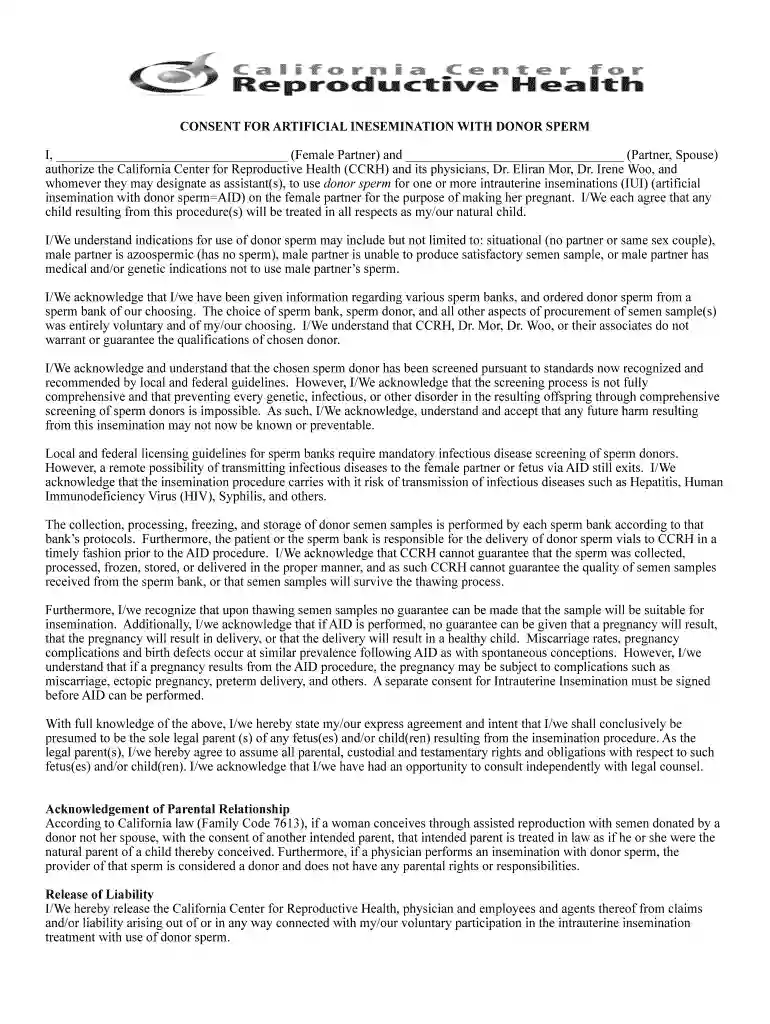
The "California Statutory Forms for Assisted Reproduction" are legal documents prescribed by the state of California to facilitate and authorize procedures involved in assisted reproductive technology (ART). These forms provide a standard framework for obtaining consent and clarifying the rights and responsibilities of all parties involved in procedures such as artificial insemination or in vitro fertilization. In essence, these forms serve to document the intent and agreements of individuals or couples deciding to pursue parenthood through assisted reproduction, ensuring compliance with state laws and regulations.
Using the California Statutory Forms for Assisted Reproduction involves several critical steps to ensure all legal requirements are met and the process proceeds smoothly. These forms are typically used by intended parents to formally agree to various aspects of assisted reproduction, such as donor involvement and parental rights. Users must carefully read and complete each section of the form, providing all required personal and procedural details. It’s essential to fully understand the legal jargon and implications of the agreements within the form. Consultation with a legal expert specializing in family law or reproductive technology is advisable to ensure the documents are completed accurately and comprehensively.
Typically, these forms are utilized by intended parents who wish to conceive through assisted reproductive technologies. This includes individuals or couples seeking parenthood via artificial insemination or in vitro fertilization with the help of donors. Additionally, reproductive health clinics and legal professionals involved in arranging and overseeing such procedures frequently engage with these forms to ensure all parties adhere to the legal requirements.


The primary legal use of these forms is to formalize the consent of all parties involved in the assisted reproduction process, delineating parental rights, obligations, and agreements related to the raising of the resulting child. They serve as a binding legal agreement recognized by the state, which can protect intended parents and donors by clarifying roles and responsibilities from the outset. Courts often rely on these documents in legal disputes involving parental rights and obligations related to assisted reproduction procedures.
California's legal framework surrounding assisted reproduction is among the most progressive in the United States. Specific state laws govern the use of reproductive technologies and mandate documentation of consent via statutory forms. Unique provisions may apply depending on the involvement of third-party donors and surrogacy arrangements, making it essential to understand the jurisdictional rules influencing these legal agreements. Adhering strictly to the state’s requirements ensures the validity and enforceability of the consent forms.
Various real-life scenarios illustrate the use of these forms:
We've got more versions of the California Statutory Forms for Assisted Reproduction - The form. Select the right California Statutory Forms for Assisted Reproduction - The version from the list and start editing it straight away!
| Versions | Form popularity | Fillable & printable |
|---|---|---|
| 2025 | 4.6 Satisfied (36 Votes) | |
| 2024 | 4.8 Satisfied (57 Votes) | |
| 2024 | 4.5 Satisfied (54 Votes) | |
| 2024 | 4.6 Satisfied (24 Votes) | |
| 2024 | 4.2 Satisfied (22 Votes) | |
| 2023 | 4.6 Satisfied (29 Votes) | |
| 2023 | 4.2 Satisfied (33 Votes) | |
| 2023 | 4.8 Satisfied (51 Votes) | |
| 2023 | 4.3 Satisfied (30 Votes) | |
| 2023 | 4.4 Satisfied (43 Votes) | |
| 2023 | 4.1 Satisfied (50 Votes) | |
| 2023 | 4.8 Satisfied (43 Votes) | |
| 2023 | 4.3 Satisfied (48 Votes) | |
| 2022 | 4.8 Satisfied (52 Votes) | |
| 2022 | 4.1 Satisfied (32 Votes) |
At DocHub, your data security is our priority. We follow HIPAA, SOC2, GDPR, and other standards, so you can work on your documents with confidence.