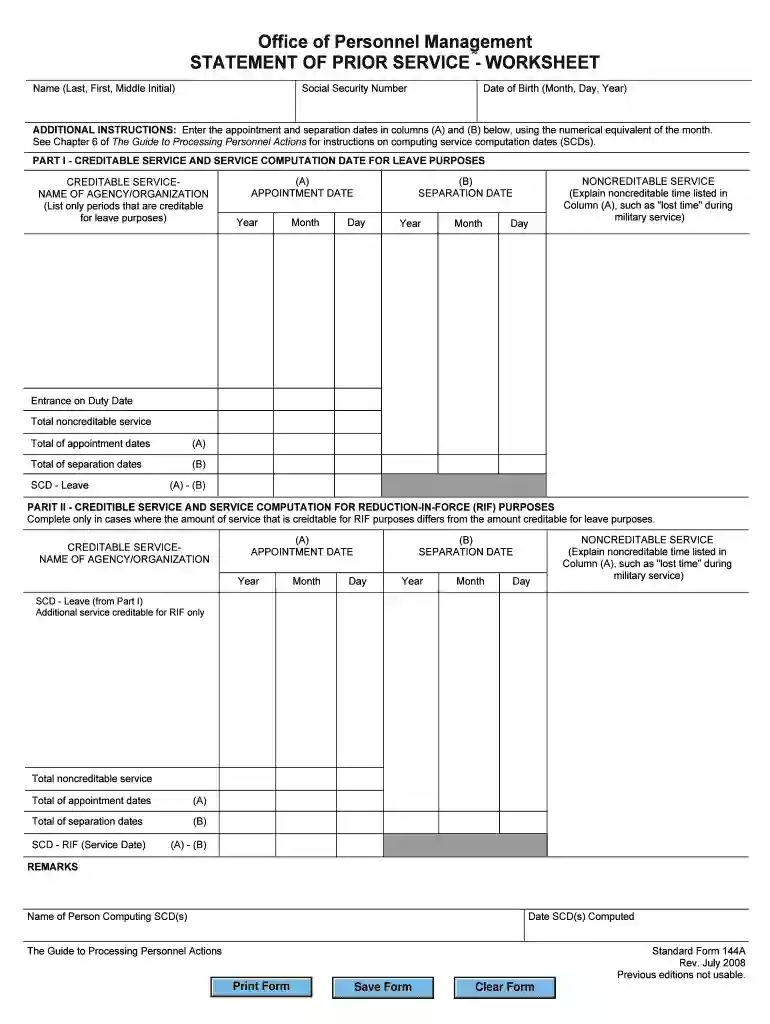
Office of Personnel Management STATEMENT OF PRIOR 2026

Get Form
sf 144 a Preview on Page 1

Here's how it works

01. Edit your sf 144 a online
Type text, add images, blackout confidential details, add comments, highlights and more.

02. Sign it in a few clicks
Draw your signature, type it, upload its image, or use your mobile device as a signature pad.

03. Share your form with others
Send it via email, link, or fax. You can also download it, export it or print it out.

Definition & Purpose of the Office of Personnel Management STATEMENT OF PRIOR

The Office of Personnel Management (OPM) Statement of Prior is a worksheet designed to calculate and record an individual's prior service for specific federal employment purposes, particularly concerning leave accrual and reduction-in-force (RIF) decisions. This form is an essential component of the federal records management system, providing a structured way to document and verify an employee’s service history. It includes sections for entering appointment and separation dates, identifying creditable and non-creditable service periods, and computing service computation dates (SCDs).

Key Functions

  • Helps determine leave accrual rates
  • Assists in RIF determinations
  • Verification of federal service history
  • Standardizes service period documentation

Steps to Complete the Statement of Prior

Completing the OPM Statement of Prior involves several steps. The process requires careful attention to details concerning an employee's federal employment dates and service types.

Detailed Instructions

  1. Gather Required Information:

    • Appointment and separation dates
    • Details of all federal employments
    • Any periods of non-creditable service
  2. Enter Appointment and Separation Dates:

    • Input specific start and end dates for each federal employment period.
    • Ensure accuracy in reflecting each transition or break.
  3. Identify Creditable and Non-Creditable Periods:

    • Examine all service periods to determine which are creditable towards total service time.
    • Document any non-creditable periods with reasons.
  4. Calculate Service Computation Dates (SCDs):

    • Utilize the information entered to calculate the SCDs.
    • Follow the guidelines provided in the form to perform these calculations accurately.

Additional Considerations

  • Consult a supervisor or HR representative if there is uncertainty in identifying creditable service.
  • Review official guidelines provided by OPM for the most accurate calculations.

Importance and Benefits of the Statement of Prior

The Statement of Prior serves several critical functions within federal employment:

Key Benefits

  • Accurate Leave Determination: The form helps ensure that employees receive the correct leave accrual based on their total service time.
  • Facilitates RIF Decisions: Provides necessary data to make informed RIF decisions, impacting job security.
  • Streamlined Record Keeping: Centralizes service records, simplifying future updates or clarifications.

Practical Implications

  • Federal employees can verify their service history and challenge inaccuracies.
  • Human resources can maintain accurate and up-to-date employee records.

Typical Users of the Statement of Prior

This form is primarily used by federal employees and their respective HR departments. Understanding who typically utilizes it can clarify its purpose and applications.

User Groups

  • Federal Employees: Particularly those nearing significant service benchmarks or participating in RIF scenarios.
  • HR Personnel: Use the form to manage employee records, process leave requests, and during organizational restructuring.
  • Supervisors/Managers: Ensure accurate employee service data is provided for decision-making.

Application Scenarios

  • New Employee Onboarding: Establishing initial leave rates for new hires with prior federal experience.
  • Retirement Planning: Ensuring all service is accounted for in benefit calculations.

Legal Context of the Statement of Prior

Understanding the legal aspects of the Statement of Prior is crucial for compliance and proper usage.

Legal Framework

  • Federal Regulations: Govern the guidelines and application of the form.
  • ESIGN Act Compliance: Ensures that digitally completed forms are legally binding.

Consequences for Errors

  • Penalties: Incorrect or fraudulent data on the form can lead to administrative penalties.
  • Discrepancies: Failure to accurately account for service can affect leave and RIF outcomes.

Required Documents for the Statement of Prior

Gathering the necessary documentation is a critical step in accurately completing the Statement of Prior.

Essential Documents

  • Previous Employment Records: Proof of federal employment periods.
  • Service Verification Letters: To confirm creditable service from previous agencies.
  • Separation Forms and Appointment Letters: Details initial appointment and separation details.

Examples of Using the Statement of Prior

Real-world scenarios can provide context for how the Statement of Prior is commonly used.

Scenarios

  • Scenario 1: An employee nearing retirement uses the form to ensure all service periods are recognized for pension calculations.
  • Scenario 2: A recently relocated federal employee uses the form to transfer service credits to their new position to maintain leave accrual rates.

Case Studies

  • Case Study 1: An HR department reviews an employee's statement to rectify discrepancies in reported service dates, impacting leave balances.
  • Case Study 2: An agency undergoing departmental changes relies on accurate Statements of Prior to determine RIF placements.

Important Terms Related to the Statement of Prior

Understanding specific terminology is critical to effectively utilizing the form.

Glossary of Key Terms

  • Creditable Service: Periods that count towards total federal service time.
  • Service Computation Date (SCD): A calculated date representing total creditable service.
  • Reduction-in-Force (RIF): The process of reorganization affecting employee retention.

Contextual Clarification

  • Creditable vs. Non-Creditable: Differentiating service that influences decisions concerning benefits and job security.
be ready to get more

Complete this form in 5 minutes or less

Get form

Got questions?

We have answers to the most popular questions from our customers. If you can't find an answer to your question, please contact us.
Contact us
Use the information provided on the SF 75 to: (1) verify information on the applicants application; (2) make decisions regarding the applicants eligibility for appointment, pay and benefits; and (3) to complete the processing necessary.
Time in grade is a requirement for a specified amount of time that an employee must spend in a grade before they are eligible for promotion. Essentially a federal employee must spend 52 weeks at their grade before being promoted to the next highest grade. For detailed information reference 5 CFR 300.604 .
How to access your annual summary of payment statement Sign in to your online account. Go to OPM Retirement Services Online. Click Annual Summary of Payments in the menu to view your statement. Click the save or print icon to download or print your statement.
As a GS employee, you have to wait one year to increase to a step 2, 3, or 4. You must wait two years before increasing to step 5, 6, or 7. Lastly, you must wait three years before increasing to step 8, 9, or 10.
The 5 year requirement period can include the following: the time you are covered as a family member under another persons FEHB enrollment; or the time you are covered under the Uniformed Services Health Benefits Program (also known as TRICARE) as long as you were covered under an FEHB enrollment at the time of your

Security and compliance

At DocHub, your data security is our priority. We follow HIPAA, SOC2, GDPR, and other standards, so you can work on your documents with confidence.

Learn more
ccpa2
pci-dss
gdpr-compliance
hipaa
soc-compliance
be ready to get more

Complete this form in 5 minutes or less

Get form

People also ask

An employee is eligible for grade retention as a result of a reduction in force only if the employee has served for at least 52 consecutive weeks in one or more positions under a covered pay system at one or more grades higher than the grade of the position in which the employee is placed.
The fifty-nine-minute rule purportedly emanates from a provision in the Code of Federal Regulations (CFR) that gives agencies the discretion to forgive brief absences when employees otherwise would have to be overcharged leave in minimum increments.
Requests for OPM Records If you are seeking access to OPM records, please visit our Open Government Portal and Freedom of Information Act (FOIA) websites to find online records. The FOIA site will also help you make a request for records that cannot be found on OPMs website.

Related links