




01. Edit your form online
Type text, add images, blackout confidential details, add comments, highlights and more.

Type text, add images, blackout confidential details, add comments, highlights and more.

Draw your signature, type it, upload its image, or use your mobile device as a signature pad.

Send it via email, link, or fax. You can also download it, export it or print it out.
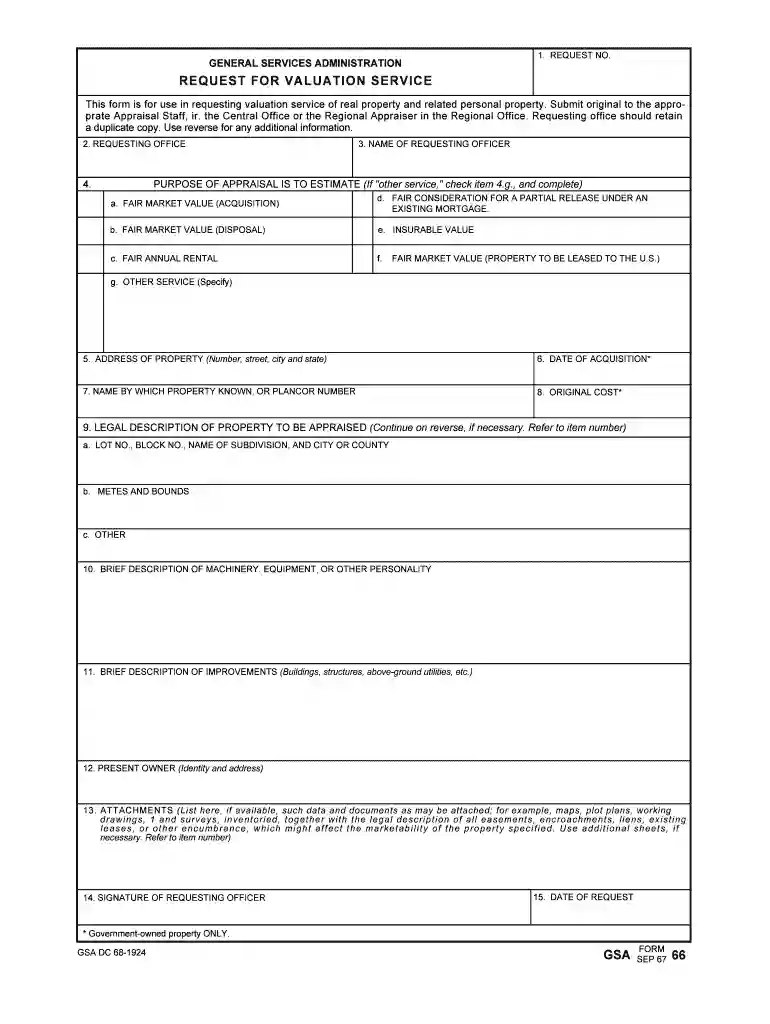
The "Request for Valuation Service" is a formal document utilized primarily by the General Services Administration (GSA) to estimate the fair market value of real property and related personal property. This valuation informs various purposes, such as acquisition, disposal, and leasing, ensuring transactions are based on accurate market values. The form is essential in laying out comprehensive details about the properties involved, including property descriptions and ownership information. For effective use, understanding its objectives is key to ensuring all necessary information is included to facilitate a precise valuation process.
The form is designed to collect specific details about the property to aid in an accurate valuation. Users can follow these steps to effectively complete and utilize the form:
Gather Required Information: Assemble all necessary details, including property location, description, and any existing appraisals.
Fill Out the Form: Begin by entering the required details in the designated sections. Ensure accuracy to prevent any delays in the valuation process.
Attach Supporting Documents: Include any relevant documents, such as previous valuations, proof of ownership, and photographs of the property.
Submission: Submit the completed form according to the prescribed method, whether it be online, via mail, or in-person.
Proper completion aligns with the intended use of the form, streamlining the valuation procedure.
Completing this form can be straightforward when you comprehend the structure and exact requirements. Here's a step-by-step guide:
Contact Information: Start with filling in the details of the requesting office, including contact details for any follow-up requirements.
Property Description: Provide a precise description of the property, including its physical address and unique characteristics that may affect its value.
Ownership Details: Clarify ownership status, highlighting whether the property is owned by an individual, corporation, or government entity.
Attachment of Documents: Attach any necessary documents, such as existing leases or contracts that might impact property valuation.
Review and Confirm: Double-check the form for completeness and accuracy before submission to ensure efficient processing.
By methodically following these steps, users can ensure the form is completed correctly, supporting a precise valuation outcome.
Several critical elements must be addressed within the form to ensure its effectiveness:
Requesting Office Information: Identification of the department or individual requesting the valuation service is crucial for processing.
Property Description and Details: Accurate and thorough descriptions ensure the valuation is performed correctly, encompassing the property's size, location, and use.
Ownership and Title Information: Information regarding current ownership and any title encumbrances provides a legal framework for the valuation.
Attachments: Supporting documents such as photographs, maps, and previous appraisals are essential to substantiate the valuation.
Understanding these elements helps in anticipating the required data and documentation, thereby streamlining the completion process.
Legally, the Request for Valuation Service form is utilized within a framework established by the General Services Administration. It serves to derive fair market value estimations applicable to various transactions involving governmental property dealings. The form must be used in accordance with the GSA guidelines to ensure accuracy and compliance. This legal foundation safeguards the interests of all parties by basing real estate decisions on objective and standardized assessments. Legal adherence ensures transparency and accountability in government property management.
To efficiently complete the form, certain documents must be prepared:
Proof of Ownership: Papers indicating current ownership, such as deeds or titles.
Previous Appraisals: Valuation reports that provide historical context for the property's value.
Property Maps and Photographs: Visual documentation to support descriptive elements of the property.
Legal Documents: Any legal stipulations or contracts that might influence property value.
These documents support a well-rounded and thorough property valuation, ensuring all potential influences are considered during the process.
Practical applications of the form range across various scenarios, including:
Government Acquisition: When the government is acquiring property for expansion, the form aids in determining an equitable price based on market values.
Lease Negotiations: In valuing properties intended for lease, the form helps structure agreements that reflect true market conditions.
Disposal of Surplus Property: When the government disposes of excess property, the form ensures a fair market valuation to optimize financial returns.
By applying these functions, the form becomes an essential tool in facilitating government real estate transactions.
Submission of the Request for Valuation Service can be performed through various channels:
Online Submission: Many organizations prefer electronic submissions for their speed and convenience.
Mail Submission: Traditional submission via mail is still an option—use certified mail to ensure delivery and confirmation.
In-Person Submission: Direct delivery to the appropriate GSA office when documents need personal verification.
Choosing the appropriate method of submission depends on user preference and the specific requirements of the valuation service, ensuring that the process aligns with both legal and practical standards.
We've got more versions of the REQUEST FOR VALUATION SERVICE form. Select the right REQUEST FOR VALUATION SERVICE version from the list and start editing it straight away!
| Versions | Form popularity | Fillable & printable |
|---|---|---|
| 1967 | 4.8 Satisfied (47 Votes) |
At DocHub, your data security is our priority. We follow HIPAA, SOC2, GDPR, and other standards, so you can work on your documents with confidence.

This form is for use in requesting valuation service of real property and related personal property. APPRAISAL IS TO ESTIMATE
NBDC provides low-cost, high quality valuation reports for small businesses with values from $100000 to $10000000;
I received cryptocurrency that does not have a published value in exchange for property or services. How do I determine the cryptocurrencys fair market value?Read more


