




01. Edit your form online
Type text, add images, blackout confidential details, add comments, highlights and more.

Type text, add images, blackout confidential details, add comments, highlights and more.

Draw your signature, type it, upload its image, or use your mobile device as a signature pad.

Send it via email, link, or fax. You can also download it, export it or print it out.
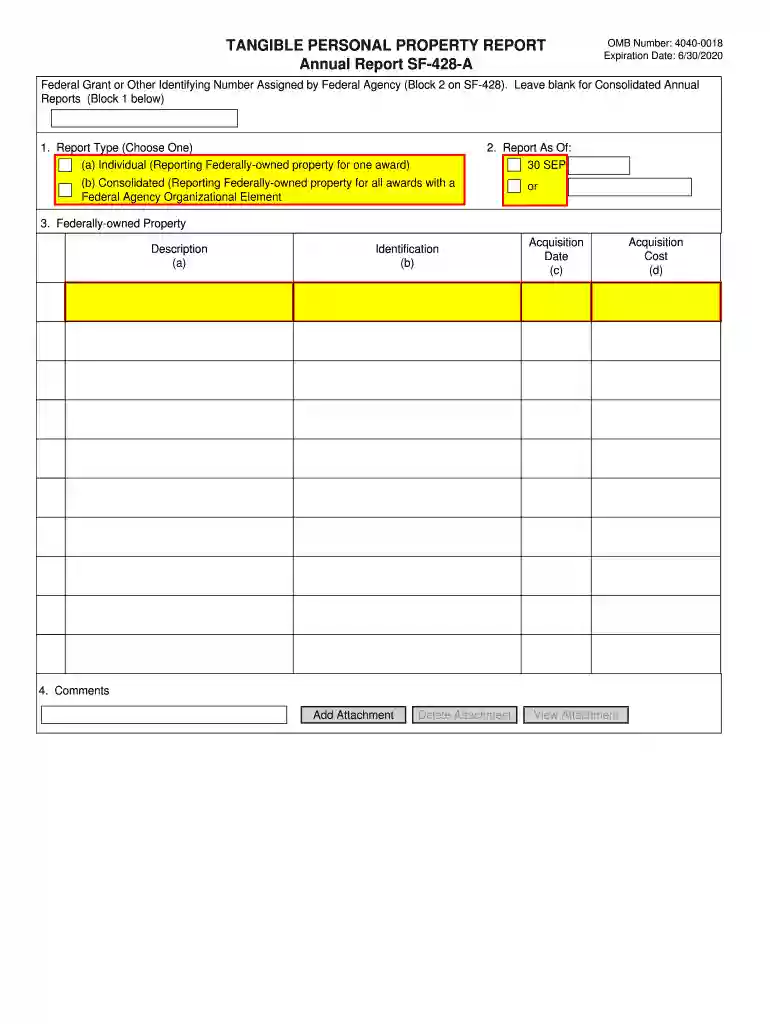
The Tangible Personal Property Report - Obama White House refers to an official documentation requirement that Federal financial assistance recipients must fulfill. This report, formally known as the Annual Report SF-428-A, mandates the disclosure of federally-owned tangible personal property held by recipients. The report's purpose is to ensure proper oversight and accountability of Federal assets distributed to various entities. It outlines necessary information such as report type, acquisition dates, and descriptions of the property to be maintained. This documentation ensures compliance with federal regulations regarding the use and management of such property.
Gather Necessary Information: Collect all relevant details about the tangible personal property in your custody. This includes acquisition dates, descriptions, serial numbers, and any pertinent identification data.
Identify Ownership Type: Determine whether the property is federally-owned, acquired, or transferred. This distinction is crucial for accurate reporting.
Access the Form: Obtain the SF-428-A form through official government websites or designated platforms that distribute federal forms.
Fill Out the Form: Begin by completing the identification section, which requires your organization’s name, contact details, and grant or project number.
Detail the Property: Provide comprehensive descriptions for each asset, including value, condition, and location.
Submit the Form: Once finalized, submit the report electronically or via mail, following the specific procedures laid out by the issuing agency.
The Tangible Personal Property Report ensures legal compliance with federal property management guidelines. By submitting this report, entities demonstrate adherence to the property stewardship rules set forth by the government. Accurate reporting helps prevent misuse or misallocation of federal assets. To legally fulfill the form requirements, submissions must reflect precise and up-to-date information about the managed assets. Non-compliance or inaccuracies may lead to administrative actions or financial penalties.
Identification Section: Contains the reporting entity's details, including name, contact number, and project identification.
Property Description: Defines each asset’s details, such as acquisition date, serial number, condition, and current use.
Ownership Status: Indicates whether the property is currently federally-owned or if ownership has transferred.
Valuation and Condition: Reports the assessed value and condition of each asset, vital for governmental record-keeping.
To complete the Tangible Personal Property Report, gather supporting documentation, including:
These documents support the data entered in the report, ensuring both completeness and compliance.
Entities must submit the Tangible Personal Property Report annually. Typical deadlines align with the fiscal year reporting requirements, often set by the specific granting agency. Submission dates can vary based on agency guidelines, so it is crucial to verify specific deadline notifications communicated by the respective agency overseeing the financial assistance.
Government contractors, universities, non-profits, and other organizations that receive federal funding and manage federally-owned property are common users of this report. These entities need to provide evidence of asset management and compliance with federal mandates. By using this report, organizations ensure they maintain transparency and accountability in handling government property resources.


Failing to complete the Tangible Personal Property Report correctly or not meeting the submission deadlines can result in penalties, such as:
Organizations must prioritize accurate and timely reporting to avoid such penalties and maintain good standing with federal agencies.
Consider a university that receives a federal grant to conduct research. This institution would use the SF-428-A form to report laboratory equipment purchased with government funds. The report would list each piece of equipment, complete with its acquisition date and usage status. This allows for transparency in how federal resources are deployed in the educational setting, ensuring accountability and compliance with the terms of the grant agreement.
We've got more versions of the Tangible Personal Property Report - Obama White House form. Select the right Tangible Personal Property Report - Obama White House version from the list and start editing it straight away!
| Versions | Form popularity | Fillable & printable |
|---|---|---|
| 2017 | 4.8 Satisfied (52 Votes) |
At DocHub, your data security is our priority. We follow HIPAA, SOC2, GDPR, and other standards, so you can work on your documents with confidence.

Feb 17, 2012 In 2008, the house of cards collapsed. We learned that mortgages had been sold to people who could not afford them or did not understand them.Read more
This Attachment is to be used by recipients when required to provide a final property report for closeout of Federal assistance awards.Read more
In 2015 under the Obama Administration, the U.S. Geological Survey published a report, Fundamentals of Carbon Dioxide-Enhanced Oil Recovery (CO2-EOR)ARead more


