




01. Edit your application for ignition interlock history online
Type text, add images, blackout confidential details, add comments, highlights and more.

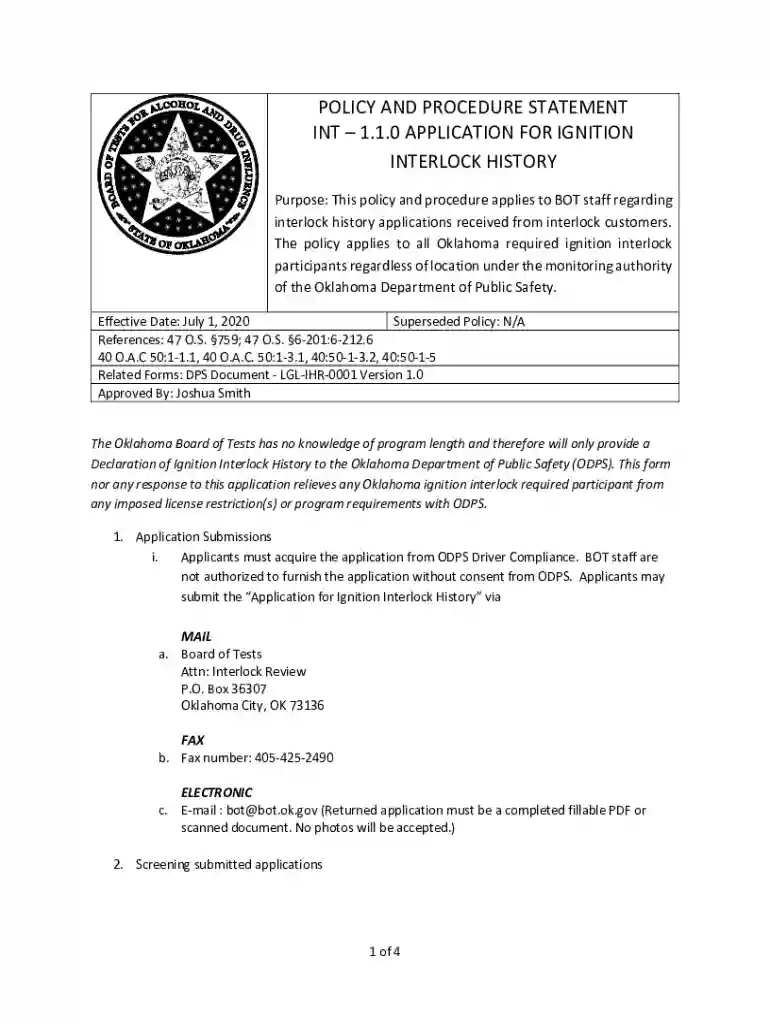
Type text, add images, blackout confidential details, add comments, highlights and more.

Draw your signature, type it, upload its image, or use your mobile device as a signature pad.

Send application for ignition interlock history via email, link, or fax. You can also download it, export it or print it out.
The "application for ignition interlock history" refers to a formal request submitted to a relevant authority—usually within a state's public safety department or a similar regulatory body—to obtain records related to an individual's use of an ignition interlock device. These devices are typically mandated by court orders for those convicted of driving under the influence of alcohol. The application serves to gather comprehensive data regarding compliance, violations, and device installation duration. This form is a critical tool, often used in legal situations to verify adherence to DUI penalties and to ensure public safety standards are met.
To effectively use the application, individuals should first identify the appropriate government agency that manages the ignition interlock program in their state. Typically, this will be the state's Department of Public Safety or equivalent. Users should ensure they have all relevant personal information and documentation ready, such as their driver's license number and court documents outlining the ignition interlock requirement. This information will assist in filling out the application accurately. Once the form is completed, it can be submitted either online or via mail, depending on the specific state’s process. Understanding these steps helps in successfully accessing one's ignition interlock history.
Gather Required Information: Start by collecting all necessary personal details, including identification numbers and any court-related documents.
Access the Application: Obtain the form from the appropriate state agency's website or office. Ensure you have the latest version of the application.
Fill Out the Form: Accurately complete each section, providing truthful and precise details about your history and the duration of the interlock device usage.
Attach Supporting Documents: Include any additional documentation that supports your application, making sure everything is legible and well-organized.
Submission: Submit the application either through the agency's online portal or by mailing it to the designated address. Confirm receipt to ensure processing begins.
Await Confirmation: After submission, wait for the agency to process the application and provide the ignition interlock history report.
Applying for your ignition interlock history is essential for several reasons. It provides a documented proof of compliance with court orders or regulatory requirements. This documentation can be crucial in legal settings, such as hearings related to license reinstatement. Additionally, understanding your own interlock history allows you to verify the accuracy of reports, challenge discrepancies, and ensure all required obligations have been fully met. For individuals seeking to transform their driving status after a DUI, this application becomes a vital step in moving forward with legal and personal responsibilities.
The primary users of this application include individuals who have been mandated to use an ignition interlock device following a conviction for driving under the influence. Legal professionals and probation officers also frequently request these histories to assess compliance with court-ordered penalties. Furthermore, insurance companies might use these histories to determine risk levels and adjust policies accordingly. Each stakeholder relies on this comprehensive historical data to make informed decisions based on compliance and violation records.


In a legal context, the application for ignition interlock history serves as evidence of a driver’s compliance with DUI penalties. It is critical in proceedings related to the reinstatement of driving privileges, contested license suspensions, or additional penalties for non-compliance. The documented history within the report can support arguments made by defense attorneys or prosecutors. Furthermore, this application upholds transparency and accountability, contributing to safer driving conditions by ensuring lawful adherence to ignition interlock programs.
To complete the application accurately, several documents are typically required:
Depending on the state regulations, there are various ways to submit the application:
Since ignition interlock policies can vary significantly from state to state, applicants must familiarize themselves with the specific rules applicable to their region. For instance, the Oklahoma Board of Tests requires strict adherence to reporting violations to their Department of Public Safety. Similarly, states may have different criteria for what constitutes a violation, timeframes for device installation, and processes for applying for history documentation. Understanding these nuances ensures compliance and helps prevent any delays in processing the application.
We've got more versions of the application for ignition interlock history form. Select the right application for ignition interlock history version from the list and start editing it straight away!
| Versions | Form popularity | Fillable & printable |
|---|---|---|
| 2020 | 4.3 Satisfied (32 Votes) |
At DocHub, your data security is our priority. We follow HIPAA, SOC2, GDPR, and other standards, so you can work on your documents with confidence.


